
Best Space Heater for Seniors: 6 Senior-Friendly Picks for Warmer Rooms (2026)
Quick answer: a ceramic tower heater with a remote control is our top pick for most seniors — stable on the floor, clear to read, and adjustable from the chair. For a bedroom, an oil-filled radiator is the quieter steady-heat alternative.
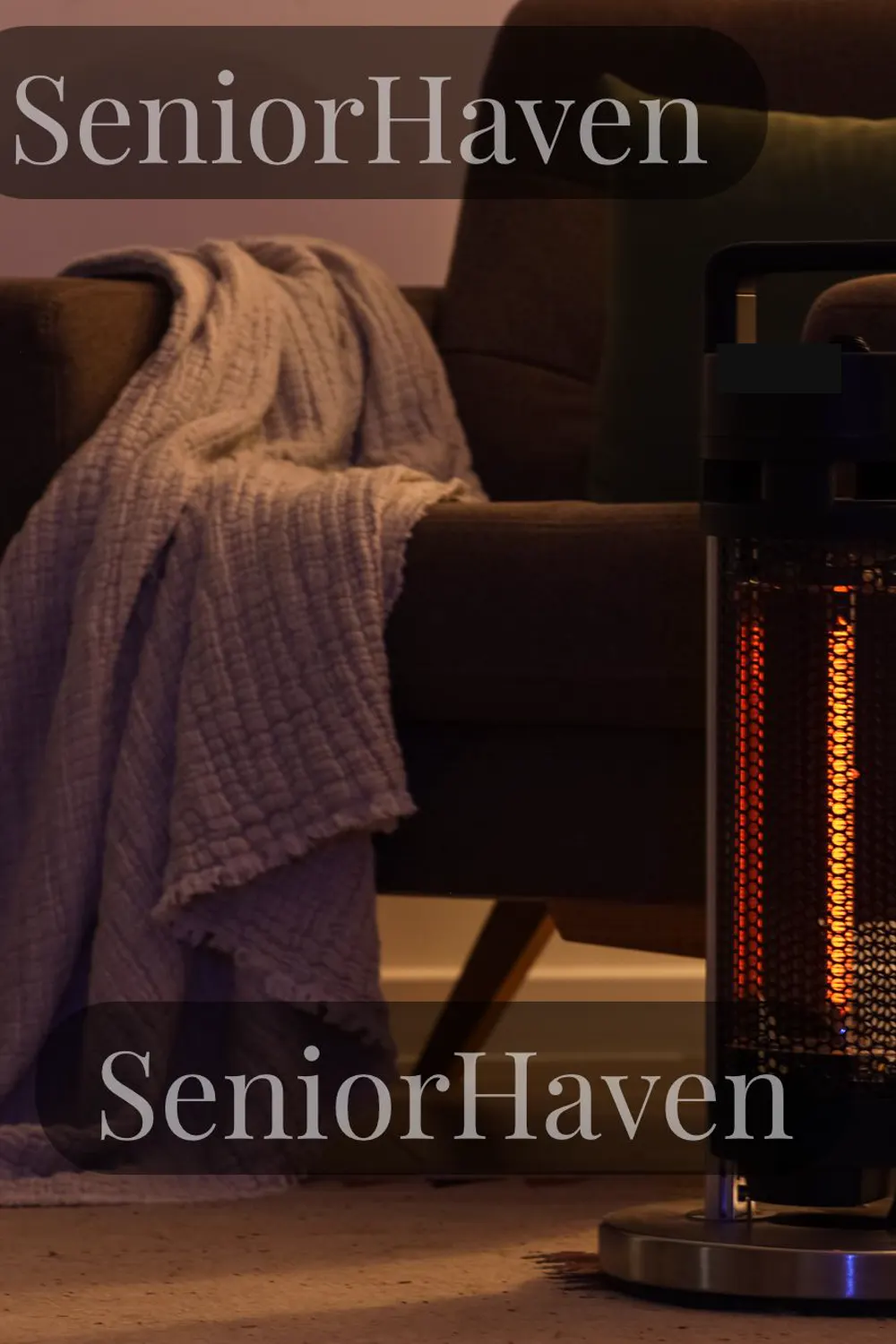
Affiliate disclosure: As an Amazon Associate I earn from qualifying purchases. This guide contains affiliate links — it costs you nothing extra and keeps our content free. Product picks come from our research into real reviews and manufacturer specifications — details and availability change, so check the current listing. Read our affiliate disclosure.
The best space heater for seniors is the one that warms the room without asking an older adult to bend down, squint at tiny buttons, drag a cord across a walkway, or remember a complicated routine. That is the short answer. The rest is details worth getting right: which heater type suits which room, which features matter for aging hands and aging balance, and exactly where the heater should stand so it warms the person without becoming a hazard in its own right.
Picture the classic scenario: a daughter setting up her father's living room for winter. He sits in one armchair most of the evening, feels the cold more than he used to, and will not get up to fiddle with a heater once settled. What works is not the most powerful heater — it is the one he can control from the chair, that switches itself off if it tips, and that nobody trips over. Now picture a senior living alone in a small apartment, bedroom cold at night. One quiet heater for the bedroom, used with a timer and a clear floor around it, and the whole winter gets easier. Here are six heater types worth buying, the honest differences between them, and a placement and buying checklist that takes one visit to follow.
| # | Heater type | Best for | Standout feature |
|---|---|---|---|
| 1 | Ceramic tower heater with remote | Best overall | Remote control, stable base |
| 2 | Oil-filled radiator heater | Best for bedrooms | Steady heat, no fan noise |
| 3 | Wall-mounted panel heater | Best for trip-free floors | Wall-fixed, floor clear |
| 4 | Compact ceramic heater | Best for one chair or a small room | Small, light, easy to place |
| 5 | Simple big-dial heater | Best for tech-free use | One large dial, no app |
| 6 | Micathermic panel heater | Best for quiet rooms | Flat panel, near-silent warmth |
See the six picks on Amazon (details change often, so we never print them here):
- Ceramic tower heater with remote — Check Price on Amazon
- Oil-filled radiator heater — Check Price on Amazon
- Wall-mounted panel heater — Check Price on Amazon
- Compact ceramic heater — Check Price on Amazon
- Simple big-dial heater — Check Price on Amazon
- Micathermic panel heater — Check Price on Amazon
How We Picked
Pick by Situation: Which Heater Fits Your Senior
- Ceramic tower with remote (Best overall) — Right for you if the senior sits in one favourite chair and should not have to get up to change the heat. Skip it if walker routes crowd the floor — a tall tower needs a clear corner.
- Oil-filled radiator (Best for bedrooms) — Right for you if the bedroom is cold and sleep matters — it warms steadily with no fan. Skip it if anyone must lift it often; radiators are heavy.
- Wall-mounted panel (Best for trip-free floors) — Right for you if the floor is cluttered, balance is unsteady, or a walker route crosses the room — it cannot be tipped or kicked. Skip it if you rent and cannot fix anything to the wall.
- Compact ceramic (Best for one chair or a small room) — Right for you if only one spot needs warming, like a reading chair or a small study. Skip it if the room is large — a small heater cannot carry a large room.
- Simple big-dial heater (Best for tech-free use) — Right for you if remotes get lost, displays confuse, or apps are out of the question. Skip it if the senior wants a timer or a remote — simple means simple.
- Micathermic panel (Best for quiet rooms) — Right for you if fan noise disturbs sleep or conversation — the flat panel warms with almost no sound. Skip it if wall or floor space is tight.
Heater Types Compared: Ceramic, Oil-Filled, Infrared, Micathermic, Wall-Mounted
Rivals mostly compare two or three types and then recommend one. That is too narrow — the right type depends on the room and the person. Here is the honest comparison, with the senior-specific trade-off for each.
Ceramic heaters: the all-rounder
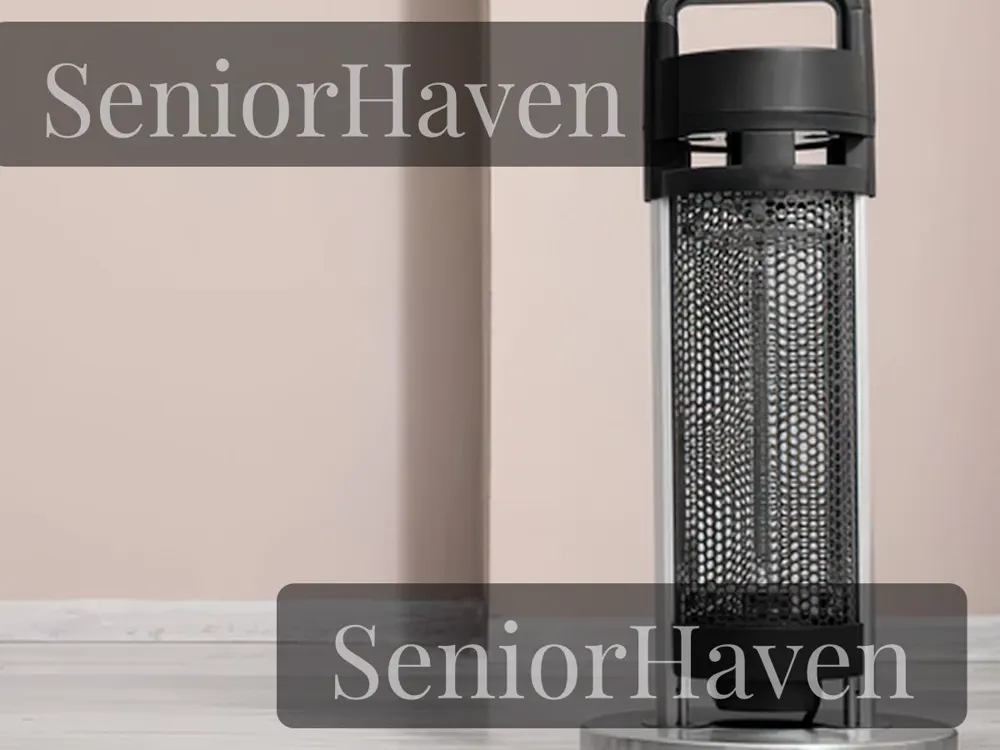
A ceramic heater blows air across a heated ceramic element and warms a room quickly, which is why towers and tabletop models use it. The fan is the trade-off: it makes a sound and stirs dust, which matters in a bedroom or for anyone with a cough. The exterior of a good ceramic tower stays cooler than an exposed-element heater, suiting rooms where someone might brush against it. Look for a stable, weighted base — a tall tower on a light base is easy to knock, and a tower that tips often is the wrong tower.
Oil-filled radiators: the bedroom steady hand
An oil-filled radiator heats sealed oil inside metal fins, then radiates warmth without a fan. It is slow to warm up and slow to cool down, which is exactly why it suits a bedroom: the heat is even, with no fan noise and no glowing element. The honest downsides are weight and size, so place it once, in the room where it will live, and leave it there. Never dry clothes on it, never cover it, and never use it as a shelf. The fins get hot while running, so it still needs its clear space like every other type.
Infrared and quartz heaters: warmth you feel on your skin
Infrared heaters warm people and objects directly rather than all the air first, so they feel warm fast when you sit in front of them — tempting for a single chair. The caution is the flip side: the heat is directional, so the person must sit facing it, and glowing-element models are the ones to avoid where a blanket, a sleeve, or a hand could get close. If you choose infrared, pick a panel-style model with a guarded element and the same tip-over and overheat features as any other heater.
Micathermic panels: the quiet flat option
A micathermic panel is a thin, flat heater giving off both radiant and convected warmth. Owners choose it above all because it is near-silent, with no fan to hum or rattle. It warms a room more evenly than a directional infrared heater. The trade-off is footprint in a different form — a panel needs a clear stretch of wall or floor, and it is not the heater to tuck behind a chair. For a light sleeper, it is the type rivals mention least and seniors often like most.
Wall-mounted panels: the heater that cannot be tripped over
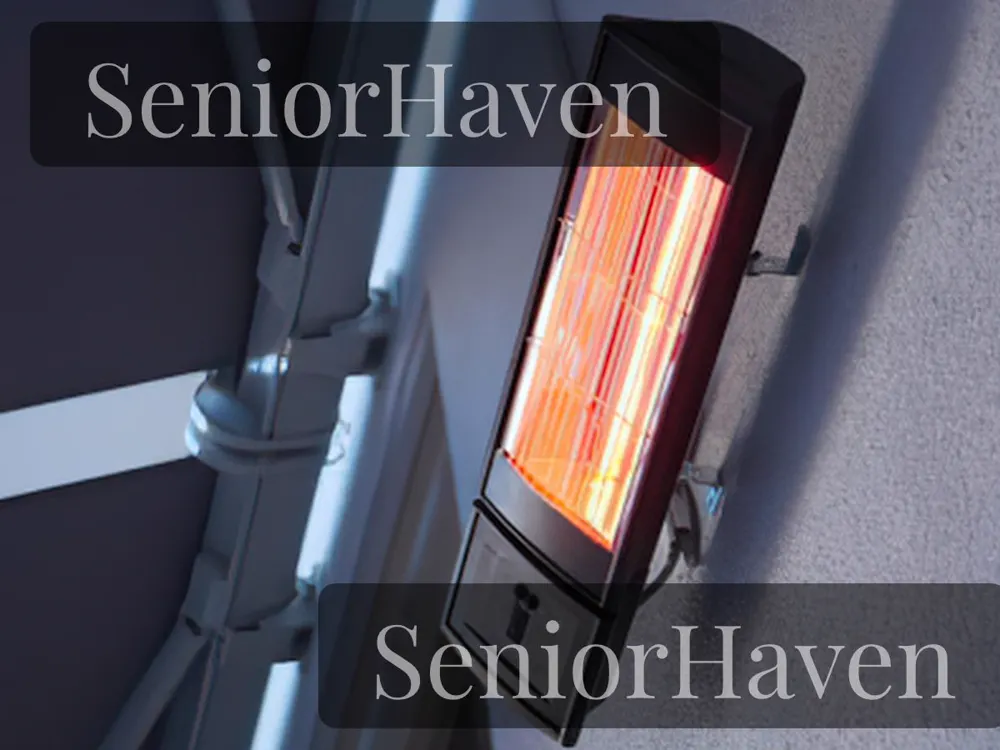
A wall-mounted heater is fixed to the wall, usually above skirting height, and warms the room from there. For a senior with balance problems, a walker, or a cluttered floor, it removes an entire category of risk: nothing on the floor to tip, kick, drag into a blanket, or trip over, and no cord crossing a walkway if the outlet is nearby. The honest costs are installation and permanence — it stays where it is put and suits a room whose layout does not change. For a rented home, check permission first. For an owned home with one cold room, it is often the most senior-friendly answer of all.

The Safety Features That Actually Matter
Every listing shouts about safety. Only five features do the real work, and a heater missing any of the first three should not be bought, whatever its price.
Tip-over shutoff. If the heater falls over, it must switch itself off at once. This is the single most important feature for a senior's home, because falls, walker bumps, and pets knock things over, and a heater running face-down into carpet or a blanket is the nightmare scenario. A tall tower without tip-over shutoff is a decoration, not a heater.
Overheat protection. If the heater's own temperature climbs too high — blocked airflow, a covered grille, a failed fan — it must cut power by itself. This is the backup for every mistake, including the ones nobody plans. It does not make covering a heater acceptable. Treat any heater without it as incomplete.
A recognised safety listing: UL or ETL. These marks mean an independent lab tested the product's electrical safety. For a heater that will run for hours in a senior's home, look for one of these marks on the listing and on the box, and skip unlisted cheap heaters entirely.
Cool-touch housing. Not every heater offers it, and it matters most where someone might brush against the unit — beside a chair, beside a bed, on a walker route. A cool-touch exterior does not mean the heater is cool everywhere; grilles and outlets still run hot. It means an accidental touch is less likely to burn. This is general information, not medical advice.
A safe cord and plug. The cord should reach a wall outlet without stretching, stay off walkways, and be in good condition with no frays or kinks. A plug with a built-in safety cutout is a bonus on some models. If the cord is damaged, stop using the heater until it is repaired or replaced by the maker — a damaged heater cord is not a do-it-yourself repair.
Beyond the five, three extras genuinely help seniors: a timer that switches the heater off by itself, a child lock that stops accidental setting changes, and an automatic shutoff when the room reaches the set temperature. None of these replaces supervision and placement, but together they turn a heater from something that must be watched into something that watches itself a little.
Controls Aging Hands Can Actually Use
Here is where most guides fail seniors: they list features without asking whether an eighty-year-old hand with arthritis, or an eye that needs large print, can actually use them. A heater with a perfect safety record and unreadable controls will end up unplugged, or set to maximum and left there.
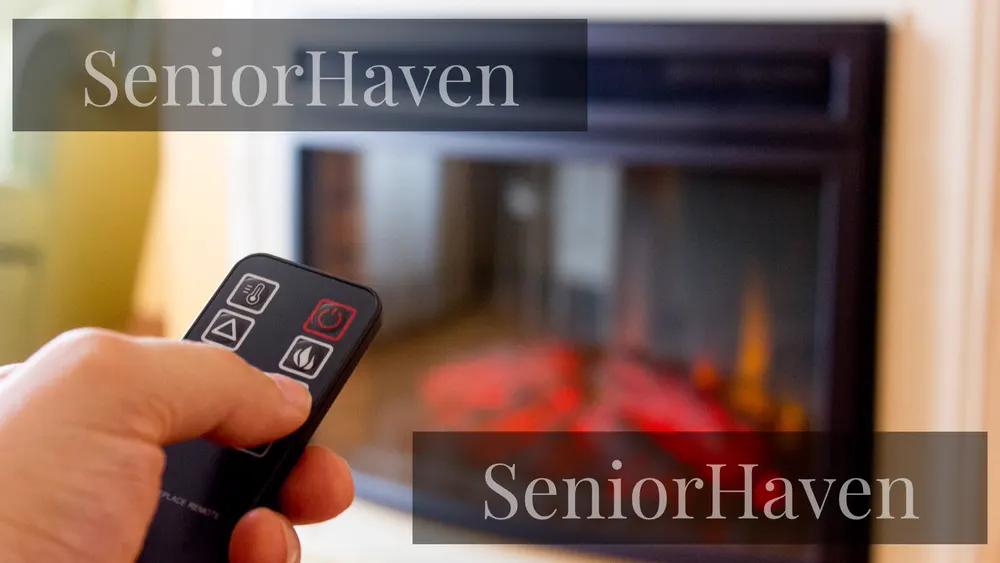
Remote control. The single most senior-friendly feature after tip-over shutoff. A remote lets the senior change the heat, set the timer, and switch the heater off from the chair, without getting up or bending down. The honest downsides are real: remotes get lost down chair cushions, and a remote with twenty tiny buttons is no better than no remote. Choose a remote with a few large buttons and keep a fixed home for it — a small basket on the chair arm works.
Big dials beat touchscreens. For hands with arthritis or tremor, one large dial that clicks between settings beats a flat touchscreen every time. A dial gives feedback you can feel without looking and cannot be changed by brushing past it. If the senior prefers buttons, choose big, raised, well-spaced ones with a clear on-off state — a light or display showing at a glance whether the heater is running.
Displays you can read from the chair. A small, dim display set low on the heater is useless to someone who cannot bend down. Look for a large, high-contrast display, ideally at the top of the unit or repeated on the remote, with numbers big enough to read from a chair. A display that dims or switches off is a bonus for the bedroom.
Sounds and signals. A beep when a button is pressed helps a senior who cannot see the display clearly, but a heater that beeps loudly every time the thermostat cycles will drive a light sleeper mad. A heater that clicks audibly as its thermostat switches on and off is normal for many types — the question is how loud, and whether it happens at night.
App-only controls are a red flag for most seniors. If a heater can only be controlled from a phone app, it fails the senior test outright, no matter how good its heating is. Apps need a charged phone, a password, updates, and good eyesight, and fail completely when the phone is in another room. Choose a heater that works fully from its own controls or its remote, and treat app control as an optional extra, never as the only way to switch the heater off.
Memory and dementia: plan for forgetting. If the senior sometimes forgets the heater is on, the features that matter most are a timer, automatic shutoff at the set temperature, and a child lock against accidental changes — plus a routine, not a lecture. A family member who checks the heater on visits and a timer set as part of the evening routine help more than any single feature. If forgetting is frequent, talk to the senior's doctor and family about whether a portable heater is the right answer at all, or whether fixed heating should be looked at instead. This is general information, not medical advice.
Room Size and Wattage: Getting the Size Right
The commonest sizing mistake is buying the biggest heater for a small room, or one small heater for a large room. The rule of thumb the sizing guides agree on is simple: about 10 watts of heating per square foot of floor in a room with standard ceilings and average insulation. A 150-square-foot bedroom therefore needs roughly 1,500 watts, which is the most a standard household plug can supply continuously. A small bedroom of around 100 square feet needs roughly 1,000 watts. A 300-square-foot living room needs roughly 3,000 watts, which no single plug-in heater can supply — that room needs two heaters, or fixed heating.
Adjust the rule for the real room, not the ideal one. Drafty rooms, big single-glazed windows, and ceilings taller than standard all push the number up — add roughly a quarter more for a drafty room or a high ceiling. Well-insulated rooms push it down. Measure first: length times width gives square footage, times ten gives the rough wattage, then check the listing for what the heater actually claims to cover. If a listing claims a 1,500-watt heater warms a huge open-plan space, that claim is marketing, not physics.
For seniors, sizing has a second half: a heater too big for the room cycles constantly, clicks through the night, and dries the air, while one too small runs all day without ever warming the room, costing more and still leaving the senior cold. Right-sized means the heater reaches the set temperature and then rests. If the room is large, two smaller heaters placed apart warm it more evenly than one big heater in a corner — and give a backup if one fails on a cold night.
One more sizing truth rivals skip: a space heater warms one room, not a home. If the whole house is cold, the answer is the central heating, insulation, or a conversation with the landlord or energy supplier — not a heater in every room. A space heater is the right tool for one cold room, one favourite chair, or one bedroom at night.
The Placement Map: Where the Heater Should Stand
Placement is half the safety of any heater. Walk the room with the senior and follow this map.
Step 1 — the hard, flat floor. The heater stands on a hard, level, non-flammable surface — a wood or tile floor, never on carpet, a rug, a bed, or a chair. A hard floor keeps the heater stable, its air intakes clear, and heat away from fibres. If the only floor is carpeted, a wall-mounted panel is the better answer.
Step 2 — clear space on all sides. Keep the heater at least three feet from anything that can burn: curtains, bedding, furniture, laundry, papers, and pet beds. Measure it — three feet is longer than most people think. Keep the space above it clear too, and never hang anything over a heater or dry clothes on it.
Step 3 — straight into a wall outlet. Plug the heater directly into a wall outlet, never into an extension cord or a power strip. Extension cords and power strips are not built for a heater's sustained power draw and can overheat, which is one of the commonest causes of heater fires. If the outlet is too far away, move the heater or the furniture — do not extend the cord. Never plug another high-draw device into the same outlet.
Step 4 — the cord route. Run the cord flat along the wall, never across a walkway, a doorway, or a walker route. A cord across the floor is a trip hazard for anyone, and for a senior with a walker it is a fall waiting to happen. Check the cord regularly for frays, kinks, or crushing under furniture legs. A damaged cord means the heater stops being used until it is repaired or replaced.
Step 5 — where the senior actually sits. Place the heater where its warmth reaches the chair or the bed without blowing directly into the senior's face all evening. A ceramic tower with oscillation spreads warmth around a sitting area; an oil radiator beside the bed warms the bedroom evenly. Test it: sit in the chair and check the warmth reaches without moving closer than three feet.
Where never to put it. Never in a bathroom unless the heater is specifically rated for bathroom use — most are not. Never in a child's room as the only heat. Never in a garage, workshop, or dusty space unless rated for it. Never behind a door that could swing into it, never under a window where curtains could fall onto it, and never where a pet sleeps against it. If any of these is the only available spot, that spot is wrong — choose a different type, usually wall-mounted.
Bedrooms and Overnight Use: The Honest Guidance
This is the question families ask most. Fire services advise switching a portable heater off when you leave the room or go to sleep, and never leaving one running unattended. That guidance exists because most heater fires happen when nobody is watching, and a sleeping household cannot react quickly. It is the right default.
The practical half is what to do instead. Warm the bedroom before bed: run the heater for an hour in the evening with the door closed, then switch it off at bedtime and let the room's warmth, a warm blanket, and warm nightclothes carry the night. An oil-filled radiator suits this routine because it keeps radiating warmth for a while after it is switched off. A timer is a backup, not a permission slip — set it so the heater switches itself off even if the senior forgets. And make sure the bedroom has a working smoke alarm, tested regularly, because no heater feature replaces an alarm.
If the senior is cold at night despite this routine, look beyond the heater before buying a bigger one. Drafts around windows and doors, thin curtains, a cold floor, and bedding that is too light are all cheaper to fix than a larger heater, and they help every night. A hot water bottle or a heated blanket used as its own instructions direct can help too — but never pile bedding over a heater. If cold at night is new or severe, that is a conversation for the doctor, not the hardware store. This is general information, not medical advice.
Noise, Light, and Sleep: The Bedroom Details
A heater that is perfect at 7 p.m. can be miserable at 2 a.m. The bedroom details are where cheap heaters reveal themselves.
Fan noise. Ceramic fan heaters make a sound — the question is how much, and whether it is a steady hum or an irritating rattle. A steady, low hum fades into the background for most sleepers; a rattling fan does not. Oil radiators and micathermic panels make almost no sound, which is why they lead the bedroom picks. If the senior is a light sleeper, fan noise alone is a reason to choose a fanless type.
Clicks and thermostat cycling. Most heaters click as the thermostat switches the element on and off. In a quiet bedroom, that click can wake a light sleeper every cycle. Oil radiators click less noticeably because their temperature changes slowly; fan heaters cycle more often. If the listing mentions a quiet thermostat, weigh it seriously for a bedroom — and test the heater for a few nights before the return window closes.
Light and display glow. A bright display or a glowing power light in a dark bedroom disturbs sleep, especially for a senior who already sleeps lightly. Look for a display that dims or switches off, and a power light that is small rather than a beacon. This small detail matters every single night, and rivals almost never mention it.
Air dryness. Any heater dries the air a little, and fan heaters dry it most noticeably. A senior who wakes with a dry throat in winter may feel it more. The fixes are simple: a glass of water by the bed, a small humidifier if the house is very dry, and a radiator or panel over a fan heater for the bedroom. If dryness is severe or persistent, that is a doctor conversation, not a heater setting.
Running Costs Without the Guesswork
Rivals either hide running costs or quote a single hourly figure that depends on an electricity rate the reader does not pay. Here is the honest way to work it out. A heater's wattage tells you its energy use: a 1,500-watt heater running for one hour uses 1.5 kilowatt-hours of electricity. Multiply the kilowatt-hours by the rate on the household's own electricity bill, and that is the cost of that hour. A 750-watt setting uses half as much per hour. A heater that reaches the set temperature and switches itself off uses less than one running flat out all evening.
The practical consequences follow from that formula. Warm one room, not the house, and close the door. Use the lower setting once the room is warm. Put the heater on a timer so it does not run after everyone is asleep or out. Fix drafts, because every draught is heat the heater must replace. A heater that warms the room in twenty minutes and then rests costs less over the evening than a smaller heater that runs all night without ever reaching the set temperature.
Common Mistakes Buyers Make With Space Heaters
Mistake 1: Running the heater on an extension cord. Still the commonest dangerous mistake. If the heater cannot reach a wall outlet, the room layout is wrong, not the cord.
Mistake 2: Buying on wattage alone. A 1,500-watt heater in a draughty 300-square-foot room will disappoint, and a 1,500-watt heater in a tiny bedroom will cycle noisily all night. Size to the room, then choose the type.
Mistake 4: Putting the heater where it looks tidy, not where it warms. Behind a chair, under a curtained window, or in a corner blocked by furniture — all three waste heat and two are hazards. Warmth must reach the person, with clear space around the unit.
Mistake 5: Drying clothes on the heater. Wet clothes block airflow, trap heat, and can scorch or catch fire. Never drape anything over a heater or use it as a drying rack, a shelf, or a towel rail.
Mistake 6: Ignoring the first-use smell. A new heater often smells faintly for the first hour as factory coatings burn off — run it first in a ventilated room, not in a closed bedroom. A smell that persists, or a burning smell after weeks of use, is different: switch it off, unplug it, and do not use it again until the cause is found.
Mistake 7: Buying the cheapest unlisted heater. An unlisted heater without tip-over shutoff or overheat protection saves a small amount once and risks a great deal every night. The listing and the two shutoffs are non-negotiable, and mainstream models include them.
Buying for a Parent: The One-Visit Checklist
If you are buying for a parent, one visit does the whole job. Take this checklist.
- Measure the room. Length times width, then times ten for the rough wattage. Note the outlets and the draughts.
- Walk the senior's route. Chair to bathroom, chair to kitchen, bed to door. Where would a cord cross the path? Where would a heater block the walker?
- Test the controls together. Hand the senior the remote or point to the dial. Can they change the setting without bending, squinting, or asking for help? If not, it is the wrong heater.
- Place it, then sit in the chair. Run the heater, sit where the senior sits, and check the warmth reaches without moving closer than three feet, with the cord flat along the wall.
- Set the routine together. Agree the evening routine: heater on before bed, off at bedtime, timer set as backup. Write it on a card by the heater if that helps.
- Test the smoke alarm. Press the test button, check the battery, and make sure the alarm can be heard from the bedroom. No alarm, no heater — fix the alarm first.
The heater is only half the winter story. For the nighttime route, see our best motion sensor night lights for seniors guide; for getting out of bed, see our best bed rails for seniors guide; for the walk itself, see our best walkers for seniors guide; and for the bathroom, see our best non-slip bath mats for seniors guide. Browse the full home safety hub for everything else.
What a Heater Does Not Do — and What Pairs With It
A heater warms a room; it does not fix a cold house. If the whole home is cold, the fixes that matter are insulation, draught-proofing, curtains that close properly, and a central heating system that works — cheapest first, roughly in that order. A space heater in every room is the most expensive way to heat a home and the least effective.
What pairs with a heater, honestly: a draught excluder on the room door, so warmth stays in the room; thick curtains drawn at dusk, so windows stop leaking heat; a rug where the senior's feet land; and warm nightclothes and bedding, so the bedroom routine works with the heater. Each costs little, helps every night, and makes the heater's job smaller.
And a heater does not replace attention. A senior who is cold all the time, or who keeps turning the heat higher without feeling warmer, deserves a check-in and, if the change is new, a doctor's visit. Heaters treat rooms. A regular visit that includes checking the heater, the cord, and the smoke alarm is worth more than any feature on any box. This is general information, not medical advice.
When the Heater Misbehaves: Smells, Clicks, and Tripped Breakers
Smells on first use. A faint smell for the first hour is common as factory coatings burn off — run the heater in a ventilated room first, not in a closed bedroom. A burning smell after weeks of use, or a smell of burning plastic at any time, is different: switch it off, unplug it, and do not use it again until the cause is found.
Clicks all night. Thermostat clicks are normal on many types, but loud or constant clicking in a bedroom means the heater is cycling too often — usually because it is oversized for the room or sits in a draught. Move it out of the draught, or choose a slower type like an oil radiator for the bedroom.
Trips the breaker. A heater plus another high-draw device on the same circuit — a kettle, a hair dryer, a microwave — will trip a breaker, because one circuit can only supply so much. Move the heater to its own outlet on a different circuit, never a power strip. If the breaker trips with the heater alone on the circuit, stop using the heater and have the circuit checked.
Won't start at all. Check the obvious first: is it plugged in firmly, is the outlet live, is the thermostat set above room temperature, is the tip-over switch engaged because the heater is not level? A heater on an uneven rug may refuse to start because its own safety switch is doing its job — level it on a hard floor and try again.
Dust and cleaning. Dust on the grille and in the air intakes makes a heater work harder, smell more, and run hotter. Switch it off, unplug it, let it cool completely, then vacuum the grille gently and wipe the housing. Never poke anything into the grille, never use water inside the unit, and never clean a heater that is still warm.
Pick-by-Pick Specs: What This Guide States, What to Check
Types and placements below follow this guide's own pick descriptions. Exact wattage, thermostat ranges, timer lengths, noise levels, and dimensions vary by model and were not verified at build, so they read check the listing — never invented.
| Pick | Type | Best placement in this guide | Wattage / timer / noise / dimensions |
|---|---|---|---|
| Ceramic tower with remote | Ceramic, fan | Living room, beside the favourite chair | Check the listing |
| Oil-filled radiator | Oil-filled, fanless | Bedroom, placed once | Check the listing |
| Wall-mounted panel | Panel, fixed | Room with a cluttered or walker-crossed floor | Check the listing |
| Compact ceramic | Ceramic, fan | One chair or a small room | Check the listing |
| Simple big-dial heater | Varies by model | Any room where tech-free matters most | Check the listing |
| Micathermic panel | Micathermic, fanless | Quiet sitting room or bedroom | Check the listing |
Frequently asked questions
- What type of space heater is best for a senior?
- A ceramic tower heater with a remote control suits most seniors, because it stands stable on the floor, shows its settings clearly, and can be adjusted from the chair. For a bedroom, an oil-filled radiator is the quieter alternative, because it warms steadily with no fan noise. If the floor itself is the problem — a walker route, clutter, unsteady balance — a wall-mounted panel is the better answer, because nothing sits on the floor to trip over.
- Are space heaters safe for elderly people?
- No heater can be called safe without qualification, and any guide that does so is overselling. What lowers the risk is a combination: tip-over shutoff, overheat protection, a UL or ETL listing, a cool-touch housing where possible, and placement with clear space, a hard floor, and a cord that never crosses a walkway. Features plus placement plus habits — together they make a heater reasonable to use, never risk-free.
- What safety features should a senior's heater have?
- Five, in order: tip-over shutoff that cuts power if the heater falls; overheat protection that cuts power if it runs too hot; a UL or ETL listing from an independent lab; a cool-touch housing where someone might brush against it; and a sound cord and plug. Helpful extras are a timer, a child lock against accidental changes, and automatic shutoff at the set temperature. Skip any heater missing the first three, whatever its price.
- Should a senior leave a space heater on overnight?
- Fire services advise switching a portable heater off when you leave the room or go to sleep, and never leaving one running unattended. The practical routine is to warm the bedroom before bed, then switch the heater off at bedtime and let the room's warmth and warm bedding carry the night. A timer is a backup for forgetting, not a reason to run the heater all night. Make sure the bedroom has a working smoke alarm.
- Can a space heater be used in a bathroom?
- Most portable heaters are not rated for bathroom use, and water plus electricity is a combination to avoid. Unless the heater is specifically rated for bathroom use, keep it out of the bathroom entirely. Warm the bedroom and the hallway instead, and keep the bathroom door open a little so some warmth reaches it, or look at fixed bathroom heating that is rated for wet rooms.
- How big a heater does a bedroom need?
- About 10 watts per square foot of floor in a room with standard ceilings and average insulation. A 150-square-foot bedroom needs roughly 1,500 watts, which is the most a standard household plug can supply continuously. A 100-square-foot bedroom needs roughly 1,000 watts. Drafty rooms and high ceilings push the number up by roughly a quarter. A large living room needs more than one plug-in heater can supply — that room needs two heaters, or fixed heating.
- Is an oil-filled radiator better than a ceramic heater for seniors?
- For a bedroom, usually yes: a radiator warms steadily with no fan noise, no glowing element, and no hot-and-cold cycling, and it keeps radiating warmth for a while after it is switched off. For a living room where fast warmth and a remote matter, a ceramic tower is usually better. The radiator's honest downsides are weight and size — place it once and leave it there. Neither type is better in every room.
- Why do experts say never to use an extension cord with a heater?
- Extension cords and power strips are not built for a heater's sustained power draw and can overheat, which is one of the commonest causes of heater fires. Plug the heater directly into a wall outlet, and never plug another high-draw device into the same outlet. If the outlet is too far away, move the heater or the furniture — do not extend the cord.
- What should I do if the heater smells when first used?
- A faint smell for the first hour is common as factory coatings burn off — run the heater first in a ventilated room, not in a closed bedroom on the first night. A burning smell after weeks of use, or a smell of burning plastic at any time, is different: switch it off, unplug it, and do not use it again until the cause is found.
- How do I stop the heater cord becoming a trip hazard?
- Run the cord flat along the wall, never across a walkway, a doorway, or a walker route. Choose a heater whose cord is long enough to reach a wall outlet without stretching but short enough not to sprawl. Check the cord regularly for frays, kinks, or crushing under furniture legs. If the cord must cross a path, the heater is in the wrong place — move it, or choose a wall-mounted panel.
- Are remote controls worth it for seniors?
- Yes, if the remote is simple — a few large buttons, not twenty tiny ones. A remote lets the senior change the heat, set the timer, and switch the heater off from the chair, without getting up, bending down, or reaching behind furniture. Keep a fixed home for the remote, such as a small basket on the chair arm, because a lost remote is no remote at all.
- What if my parent has dementia or forgets to turn the heater off?
- Choose a heater with a timer, automatic shutoff at the set temperature, and a child lock against accidental changes, and build a routine around it: a family member or carer who checks the heater on visits, and a timer set as part of the evening routine. If forgetting is frequent, talk to the senior's doctor and family about whether a portable heater is the right answer at all, or whether fixed heating should be looked at instead. This is general information, not medical advice.
- Why does my heater keep tripping the breaker?
- A heater plus another high-draw device on the same circuit — a kettle, a hair dryer, a microwave — will trip a breaker, because one circuit can only supply so much. Move the heater to its own outlet on a different circuit, and never plug it into a power strip to solve the problem. If the breaker trips with the heater alone on the circuit, stop using the heater and have the circuit checked.
- How much does it cost to run a space heater?
- Work it out from wattage, not from a figure on a box. A 1,500-watt heater running for one hour uses 1.5 kilowatt-hours of electricity. Multiply the kilowatt-hours by the rate on the household's own electricity bill, and that is the cost of that hour. A 750-watt setting uses half as much per hour. A heater that reaches the set temperature and switches itself off uses less than one running flat out all evening.
- Where should you never put a space heater?
- Never on carpet, a rug, a bed, or a chair — always on a hard, flat floor. Never within three feet of curtains, bedding, furniture, laundry, or pet beds. Never with anything draped over it or dried on it. Never in a bathroom unless it is specifically rated for bathroom use. Never behind a door that could swing into it, and never where its cord crosses a walkway or a walker route.