← Back to Mobility & Daily Living
Mobility & Daily LivingBest Walkers for Seniors With Balance Problems: 6 Safe, Stable Picks
For poor balance, the walker type matters more than the brand — here is which design actually stays put, and the six worth buying.
Last updated: October 21, 2026
Affiliate disclosure: as an Amazon Associate, SeniorHaven earns from qualifying purchases (#ad). Product picks come from our research into real reviews and manufacturer specifications — prices and availability change, so check the current listing. It costs you nothing extra, and it keeps this site free. Read our affiliate disclosure.
When someone you love has balance problems, shopping for the best walkers for seniors with balance problems feels scary — and it should, a little. A rollator that rolls away under an unsteady senior can cause the very fall you are trying to prevent. Here is the short, honest version: if balance is genuinely poor — recent falls, real unsteadiness, leaning hard on furniture — buy a standard walker with no wheels (the Drive Medical Two-Button Folding Walker is the one care agencies buy most). If balance is only mildly shaky and the senior tires on outings, a rollator with a seat and locking brakes can be right — but only with the warnings in this guide.
Check the #1 Stability Pick on Amazon
Key Takeaways — The 6 Picks in 6 Lines
- Drive Medical Two-Button Folding Walker — the safest for genuinely poor balance; four legs planted, nothing to roll away; no ongoing costs, the price is the price.
- Drive Medical 10210-1 (5″ wheels) — the 2-wheel compromise: no lifting needed, still very stable; best when the senior cannot lift a standard walker.
- Drive Medical Nitro Euro Style Rollator — the best rollator for mild balance issues; large wheels, folds narrow; NOT for poor balance.
- Hugo Elite Rollator — the comfort pick for mild balance issues; widest height range and generous storage; NOT for poor balance.
- ELENKER Upright Walker — the posture pick; padded forearm rests take weight off the back; needs some forearm strength and costs more.
- Medline Premium Empower Rollator — the best seat for seniors who rest often; extra-wide padded seat; for mild balance issues with frequent breaks.
None of these have subscriptions, apps, or ongoing fees — the total cost of ownership is the purchase price plus, eventually, replacement rubber tips or brake pads. Anyone selling you a walker with a monthly plan is selling you something else.
Standard vs 2-Wheel vs Rollator vs Upright — Compared for Balance
Capsule: the fewer the wheels, the safer the walker for poor balance. A standard walker (no wheels) cannot roll away; a rollator can, which is why rollators suit only mild balance problems.
| Walker type | Stability for poor balance | Best for | Where it can fail (read this) |
|---|---|---|---|
| Standard walker (no wheels) | Maximum — 4 legs planted | Genuinely poor balance, post-fall recovery | Requires lifting each step; slow; a senior who cannot lift it will abandon it |
| 2-wheel walker | Very high | Poor-to-moderate balance, weak arms that cannot lift | Front wheels can roll on slopes or wet floors; no seat for rest breaks |
| 4-wheel rollator | Moderate — rolls freely | Mild unsteadiness + tiring easily (needs a seat) | Can roll away when leaned on; requires working hand brakes and the discipline to lock them before sitting |
| Upright walker | Moderate-high for posture, not for severe balance loss | Back pain, stooping, kyphosis with mild balance issues | Expensive; needs forearm strength; not designed for severe balance loss — the premium price buys posture, not anti-fall magic |
The pattern is simple: wheels trade stability for convenience. Every wheel you add is stability you give up. For balance problems, you want to give up as little as possible.
Our 6 Picks — Best Walkers for Seniors With Balance Problems
1. Drive Medical Two-Button Folding Walker — Best for Serious Balance Problems
Capsule: when balance is genuinely poor, this is the safest design sold — four legs planted, nothing that can roll. This is the walker physical therapists prescribe most after falls and surgery, and the reason is pure physics: no wheels means it cannot roll away when leaned on, full stop. It supports up to 350 pounds, folds flat with two buttons for the car, and weighs only a few pounds. It is unglamorous. It is also exactly right for its job.
Pros
- Maximum stability — cannot roll away under weight
- 350 lb capacity with real headroom
- Very light (roughly 5–7 lb), folds flat for transport
Cons
- Lift-and-step walking is slower and takes arm strength
- No seat, no storage, not for long outings
Who should keep looking: if the senior cannot lift even a few pounds each step, or walks long distances and needs rest breaks, this will be abandoned — look at pick #2 (2-wheel) or #3 (rollator) instead, and be honest about which limitation matters more.
2. Drive Medical 10210-1 Deluxe Two-Button Folding Walker (5″ Wheels) — Best Stability Without Lifting
Capsule: the same planted rear legs as a standard walker, with front wheels so weak arms never have to lift. This is the hybrid most families overlook: the two front wheels glide while the two rear legs stay planted, so the walker moves forward without being lifted — but it cannot roll away the way a four-wheeler can. The 5-inch wheels handle indoor floors and smooth pavements. For the senior whose balance is poor but whose arms cannot manage lift-and-step walking, this is often the real-world answer.
Pros
- Near-standard-walker stability with no lifting required
- 5-inch front wheels glide on indoor floors
- Folds for transport; simple push-button height adjustment
Cons
- No seat — no rest breaks on outings
- Front wheels can roll on slopes; not an outdoor-all-terrain tool
Who should keep looking: if rest breaks on outings are non-negotiable (the senior sits down often), there is no seat here — that need points to a rollator, which means accepting the rollator's stability trade-off honestly.
3. Drive Medical Nitro Euro Style Rollator — Best Rollator for Mild Balance Issues
Capsule: the most recommended rollator in buyer reviews — for seniors whose balance is mildly shaky, not genuinely poor. Let me be blunt, because this is where families go wrong: a rollator is a wonderful tool for the wrong person. The Nitro earns its reputation — cross-braced aluminum frame, large front casters that handle sidewalks, folds narrow for a car trunk, around 18 pounds — but it rolls. If the senior leans hard or has had recent falls, this is not their walker; that is pick #1 or #2. If they walk steadily, tire easily, and need a seat on outings, the Nitro is the best-executed version of that tool.
Pros
- Excellent stability for a rollator; large wheels handle uneven ground
- Seat plus locking brakes for rest breaks
- Folds compactly for transport
Cons
- Not safe for genuinely poor balance — it can roll away
- Needs working hand brakes and the habit of locking them before sitting
Who should keep looking: anyone with recent falls, real unsteadiness, or a habit of leaning their full weight on the frame — you need pick #1 or #2. Also skip if arthritic hands cannot reliably squeeze and lock the brakes (see the arthritis question below).
4. Hugo Elite Rollator Walker — Best for Comfort and Storage (Mild Balance Issues)
Capsule: the "live with it" rollator — widest height adjustment and roomy storage, for steady walkers who tire. The Hugo Elite (from Drive Medical's Hugo line) wins on daily-life details: a wide height range that fits short and tall users, an under-seat basket plus a front pouch, and a padded backrest. Reviewers consistently describe it as the comfortable everyday rollator. The same honesty as pick #3 applies: this is for mild balance issues. Four wheels roll, and no amount of comfort changes that physics.
Pros
- Widest height range in its class — fits short and tall users
- Generous built-in storage for daily errands
- Tool-free assembly; padded backrest
Cons
- Bulky when folded; not the lightest to lift
- Rollator stability limits apply — not for poor balance
Who should keep looking: if the senior is very short or the car trunk is small, the folded bulk may frustrate — and if balance is genuinely poor, you are in the wrong section of this guide entirely (picks #1–#2).
5. ELENKER Upright Walker — Best for Back Pain and Upright Posture
Capsule: padded forearm rests let the senior stand tall — for stooping and back pain with mild balance issues, not severe ones. The upright walker is a different idea: instead of gripping low handles (which encourages hunching), the senior rests their forearms on padded supports at elbow height, which takes weight off the spine and encourages an upright posture. For the senior whose main problem is back pain and stooping with only mild unsteadiness, this can be transformative. But note the two honest limits: it costs significantly more than a standard walker, and it needs some forearm and upper-body strength — and it is not designed for severe balance loss.
Pros
- Upright posture reduces back and neck strain
- Forearm support feels secure for stooping seniors
- Usually includes a seat and storage
Cons
- Premium price vs. standard walkers
- Not designed for severe balance loss
- Needs forearm strength; bulkier frame
Who should keep looking: if balance is genuinely poor rather than posture being the issue, this premium buys the wrong thing — pick #1 or #2. Also skip if the senior cannot bear weight through their forearms.
6. Medline Premium Empower Rollator — Best Seat for Seniors Who Rest Often
Capsule: the widest, most padded seat in its class — for the steady walker who sits down a lot. Some seniors do not have a distance problem; they have a resting problem — they need to sit every block or two. The Medline Premium Empower is built around that reality: an extra-wide memory-foam seat and backrest, a cup holder, and the sturdy Medline frame. Same rollator honesty as picks #3–#4: this serves mild balance issues plus frequent rest breaks. If balance is genuinely poor, no seat is worth the roll-away risk.
Pros
- Extra-wide padded seat — the most comfortable rest stop here
- Sturdy frame; thoughtful accessories (cup holder, storage)
- Good for daily outings with frequent breaks
Cons
- Heavier and wider than basic rollators
- Rollator stability limits apply — not for poor balance
Who should keep looking: if the senior rarely sits on outings, you are paying for (and lifting) a seat they will not use — pick #3 instead. And the standing rule: genuinely poor balance means picks #1–#2.
What Owners Consistently Report
Capsule: across thousands of buyer reviews, the praise is about folding and feel; the complaints are about weight and seats — plan for both. We did not run lab tests (nobody reviewing walkers online did either — be suspicious of anyone who claims otherwise). What we can honestly report are the patterns that repeat across verified owner reviews of these models:
- Consistent praise: how flat standard walkers fold for the car; the Nitro's planted feel on sidewalks; the Hugo's storage being genuinely useful on errands; upright walkers making long-standing tasks (cooking, chatting) comfortable again.
- Consistent gripes: rollators being heavier than expected when lifted into a car daily; rollator seats being functional rather than plush (the Empower is the exception owners praise); brake cables needing adjustment out of the box; 3-wheel models feeling tippy on sharp turns.
- The pattern that matters for balance: owners who bought a rollator for a parent with genuinely poor balance are the ones who write the worried reviews — "it rolls away from her." Owners who matched a standard walker to poor balance write the relieved ones. The product is rarely the problem; the match is.
How We Chose These Picks
Capsule: research-based selection from manufacturer specs and owner-review patterns — no fake testing claims, ever. Our method: (1) we started from the walker types physical therapists and home-care agencies actually prescribe for balance problems — standard, 2-wheel, rollator, upright; (2) within each type we compared manufacturer specifications (weight capacity, frame weight, wheel size, brake type, seat dimensions) across the major brands; (3) we read owner-review patterns for recurring praise and recurring complaints; (4) we applied one hard filter — does this type match its balance level honestly? — and cut anything marketed for balance that physics says is wrong for it. We have not hands-on tested these walkers, and we will not pretend otherwise. What we offer instead is the match: the right type for the right balance level, with the failure modes stated plainly.
Related reading: our main best walkers for seniors guide compares all seven walker types side by side — start there if you have not yet decided between a walker and a rollator at all.
Walkers for Seniors With a Seat — The Full Seat Guide
Capsule: only rollators have real seats — and a seat is only safe if the brakes lock and the senior can stand back up from it. "Walkers for seniors with seat" is one of the most searched phrases in this space, so let us settle it plainly. Standard walkers and 2-wheel walkers do not have seats — if the senior needs to sit, they must find a chair or upgrade to a rollator. Four-wheel rollators almost always include a seat; three-wheel models generally do not. That is the whole menu. Now the part that actually matters — the three seat rules:
Rule 1: Lock the brakes before sitting — every single time
A rollator whose brakes are not locked is not a chair; it is a skateboard. The senior must squeeze the brake levers and push them down into the locked (parking) position before turning around to sit, and the caregiver should verify this becomes a habit in the first week. If the senior cannot reliably operate the brakes — arthritic hands, cognitive decline, simple forgetfulness — a rollator with a seat is the wrong device, however much they want the seat.
Rule 2: Seat height must let them stand back up
The cruel irony of a too-low seat: the senior sits down fine and then cannot get up. Seat-to-floor height should let the senior's feet rest flat on the floor with knees roughly at hip level or slightly below — the same rule as a good chair. For shorter seniors, check the seat height in the specifications before buying; for taller seniors, the Hugo Elite's wide adjustment range is why it made our list. If standing up from a low chair is already hard at home, it will be hard from a low rollator seat too.
Rule 3: Sitting weight counts toward capacity
Weight capacity covers the senior sitting on the seat, not just leaning on the handles — and sitting drops the full body weight onto the seat at once. Choose a capacity comfortably above the senior's weight (a 300-pound capacity for a 220-pound senior is sensible headroom, not overkill). The Medline Premium Empower's wider seat exists precisely because rest-break sitters use the seat constantly.
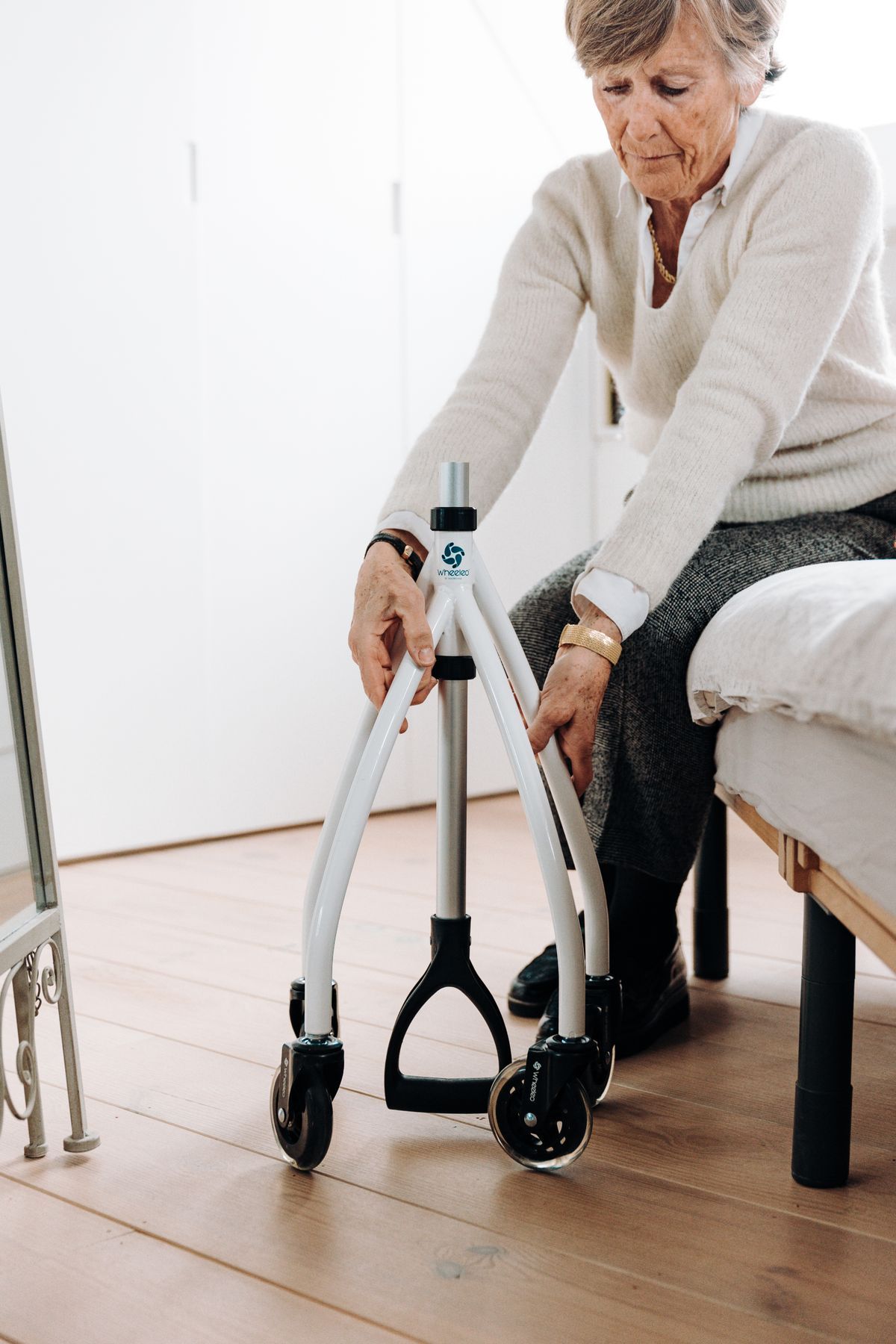
The seat decision, one line: if the senior walks steadily but must sit every few minutes, they need a rollator with a seat (picks #3, #4, or #6) — and the brake-locking habit to go with it. If balance is genuinely poor, the seat is a luxury that costs the stability they cannot afford to lose.
Fitting a Walker — The 4 Measurements That Prevent Returns
Capsule: measure the senior and the home before buying — handle height, seat height, narrowest doorway, and both weights decide everything. Most walker returns happen for one reason: nobody measured. Five minutes with a tape measure now prevents a second delivery. Only four numbers matter:
1. Handle height — the wrist-crease rule
Have the senior stand upright in their usual walking shoes, arms hanging relaxed at their sides. The walker's handgrips should sit level with the wrist crease — elbows bending slightly, about 15–20 degrees. Too low forces hunching (which causes back pain and actually worsens balance); too high pushes the shoulders up and tires the arms. Compare this measurement against the product's adjustable handle-height range in the specifications — especially for shorter or taller seniors, where some models simply do not reach.
2. Seat height — the stand-back-up test
For rollators: the seat-to-floor height should let the senior sit with feet flat and knees at or slightly below hip level. Test it against a dining chair at home — if they struggle to stand from that chair, they will struggle from a rollator seat at the same height.
3. The narrowest doorway — minus an inch
Walk the walker's daily route and measure the narrowest doorway or hallway it must pass — usually the bathroom door. Subtract an inch for knuckles and steering. Most four-wheel rollators run 24–28 inches wide; standard walkers are narrower. A walker that constantly jams in the bathroom doorway stops being used — and an unused walker is a fall risk, not a safety device. For tight homes, our narrow walkers guide compares the slimmest frames by real doorway clearance.
4. Weight — both directions
Two weights matter: the senior's weight against the walker's capacity (comfortable headroom, since leaning puts real force through the frame), and the walker's own weight — because if the senior or caregiver cannot lift it into the car alone, it will not go anywhere. Standard walkers weigh roughly 5–7 pounds; rollators typically 12–18.
| Situation | Small home / narrow doors | Average home | Outdoors often |
|---|---|---|---|
| Poor balance, recent fall | Standard walker (narrowest frame) | Standard walker | Standard walker + larger wheels is a myth — stay with the standard; outdoor distance comes later |
| Poor balance, weak arms | 2-wheel walker, narrowest model | 2-wheel walker | 2-wheel walker; smooth paths only |
| Mild unsteadiness, tires easily | Compact rollator (check width vs. doorway) | Rollator with seat (Nitro / Hugo) | Rollator with 8″+ wheels (Nitro) |
| Mild unsteadiness, back pain/stooping | Upright walker if doorways allow | Upright walker (ELENKER) | Upright walker with larger wheels |
| Mild unsteadiness, rests very often | Rollator with seat, narrowest that fits | Medline Empower (widest seat) | Medline Empower |
Related reading: the caregiver's aging-in-place checklist walks room by room through the same doorway, bathroom, and hallway measurements — the walker is one piece of a safer home.
Wheels, Brakes and Terrain — The Details That Decide Safety
Capsule: small wheels for indoors, 8-inch wheels for outdoors — and brakes are only as good as the hands squeezing them.
Wheel size decides where the walker actually works. Small wheels (around 6 inches) suit indoor floors and smooth pavements. Medium wheels (7–8 inches) handle sidewalk seams, threshold strips, and modest outdoor use — the sweet spot for most seniors. Large wheels (10 inches and up) roll over grass and gravel more easily, at the cost of a wider, heavier frame. For balance problems specifically: bigger wheels roll over obstacles instead of stopping dead — and a wheel that stops dead on a pebble is a fall.
Brake type matters more than marketing suggests. Loop-lock brakes (squeeze up to brake, push down to lock) are the standard on rollators — but they demand real hand strength. Here is the arthritis answer, plainly: if arthritic hands cannot squeeze and lock the brakes reliably, a rollator is not safe for that senior — no matter how much they want the seat. The honest alternatives are a standard walker (no brakes to squeeze) or a 2-wheel walker (no brakes at all), possibly paired with a lightweight transport chair for outings where rest breaks are needed. Feather-touch brake designs (like the NOVA Zoom's) help at the margins, but "helps" is not "solves" — test the actual hands on the actual brakes before deciding.
And the rule that prevents the classic rollator accident: never sit on a rollator whose brakes are not locked. Teach it, watch it happen three times, then trust it.
10 Real Situation Questions, Answered Honestly
Capsule: these are the questions caregivers actually ask — each answered for the specific situation, not in generalities.
1. My father has arthritis — which walker can he actually work with his hands?
Capsule: arthritic hands point away from rollators — standard and 2-wheel walkers have no brakes to squeeze. Be honest about the hands, not hopeful. If he cannot squeeze a brake lever firmly and push it down into the lock position, a rollator is unsafe for him — the seat becomes a trap. A standard walker (pick #1) or 2-wheel walker (pick #2) asks nothing of the hands except gripping. For outings where he must rest, pair it with a lightweight transport chair rather than forcing a rollator. Feather-touch brake models help mild arthritis; they do not fix severe grip loss.
2. My mother just came home after a hip fracture — what walker is safe for her first weeks?
Capsule: post-fall and post-surgery, the standard no-wheel walker is the default — it is what discharge planners hand out, for a reason. The first weeks after a fall or hip surgery are the highest-risk window, and this is exactly what the standard walker (pick #1) is for: four legs planted, nothing that rolls, weight capacity with headroom. Do not "upgrade" her to a rollator for comfort in week two — comfort is not the job right now. Follow the discharge instructions first, this guide second, and reassess with her physical therapist before changing types.
3. My dad lives in a small apartment with narrow hallways — what walker fits?
Capsule: measure the narrowest doorway, subtract an inch, and buy narrower than that number. Small apartments punish wide rollators — a walker that jams in the bathroom doorway gets abandoned, and an abandoned walker is a fall risk. Standard and 2-wheel walkers are naturally narrower than rollators. If a rollator is genuinely the right type for his balance level, choose the narrowest one whose width clears the measured doorway, and verify the folded width too (hallway storage matters). Our narrow walkers guide compares slim frames by real doorway clearance.
4. My mother tires on outings and needs to sit down often — which walker lets her rest?
Capsule: frequent rest breaks mean a rollator with a seat — but only if her balance is mild and she can lock the brakes. This is the seat section's core question. If she walks steadily, tires quickly, and can reliably lock brakes before sitting: a rollator with a seat (picks #3, #4, #6 — the Empower has the widest seat). If her balance is genuinely poor, the honest answer is harder: no seat is worth a rollator rolling away under her. Then the solution is a standard walker for walking plus planned rest stops (benches, a transport chair in the car) — two tools doing two jobs safely.
5. How do we know the walker fits my parent's height?
Capsule: wrist-crease rule — grips level with the wrist crease, elbows bending slightly; then check the spec sheet's adjustment range. Stand the senior in their usual shoes, arms relaxed: grips at the wrist crease, about 15–20 degrees of elbow bend. Too low causes hunching (which worsens balance); too high hikes the shoulders. Then — and this is the step everyone skips — compare that number against the product's stated handle-height range before buying. Shorter and taller seniors get burned here most. The full method with the worked example is in the fitting section above.
6. My dad shuffles and sometimes freezes mid-step — will a regular walker work?
Capsule: shuffling or freezing steps are a doctor's question first, a product question second. When walking changes involve shuffling, freezing, or sudden hesitation, something neurological may be going on — that needs a doctor's assessment, not a shopping decision. What we can say about products: standard walkers suit slow, deliberate stepping; rollators can actually make freezing episodes scarier because the device keeps rolling while the feet stop. Do not buy any walker to "fix" a freezing gait — get the medical assessment, then let the physical therapist match the device to the diagnosis.
7. My mother leans her full weight on the walker — which type won't give way?
Capsule: heavy leaners need a standard walker with capacity well above their weight — wheels plus heavy leaning is the fall combination. Leaning puts far more force through the frame than walking does. A senior who leans hard needs: (a) a standard walker (no wheels to roll out from under the lean), (b) weight capacity comfortably above her weight — 350 lb capacity for a 220 lb leaner is sensible, not excessive, and (c) a frame wide enough that the lean does not tip it sideways. This is also the signal to ask her doctor whether her balance has declined past what any walker safely supports — sometimes the honest answer is a wheelchair assessment, not a better walker.
8. Which walker is light enough for my dad to lift into the car every day?
Capsule: if he loads it alone, walker weight is a feature — standard walkers (5–7 lb) beat rollators (12–18 lb) for daily lifting. A walker that lives in the car trunk gets lifted twice a day, every day. Standard walkers are the lightest things with four legs sold (roughly 5–7 pounds) and fold flat. Rollators weigh roughly 12–18 pounds — manageable for a caregiver, punishing for a frail senior lifting alone. If a rollator is the right type but the weight is the problem, that is a caregiver-loads-it situation, not a buy-the-flimsy-one situation: ultra-light no-name rollators achieve their weight by giving up the frame strength a balance-problem senior is leaning on.
9. My mom uses her walker mostly outdoors — what actually matters?
Capsule: outdoors means 8-inch-plus wheels and real brakes — small wheels stop dead on pebbles, and dead stops cause falls. Three things: (1) wheel size — 8 inches minimum for sidewalks and park paths, 10 for grass and gravel; (2) a frame that does not flex on uneven ground (the Nitro's cross-bracing is why it leads outdoor recommendations); (3) brakes that actually hold on a slope — test the parking lock on an incline before trusting it. And the balance caveat stands outdoors too: genuinely poor balance plus outdoor terrain is the highest-risk combination — a standard walker on smooth paths, with outings kept short, beats a rollator on rough ground.
10. Should we buy the walker before or after the physical therapy visit?
Capsule: if a PT visit is already scheduled, wait — a fitting beats a guess; if not, buy the safe default now and bring it to the fitting. When balance problems are new or worsening, the physical therapist's fitting (type, height, technique coaching) is worth more than any guide. If the appointment is days away, waiting is fine. If there is no appointment and the senior is unsafe today, buy the conservative default — a standard walker (pick #1) — because it is the type least likely to be wrong, then bring it to the fitting for adjustment. What you should not do: buy the fancy rollator first and hope the therapist approves it.
Red Flags — What NOT to Buy
Capsule: the most dangerous walker is the wrong type bought confidently — these are the purchases to avoid.
- A rollator for genuinely poor balance. The #1 mistake. Marketing shows smiling seniors gliding on rollators; physics shows a wheeled frame rolling away under an unsteady lean. Match the type to the balance level (the table at the top), not the advertisement.
- A 3-wheel walker for balance problems. Three-wheelers are maneuverability tools for tight spaces — they are the least stable walker type sold, with no seat. For balance problems they are the wrong answer in almost every case.
- A cheap no-name walker from a marketplace seller. A walker is load-bearing safety equipment. Unknown brands with no verifiable manufacturer, no stated weight capacity, and no replacement parts are gambling with a fall. Stick to established manufacturers with real specifications and real customer support — the price difference is a few dozen dollars; the failure difference is a hip fracture.
- A used walker with worn brakes, wobbly wheels, or a bent frame. Walkers wear out. Brake cables stretch, wheels develop flat spots, frames bend microscopically. A free used walker that fails is the most expensive walker.
- Any walker bought to skip the professional fitting. If there has been a recent fall, a hospital stay, or worsening balance, the physical therapist's fitting is not optional — it is the purchase that makes the purchase safe.
When the Walker Feels Wrong — Repair, Replace, or Reassess?
Capsule: wobble, brake fade, and avoidance are the three signals — two mean maintenance, one means a professional reassessment.
- It wobbles or clicks: check the height-adjustment pins first (not fully seated is the classic cause), then tighten every bolt, then inspect the rubber tips — worn tips are a $10 fix that restores grip. If the frame itself is bent or cracked, replace the walker; bent aluminum does not unbend safely.
- The brakes fade: brake cables stretch with use — most rollators have a barrel adjuster for this. If adjustment no longer holds, replace the brake assembly or the walker. Brakes that "mostly work" do not work.
- The senior avoids using it: this is the signal most families miss. If the walker sits in the corner while the senior furniture-walks, something is wrong: wrong type, wrong height, brakes they cannot work, or balance that has declined past what the device supports. Do not buy a "better" walker yet — get the reassessment first. The device did not fail; the match did.
Rule of thumb: maintain the walker yearly (tips, brakes, bolts), replace it when the frame or brakes are compromised — and reassess the person whenever the device that used to work stops working.
Who This Guide Is For — and Who Should Skip It
Capsule: this guide is for families choosing a walker for balance problems — it is not medical advice, and new or worsening balance problems need a professional first.
This guide is for you if: your parent's balance is shaky and you are choosing between walker types; you want to understand which design features actually matter for stability; or you are a caregiver double-checking a purchase. It is written in plain language, one step at a time, because this decision deserves patience — like a mother explaining something important, slowly, until it is truly understood.
Skip this guide — and call a professional first — if: balance problems are new, sudden, or rapidly worsening; there has been a recent fall with injury; or walking changes involve shuffling, freezing, dizziness, or fainting. Those are medical questions, and no product guide answers them.
Related reading: if falls are the worry rather than just the walker, our fall detection devices guide covers the backup layer — and the bed rails guide covers the other end of the night, getting in and out of bed safely.
Quick answers
Best for serious balance problems: Drive Medical Two-Button Folding Walker — four legs planted, nothing that can roll away.
Best without lifting: Drive Medical 10210-1 2-wheel walker — glides forward, rear legs stay planted.
Best rollator (mild balance issues only): Drive Medical Nitro — stable for a rollator, seat and locking brakes included.
Frequently asked questions
- What type of walker is best for balance problems?
- For genuinely poor balance, a standard walker with no wheels is best — four legs stay planted and it cannot roll away when leaned on. A 2-wheel walker is the next step down in stability for seniors who cannot lift a standard walker. Rollators suit only mild balance problems, because their wheels roll freely.
- Is a rollator safe for someone with bad balance?
- No — a rollator is not safe for genuinely poor balance. Its four wheels let it roll away when leaned on, which can cause the fall you are trying to prevent. Rollators are safe for seniors who walk steadily but tire easily, provided they can reliably squeeze and lock the hand brakes.
- What is the difference between a 2-wheel walker and a 4-wheel rollator for stability?
- A 2-wheel walker has two planted rear legs and two front wheels, so it moves without lifting but cannot roll away like a 4-wheel rollator. The rollator rolls freely on all four wheels, has a seat and brakes, and is less stable. For balance problems, fewer wheels means more stability.
- Do I need a walker with a seat if my mom has balance problems?
- Only rollators have real seats — standard and 2-wheel walkers do not. A seat is worth it if she walks steadily but must rest often, and only if she can reliably lock the brakes before sitting. If her balance is genuinely poor, skip the seat: no rest break is worth a rollator rolling away under her.
- How do I know if the walker is the right height?
- Have the senior stand in their usual shoes with arms relaxed: the handgrips should sit level with the wrist crease, with elbows bending slightly (about 15–20 degrees). Too low causes hunching, which worsens balance; too high hikes the shoulders. Always compare your measurement against the product's stated handle-height range before buying.
- Can a senior with Parkinson's use a regular walker?
- Only with professional guidance. Shuffling or freezing steps need a doctor's assessment first — no walker fixes a freezing gait, and rollators can make freezing episodes scarier because the device keeps rolling while the feet stop. Let a physical therapist match the device to the diagnosis.
- Does Medicare pay for walkers for balance problems?
- Original Medicare Part B generally covers walkers as durable medical equipment when a doctor prescribes one for home use, with the usual deductible and coinsurance. Coverage rules change, so confirm with the supplier and Medicare directly before counting on it.
- Are upright walkers good for balance problems?
- Upright walkers help posture and back pain for seniors with mild balance issues, but they are not designed for severe balance loss and they cost significantly more. If balance is genuinely poor, a standard no-wheel walker is the safer choice; buy the upright for posture, not for fall protection.
- What weight capacity should a walker have for a senior who leans hard?
- Choose a capacity comfortably above the senior's weight — leaning puts far more force through the frame than walking. A 350-pound capacity for a 220-pound senior who leans is sensible headroom, not overkill. Sitting weight counts too: capacity must cover the senior sitting on a rollator seat.
- When should I replace my parent's walker?
- Replace it when the frame is bent or cracked, when brakes no longer hold after adjustment, or when wheels wobble and will not tighten. Maintain it yearly — rubber tips, brake cables, bolts. And if a walker that used to work stops working for the person, reassess the person with a professional before buying a new device.