
Grandparents Day Gifts and Activities That Actually Land (2026)
Grandparents Day 2026 falls on Sunday, September 13 — the first Sunday after Labor Day. The gifts that land best are not the most expensive ones: they are the ones that give grandparents time with family, something personal to look at every day, or a small comfort they would never buy for themselves.
Affiliate disclosure: As an Amazon Associate I earn from qualifying purchases. This guide contains affiliate links; they cost you nothing extra. Prices and availability change, so check the current listing before you buy. Read our affiliate disclosure.
The short answer is in the first section below: a good Grandparents Day gift is one that fits the grandparent you actually have — their mobility, their eyesight, their hearing, how far away they live, and what they already own. Decide those five things first, then pick from the shortlist. Most failed grandparent gifts fail on fit, not on thought: a day trip for someone who cannot travel, a fiddly gadget for someone with shaky hands, or another object for a house that is already full.

The short answer: a good Grandparents Day gift fits the grandparent you actually have — their mobility, eyesight, hearing, distance, and what their house already holds. Decide those five things first, then pick from the shortlist. Most failed gifts fail on fit, not on thought.
What Grandparents Day is — and when it falls
National Grandparents Day in the United States is celebrated on the first Sunday after Labor Day, which is the first Monday in September. In 2026 that is Sunday, September 13. In 2027 it is Sunday, September 12. Because Labor Day moves, the date moves with it — it always falls between September 7 and September 13, and it is always a Sunday. If you see a different September date online, it is usually another country's observance: the United Kingdom uses the first Sunday in October, and Australia uses the last Sunday in October. This guide is about the American day.
The day began with Marian McQuade, a West Virginia homemaker who campaigned from 1970 to set aside a day honoring grandparents and to encourage grandchildren to learn from their heritage. Congress passed legislation in 1978, and President Jimmy Carter signed the proclamation designating the first Sunday after Labor Day as National Grandparents Day; the first observance followed in 1979. The day is a national observance under federal law (36 U.S.C. § 125), not a federal holiday: there is no day off work and no closure of government offices or schools. Businesses keep regular Sunday hours.
The observance has an official flower and an official song, chosen by the National Grandparents Day Council. The flower is the forget-me-not — a small blue flower whose name is itself a plea to remember — and the song is Johnny Prill's "A Song for Grandma and Grandpa." Neither fact changes what you should buy, but both make a cheap, thoughtful touch: a small bunch of flowers with a card that names the flower, or a playlist that includes the song, shows you did more than grab the first gift list. Schools often mark the day too, with classroom cards, songs, and grandparent visits; if your child's school celebrates it, ask the teacher for the date, because school celebrations sometimes land on a nearby school day rather than the Sunday itself.
Note: this guide went live on October 31, 2026, after that year's day had passed; the 2027 date above and every idea here still apply.
The 15-minute method when you have no idea
First five minutes: remember. Think of the last three things they enjoyed and the last thing they mentioned wanting to try. It is almost always something small — a restaurant they talked about, a walk they used to take, a show they follow. Write down three things without judging them yet. Then add the five fit facts: how far away they live, how they get around, how their eyesight and hearing are, what their house already holds, and what they complain about most (cold feet, loneliness, boredom, aches). These five facts eliminate more bad gifts than any gift list ever will.
Second five minutes: discard. Cross out anything they already own, anything that needs space they do not have, anything that assumes mobility or tech skills they do not have, and anything that only one of them would enjoy when the gift is meant for two. This step saves the most money: most failed gifts were not bad ideas, they were repeats, impossibilities, or ideas meant for a different person. A day trip is a repeat of nothing, but it is impossible for someone who cannot travel; a smart speaker is a fine idea, but not for someone who cannot hear it well without help setting it up.
Last five minutes: decide and check. Pick one option, check the delivery date or the booking's validity, and write the card. One concrete sentence — "I remembered that afternoon at…" — turns an ordinary object into a personal gift. Keep the receipt and check the exchange policy before you pay, not after. If the gift is personalized, order it now: personalization is the one category where "I will do it tomorrow" reliably becomes "it arrived two weeks late."
The four-gift rule, adapted for grandparents
The four-gift rule says: something they want, something they need, something to wear, and something to read. It works because it sets a limit — four gifts at most, one per type, no filler. Adapted for grandparents, the four types shift slightly: something they want is the confessed wish, the thing they mentioned in passing; something they need improves an ordinary day; something to wear must be sized without guessing; and something to read should match their eyesight, which usually means large print or audio.
Something they want is the hardest to fake and the easiest to get right if you listened during the year: the restaurant they keep mentioning, the puzzle brand they finished, the tea they ran out of. Something they need is the practical gift that earns its place daily: warm non-slip slippers, a good reading light, a bird feeder outside the window they sit beside. Something to wear is the trap category — never guess sizes. Safe versions need no size at all: a soft throw, warm socks, a shawl. Something to read, for most grandparents, means large-print puzzle books, a large-print edition of a favorite author, or an audiobook subscription they can start without learning new software.
For the grandparent who has everything
"They have everything" almost never means they have everything. It means one of three things, and each asks for a different answer. If they buy whatever they want, nothing material is missing: give something that cannot be bought in a shop, like time together with a date, an experience, or something you made. If they ask for nothing because they do not want to be a bother, a small, thoughtful gift with a card that says asking is no bother at all lands better than a big one. If their house is full, give what gets used up, what gets lived, or what gets eaten.
Experiences are the safest way out: they take up no space and cannot duplicate what is already in the house. The key is an open voucher — they choose the date, and ideally the plan — with the validity and exchange terms checked before you buy. Give the voucher with a proposed date, not a blank "sometime." Services work the same way: grocery delivery, a meal service, lawn care, or a ride service for someone who has stopped driving. These are gifts of ease, and they keep giving after the day itself. The one caution: never give a service that implies they cannot manage. Frame it as a treat, not as help — "so you never have to cook on a Tuesday" lands better than "because cooking is hard now."
Grandma and grandpa are not the same gift
Most gift lists treat "grandparents" as one person. They are not, and the differences are practical, not sentimental. Grandmothers in the gift research skew toward keepsakes, comfort, and connection: photo gifts, memory journals, warm things, flowers, and the standing call. Grandfathers skew toward useful things, hobbies, and food: a tool or gadget they will actually use, something for the garden or the garage, a food gift, a game. These are tendencies, not rules — the grandma who wants a bird feeder camera and the grandpa who wants the memoir book both exist, and the 15-minute method beats any stereotype. But when you know nothing else, the tendency is a better starting guess than a generic "gift for grandparents" basket.
The practical differences matter more than the taste differences. Grandfathers are more likely to be the one who drives, fixes, and grills; gifts that support a hobby they already have — birding, woodworking, fishing, crosswords — beat gifts that start a new hobby. Grandmothers are more likely to be the keeper of family photos and stories; gifts that organize, preserve, or share those — a photo book, a memory journal, a frame the whole family can send pictures to — beat gifts that add another decorative object. For a couple, the best single gift is usually something they share: a meal out, a show, a game they play together, or something for a room they both use.
New grandparents: their first Grandparents Day
A first Grandparents Day is different from the tenth. New grandparents are usually younger, still working, and often still buying things for themselves — which makes them easier to buy for and easier to get wrong. The gift that lands best is one that marks the new role without treating them as old: a framed photo of them with the baby, a "first Grandparents Day" keepsake with the date on it, or a gift that makes the grandchild's visits easier, like a folding high chair for their house, a small box of toys kept at their place, or a children's book they read on every visit.
What to avoid for new grandparents: anything that ages them. No "world's best grandpa" mug that reads like a retirement joke, no large-print anything, no gift that assumes frailty they do not have. New grandparents often want to be useful more than they want to be celebrated: the most appreciated gift is often a standing invitation — a regular Tuesday dinner, a standing Saturday morning with the baby — that makes the role real. If they live far away, the frame the family can send photos to (see the keepsakes section) is the new-grandparent gift that gets used daily, because the baby changes weekly and the photo on the wall does not.
Long-distance grandparents
Distance changes the gift completely. A gift that needs you to be there — a day trip, a meal, a visit — becomes a promise instead of a present, and promises need dates. The long-distance formula that works is: one thing that arrives, one thing that connects, and one date on the calendar. The thing that arrives is the card and the small gift, sent early enough to beat the postal rush. The thing that connects is the device or service that makes the next contact easy. The date is the video call itself, booked like an appointment, with a backup plan if the connection fails.
The connection gift matters more than the arriving gift. A Wi-Fi photo frame the whole family can send pictures to is the lowest-effort option: nobody at the grandparent's end has to learn anything, and new photos of the grandchildren appear on their own. A smart display with voice calling is the next step up: the grandparent says a name and the call starts, which removes the hardest step for shaky hands or poor eyesight. A tablet does the most but asks the most, and it only works if someone sets it up first — large text switched on, the calling app on the home screen, notifications off, and a short favorites list. Whoever gives the tech should also give the setup, in person or by phone, before the day.

Limited mobility, low vision, or hard of hearing
Fit is everything here: if a gift assumes they get out easily, it is the wrong gift.
For low vision, the details are the gift: large print, high contrast, big buttons, and no tiny instructions. Large-print word search and crossword books, a jigsaw puzzle with larger pieces, a digital frame with a big bright screen, an e-reader with adjustable text size, and a book light that clips on without fiddling all qualify. Avoid anything where the pleasure is in fine detail — a 1,000-piece puzzle with a busy photograph is a punishment, not a gift, for someone whose eyesight is fading. A 500-piece puzzle with large pieces and a clear, simple image is the same pleasure at the right scale.
For hearing loss, the trap is the voice-first gadget: a smart speaker they cannot hear well, a phone call as the main event. Choose instead what can be seen or read: captioned video calls, a frame that shows photos, written letters, a captioned telephone if they still use a landline, and visits in person where you face them and speak clearly. If you give a calling device, check first whether it shows live captions or text of what the caller says — that single feature decides whether the device gets used daily or gathers dust. And for every gift in this section, ask one question before buying: can they enjoy it alone, on an ordinary Tuesday, without help? If the answer is no, it is a visit in disguise, and you should give the visit instead.
By budget: under $25, $25–$50, over $50
Grandparents are not impressed by price, and the research behind this guide agrees: the gifts families report treasuring most are rarely the most expensive. Use the bands below as planning bands, not as prices — every figure is a band for the type of gift, and you should check the current listing for the exact price. Thoughtful beats pricey at every band; the difference between bands is usually how long the gift lasts, not how much it is loved.
Under $25 is the strongest band in this whole guide. It holds the handwritten letter about a specific memory, the playlist of songs from their youth, a large-print puzzle book, a bird feeder, a small bunch of forget-me-nots with a card, a favorite tea or coffee, and a tile game like Rummikub that a nine-year-old and an eighty-year-old can both enjoy. A $25 gift chosen with a real detail in it beats a $100 gift chosen from a list. This is also the band for the add-on: a pair of warm non-slip socks tucked into any bigger gift, or a printed family photo slipped into the card.
The $25–$50 band holds the gifts that last: a good heated throw or a quality pair of slippers, a memory journal with guided prompts, a custom family calendar with birthdays marked, a jigsaw puzzle of a place that matters to them, a food basket, or a three-month subscription to a coffee or tea club. Over $50 is where the big-ticket connection gifts live: the Wi-Fi photo frame, the smart display, the memoir book service, and the experience with a date. Storyworth's memoir plans are the one service in this guide with a price verified on the company's own pages on October 31, 2026: Basic $69, Color $99, and Unlimited $199, each a year of weekly prompts ending in a hardcover book. Check the current listing before buying, as plans change.
Photo keepsakes that actually get looked at
Photo gifts fail in two predictable ways: they go up on a wall and stop being seen, or they need technology nobody maintains. The keepsakes that keep working are the ones that change. A Wi-Fi digital photo frame wins for exactly that reason: family members send new photos from their phones, and the frame updates itself. Set it up before you give it — connect the Wi-Fi, add the family members who will send photos, and preload it with twenty pictures — so the first thing they see is a full frame, not a setup screen. The frame belongs where they sit every day, not in the hallway: the kitchen counter, the side table, the bedroom dresser.
The second keepsake that works is the memory journal with guided prompts: one question a week for a year, answered in writing or by phone, printed as a hardcover book at the end. It works because the prompts do the hard part — "What was your first job?" is easier to answer than "write your life story" — and because the book that comes back belongs to the whole family. A custom photo book of one year — "The Year in Photos" — works the same way, provided the photos are captioned with names and dates. An uncaptioned photo book is a guessing game; a captioned one is a family record.
Check Price on Amazon Check Price on Amazon

Experiences and services instead of more stuff
When a house is full, the best gift is not a thing at all. Experiences take up no space, cannot duplicate what is already owned, and come with the thing grandparents want most: company. The rule for experiences is the same as for vouchers: open date, checked validity, proposed date included. A meal out, a show, a short trip, a class taken together, or a day at a garden or museum all work, provided the plan fits their mobility and stamina. A full day out is too much for many older grandparents; a two-hour outing with a meal and a rest is about right. Always have a shorter version of the plan ready, and never make the experience depend on weather, driving at night, or walking further than they comfortably do.
Services are the quiet version of the same idea. Grocery delivery, a meal service, lawn care, a ride service for someone who has stopped driving, a cleaning visit, or a subscription that arrives monthly — tea, coffee, flowers, magazines, audiobooks — all remove a small weekly friction and remind them of you every time they arrive. The honest caution, repeated from the has-everything section: frame a service as a treat, never as help. "So you never have to cook on a Tuesday" is a gift; "because cooking is hard now" is a judgment. A three-month subscription is a safer gift than a full year — it can be renewed with pleasure, but it cannot become an unwanted bill.
Things to do together on the day
Grandparents Day itself is a Sunday, which is a gift: no work, no school run, and the whole afternoon free. The best plans for the day are short, seated, and built around conversation, not performance. A meal together is the default for a reason — cook at their house so they are hosts in their own kitchen, or take them somewhere they already like rather than somewhere new and loud. Bring the food if you cook: arriving with the shopping done and the plan made is part of the gift, because it removes the work from the person being celebrated.
After the meal, the activities that work across generations share three traits: no tiny pieces, no speed, and no single winner. A large-piece jigsaw puzzle worked on together across the afternoon, a tile game like Rummikub, a card game with jumbo-index cards, a large-print crossword done as a team, or a photo-sorting session — old albums on the table, stories told as each picture surfaces — all fit. Avoid games that reward speed or memory under pressure; they embarrass the slower player and end the afternoon early. The photo-sorting afternoon deserves special mention: it produces stories no gift can buy, and it gives the family a labeled set of photographs at the end. Bring a pen and write names and dates on the backs as you go.
Check Price on Amazon Check Price on Amazon Check Price on Amazon

Kid-made gifts, by the child's age
Ages 2–4: handprints and thumbprints
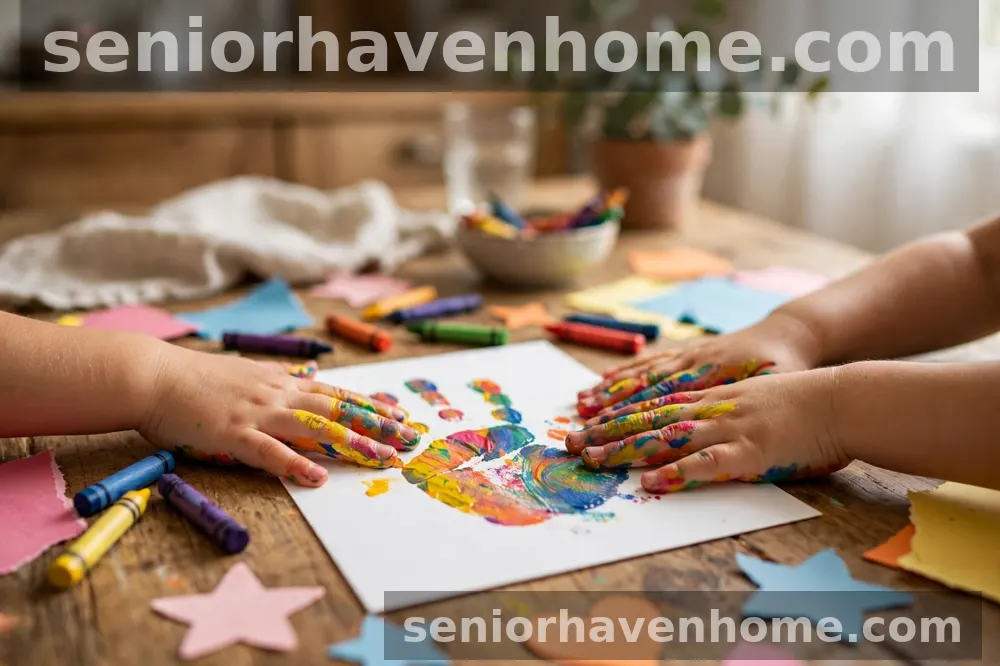
At this age the gift is a print, not a project. A handprint or thumbprint card, a thumbprint family tree with a fingerprint for each person, or a handprint flower bouquet made from painted paper hands. Keep it to one sitting of fifteen minutes, use washable paint, and write the child's name, age, and the date on the back. The date matters: a handprint dated "September 2026, age 3" is a growth record; the same print undated is just a smudge. Frame the best one simply — a cheap frame makes a handprint look like art, and it protects it from the kitchen wall.
Ages 5–7: cards, coupons, and coloring
School-age children can make a real card: a folded card with a drawing on the front and a dictated or written message inside, a coupon book ("one hug," "one story read aloud," "one walk together"), or a coloring page finished with care and mounted on card. This is also the age for the interview gift: an adult asks the child ten questions about grandma or grandpa ("What is grandpa's favorite food? What makes grandma laugh?") and writes down the answers word for word. The answers are always funny and always treasured, because they are honest in a way no adult gift can be.
Ages 8–12: real projects
Older children can make something that lasts: a photo book they lay out themselves, a recorded video message edited with music, a recipe card written out in their own handwriting, a small wooden or clay project from a kit, or a playlist of songs with a note explaining each choice. This is also the age for the family-history project: the child interviews the grandparent, records the answers on a phone, and writes up three stories.
The gift that goes the other way
One of the most-searched Grandparents Day questions runs in the opposite direction: what meaningful gifts can grandparents give to their grandchildren? It deserves its own section, because the answer is different from everything above. The grandparent-to-grandchild gift works best when it carries the grandparent in it: a story, a skill, a recipe, or an object with a history. A letter written to be opened on a future birthday, a recipe book in the grandparent's own handwriting, a recorded story read aloud, a tool or instrument taught in person — these are gifts a grandchild keeps into adulthood, long after toys are forgotten.
If you are the parent in the middle, your job is to make the reversed gift easy: suggest it, supply the materials, and stay out of the way. A grandparent who is helped to record three stories on a phone, or to write down five recipes, has given a gift that outlasts every object in this guide. And if the grandparent wants to give an object, steer toward one with a story attached — the watch they wore, the book they read as a child, the tool they used — with the story written down and kept with it. An object without its story is just an old thing; with the story, it is an inheritance.
Simple tech that keeps you close
The three devices worth considering are the Wi-Fi photo frame, the smart display, and the tablet, in that order of simplicity. The frame asks the least of anyone and cannot really go wrong. The smart display adds hands-free video calling by voice, which suits shaky hands and poor eyesight, and it doubles as a photo frame when idle. The tablet does the most — video calls, books, games, photos — but arrives full of apps and alerts nobody asked for, and it only works if someone clears the clutter first: large text on, the calling app on the home screen, notifications off, a short favorites list. Senior tablets with cellular data solve the no-Wi-Fi home, but they carry a monthly bill; budget for it before you buy, and check whether the household qualifies for the federal Lifeline discount on phone or internet service.
Two more tech gifts deserve a mention. An e-reader with adjustable text size is the right reading gift for low vision: one device, every book in large print, no shelf space. And a captioned telephone — one that shows live text of what the caller says — is the right calling gift for hearing loss. Both share the same test as every gift in this guide: can they enjoy it alone, on an ordinary Tuesday, without help? If the answer needs you in the room, give the setup visit first and the device second. Our site's own guide to video calling on WhatsApp and guide to choosing a tablet for grandparents cover the step-by-step setup for both.
Check Price on Amazon Check Price on Amazon
Food and treats
Food is the most forgiving gift category: it gets used up, it needs no space, and it rarely disappoints. The rule is to buy a little nicer than they would buy for themselves, and to check the practicalities first — dietary restrictions, diabetes, salt, chewing, and whether they live alone (a basket that feeds six is a burden for one). A gift basket of pears, cheese, nuts, and sweets; a soup package that feeds four to six with rolls and cookies; a tea or coffee subscription that arrives monthly; a box of chocolates or fruit — all fit, provided they match the grandparent's actual tastes and not a generic "senior" idea of them.
The food gift that lands hardest is the one you make or share. A dish cooked together, a recipe of theirs cooked back for them, a meal delivered hot on the day itself, or a standing monthly dinner you cook at their house — these are food plus company, which is the combination grandparents value. If you send food from a distance, order early and check the delivery date in writing: perishable gifts that arrive a day late arrive spoiled. And always include a card: an anonymous box of food feels like a delivery, while the same box with a handwritten note feels like a gift.

Last-minute gifts that still feel planned
Grandparents Day has a way of sneaking up, because the date moves every year. If you are shopping in the last few days, the honest move is to stop chasing delivery dates and switch to gifts that need no shipping at all. A personalized gift card with a family photo and a message on it, ordered online and delivered quickly, works when you cannot be there in person — but only if the photo and message are real and specific. A generic card with no message says "I forgot"; the same card with a photo and three sentences says "I was thinking of you."
The better last-minute gifts are not bought at all. A handwritten letter, a phone call with a plan, a playlist made that morning, a photo printed at a local shop and framed, a promise of a visit with the date already in the diary — all can be done in an afternoon, and all feel more planned than a parcel ordered in a panic. The standing weekly call, started on Grandparents Day itself, is the best last-minute gift in this guide: it needs no delivery, it costs nothing, and it turns a forgotten date into a year of contact.
Check Price on Amazon Check Price on Amazon Check Price on Amazon Check Price on Amazon
Ordering and delivery: the cut-off rule
This guide deliberately gives no delivery cut-off dates, because every retailer's cut-off is different and they change every year. The rule is: read the date the actual shop promises before you pay, and buy with margin. Personalized gifts take the longest — photo books, custom portraits, engraved items, and memoir books all need days or weeks of production before shipping even starts — so order those first, ideally three to four weeks before the day. Standard gifts from large retailers are faster, but September is back-to-school season, and delivery estimates slip. Flowers and perishable food need the exact delivery date confirmed in writing, not assumed.
What to skip
Skip the gift card as the whole gift. A gift card on its own says "I did not know what to get you." A gift card tucked inside a handwritten letter, chosen for a shop they love, with a note saying why, is a thoughtful gift. The difference is never the card; it is the words around it. And skip the guilt gift — the expensive object bought to make up for absence. Absence is fixed with presence, not with price. A visit, a call, and a card beat a costly parcel every time.
After the day: making it last all year
A gift's real test comes the week after Grandparents Day, when the cards are put away and ordinary life resumes. The gifts that pass that test are the ones with a built-in second act: the frame that receives new photos, the subscription that arrives monthly, the standing call that repeats weekly, the puzzle that gets finished across rainy afternoons, the journal that asks a new question every week. When you choose, ask what the gift does on an ordinary Tuesday in November. If the answer is "nothing," it was a one-day gift, and one-day gifts are the ones that end up in drawers.
Make the afterlife deliberate. Put the next three call dates in the diary before you leave. Load the frame with a fresh batch of photos the following Sunday. Write the first journal prompt together, so the book starts with a shared memory rather than a blank page. Finish the puzzle together across two visits, and frame it if it matters to them. And keep a note of what worked: which gift got used, which got mentioned twice, which produced a story. That note is next year's gift list, written by the grandparent themselves without knowing it.
How we chose these ideas
We did not test these gifts at home, and this guide does not pretend otherwise. The ideas were chosen from three sources: the questions people actually ask about Grandparents Day and grandparent gifts, the gift guides that currently rank for those questions, and the gaps in them. We read the top rival guides in full on October 31, 2026 — a 25-pick list organized by category, and a 14-idea list built around gift cards — and recorded what they covered and what they missed. Both are competent lists of objects. Neither gives the date and history in full, neither covers activities to do together, kid-made gifts by age, the reversed gift, or ordering cut-offs, and neither separates the advice by mobility, vision, hearing, or distance. This guide is built around those gaps.
Prices in this guide are planning bands, not prices: under $25, $25–$50, and over $50 describe the type of gift, and you should check the current listing for the exact figure. The one exception is the Storyworth memoir service, whose Basic $69, Color $99, and Unlimited $199 plans were read on the company's own pricing pages on October 31, 2026, and are labeled with that date and source in the budget section. Dates were verified against multiple calendar sources the same day: Sunday, September 13, 2026, and Sunday, September 12, 2027, on the first-Sunday-after-Labor-Day rule. The history — Marian McQuade's campaign, the 1978 legislation and proclamation, the forget-me-not flower, and the official song — was verified against the Old Farmer's Almanac, timeanddate, and the U.S. Census Bureau's own account.
The shortlist, compared
| Gift | Best for | Budget band | Needs setup? |
|---|---|---|---|
| Standing weekly call + handwritten card | Every grandparent, especially long-distance | Free | No |
| Wi-Fi photo frame, pre-loaded | Long-distance and new grandparents | Over $50 | Yes — by you, before giving |
| Memory journal or memoir book service | The grandparent with stories to tell | $25–$50 / over $50 | No |
| Large-print puzzle books + jumbo-index cards | Low vision; game nights together | Under $25 | No |
| Tile game (Rummikub) or large-piece puzzle | Doing something together on the day | Under $25 | No |
| Heated throw or non-slip slippers | Comfort; limited mobility | $25–$50 | No |
| Smart display for hands-free video calls | Shaky hands; poor eyesight | Over $50 | Yes — by you, before giving |
| Experience or service with a date | The grandparent who has everything | $25–$50 / over $50 | Check validity first |
| Food basket or subscription | Every grandparent; check diet first | $25–$50 | No |
| Kid-made gift (by age) | Grandchildren under 12 | Under $25 | Adult help by age |
The table's rule is the guide's rule: the best gift is the one that fits the grandparent's mobility, senses, distance, and house. Start from the fit facts in the 15-minute method, then read across the row. If two rows fit equally well, pick the one with a date on it — the call, the visit, the booked experience — because dated gifts get used and undated ones get postponed.
The bottom line
Start with the five fit facts: distance, mobility, eyesight, hearing, and how full the house is. Then give time with a date on it — a visit, a standing call, or an experience booked for a real day — plus one small personal thing: a card with a specific memory, a photo with names and a date, or a keepsake that changes as new photos arrive.
If the budget is small, the letter, the playlist, and the standing call cost nothing and are remembered longest. If the budget is larger, spend it on connection — the frame, the display, the memoir book — and spend the setup time yourself, because setup is the difference between a device that gets used and a device that gathers dust. If they live far away, send the gift early and make the call the event. If they live nearby, be the event: arrive with the food, the game, and the afternoon free.
Frequently asked questions
- When is Grandparents Day 2026?
- Sunday, September 13, 2026 — the first Sunday after Labor Day in the United States. The date moves every year with Labor Day, always falling on a Sunday between September 7 and September 13.
- When is Grandparents Day 2027?
- Sunday, September 12, 2027, on the same first-Sunday-after-Labor-Day rule. Labor Day 2027 falls on Monday, September 6, so the first Sunday after it is September 12.
- Is Grandparents Day a federal holiday?
- No. It is a national observance under federal law (36 U.S.C. § 125), not a federal holiday. There is no day off work, and schools, government offices, and businesses keep regular Sunday hours.
- What is a good present for grandparents?
- Something personal or shared rather than expensive: a visit with a date, a standing weekly call, a photo keepsake the whole family can add to, a memory journal, or a small comfort they use daily. The gift should fit their mobility, eyesight, hearing, distance, and how full their house already is.
- What do you buy a grandparent who has everything?
- Give what cannot already be in a closet: time together with a date, an experience with an open voucher, a service that removes a weekly friction, or something consumable. A handwritten letter about a specific memory costs nothing and is consistently the most treasured gift of all.
- What are good Grandparents Day gifts from grandchildren?
- It depends on the child's age: handprint and thumbprint cards at ages 2–4, cards and coupon books at 5–7, and real projects — a photo book, a recorded interview, a recipe in their own handwriting — at 8–12. Put the child's name, age, and the date on everything.
- What is the 5-gift rule for adults?
- The popular version says five gifts: something they want, something they need, something to wear, something to read, and something to do together. This guide uses the four-gift version — want, need, wear, read — and treats the shared activity as the gift that matters most, given its own section rather than squeezed into a list.
- What gifts should you avoid for grandparents?
- More objects for a full house, complicated tech without setup help, event tickets that assume travel, heavy items, clothing in guessed sizes, perfume bought blind, diet products, age jokes, and anything that makes them feel old rather than loved. A gift card on its own is also a miss — pair it with a personal letter.
- What is a good gift for a grandparent with limited mobility?
- Small, light, usable from their favorite chair: a good reading light, a lap blanket or heated throw, large-print puzzle books, a bird feeder outside the window they sit beside, or a subscription that arrives at the door. Never give anything that assumes they get out easily.
- What is a good gift for long-distance grandparents?
- One thing that arrives, one thing that connects, and one date on the calendar: a card and small gift sent early, a Wi-Fi photo frame or smart display set up by you, and a video call booked like an appointment. Put the next call in the diary before you hang up.
- What meaningful gifts can grandparents give their grandchildren?
- Gifts that carry the grandparent in them: a letter for a future birthday, a recipe book in their own handwriting, a recorded story read aloud, a skill taught in person, or an object with its story written down and kept with it. Grandchildren forget objects; they remember the adult who always showed up.
- How much should you spend on a Grandparents Day gift?
- Thoughtful beats pricey. A $25–$50 personalized or cozy gift is plenty for most occasions; under $25 holds the strongest ideas in this guide, including the letter, the playlist, and the standing call. Save bigger budgets for milestone occasions, and split a couples' budget by thought, not by dollars.
- What is the official flower of Grandparents Day?
- The forget-me-not, chosen by the National Grandparents Day Council. Its name is a plea to remember, which is why a small bunch with a card naming the flower is a thoughtful, inexpensive touch. The day's official song is Johnny Prill's "A Song for Grandma and Grandpa."
- Do schools celebrate Grandparents Day?
- Many do, with classroom cards, songs, and grandparent visits. School celebrations sometimes land on a nearby school day rather than the Sunday itself, so ask the teacher for the school's date if your child is making something to bring home.
- What is a good last-minute Grandparents Day gift?
- Switch to gifts that need no shipping: a handwritten letter, a phone call with a plan, a playlist made that morning, a photo printed locally and framed, or the standing weekly call started on the day itself. If you must order, choose digital or local delivery and check the promised date in writing before you pay.