
Home Safety Checklist for Seniors: Room-by-Room Fixes That Work
More than one in four Americans aged 65 and older falls each year, and most falls happen at home. This room-by-room checklist — built on the National Institute on Aging's guidance and the CDC's STEADI materials — sorts every fix into tonight, this weekend, or hire a professional, with a free printable and a fridge card at the end.
Affiliate disclosure: As an Amazon Associate I earn from qualifying purchases. This guide contains affiliate links; they cost you nothing extra. Prices and availability change, so check the current listing before you buy. Read our affiliate disclosure.
The short answer is in the first three sections below: walk the house room by room with this checklist, fix the night route from bed to bathroom first, and sort everything you find into three piles — tonight, this weekend, and hire a professional. Most home accidents for older adults come not from one big danger but from ten small ones nobody wrote down: the loose rug, the dark hallway, the cord across the floor, the shower with nothing to hold. Write them down, star what matters most, and fix the stars in order.

The short answer: walk the house room by room, fix the night route first, and sort every fix into tonight, this weekend, or hire a professional.
Why a checklist, and why now
Falls are the leading cause of injury — and of injury deaths — for Americans aged 65 and older, and the home is where most of them happen. In patient and caregiver materials updated in September 2026, the Centers for Disease Control and Prevention (CDC) reports that more than one in four older adults reports falling each year, over 3 million are treated in emergency departments for fall injuries, and about 43,000 older adults die as a result of a fall — 117 older adults every day. A fall is rarely bad luck. In most cases it is a predictable meeting between a person and a house that has not kept up with them.
The hopeful half of the same evidence is that most falls are preventable. The CDC's STEADI initiative — Stopping Elderly Accidents, Deaths & Injuries — asks clinicians to screen for fall risk, assess the modifiable risk factors, and intervene on them. The National Institute on Aging (NIA) publishes the same idea as a room-by-room list: floors and stairs, bathrooms, bedrooms, kitchen, outdoor spaces, and other living areas. This guide follows that shape and adds what the short government lists leave out: what to fix first, what it costs, and when to walk the house again. Do the walk with the person who lives there, not around them — a grab bar they agreed to gets used, and one installed while they were out gets resented. This guide is general information, not medical advice: a fall, repeated falls, or dizziness on standing is a doctor's conversation, and the NIA says a doctor may suggest an occupational therapist, physical therapist, or nurse visit the home to assess its safety.
How to use this checklist
Print the checklist section near the end of this guide first. Walk with your parent, not ahead of them. Tick what is already safe, and star what needs fixing: one star means this week, two stars mean before anything else. Then walk the night route once after dark, because that is the part everyone skips and the part that matters most. Most serious falls happen at 2 a.m., half asleep, on the way to the bathroom, in a house the person has walked ten thousand times.
Write down everything, even the small things, with an owner and a date beside each star. The free fixes happen before you leave. The cheap fixes happen this week. The professional jobs get booked, with a date, before you leave too — a job without a date quietly never happens. If you live far away, a local family member, a neighbor, or a professional assessor can walk the same checklist and send photos of each room. Renters can do nearly everything on the free and cheap lists; anything that drills into tile, changes wiring, or alters structure needs the landlord's written permission first.
Fix first: tonight, this weekend, hire a professional
Every starred item belongs on one of three ladders. Ladder one is free, tonight, before you leave: move the cords, clear the night route, shift everyday kitchen items down to waist height, put the flashlight and the phone where they belong, write the fridge card. Ladder two is cheap, this week, hardware-store money: plug-in night lights, non-slip mats, fresh batteries, a shower caddy that ends the bending. Ladder three is book a professional and do not do it yourself: grab bars anchored into studs, anything electrical, anything gas, water-heater work, and structural step or deck repairs. A grab bar that pulls out of drywall is worse than no grab bar, because it fails exactly when someone trusts it with their full weight.
| Priority | What goes here | Best for | Typical cost |
|---|---|---|---|
| Tonight — free | Clear the night route; move cords to walls; shift daily items to waist height; test alarms; write the fridge card | Every home, before anything else | Free |
| This weekend — small purchase | Night lights; non-slip mats and strips; cord covers; a flashlight by the bed; batteries | Homes where the structure is sound | Small purchases, hardware-store prices |
| Book a professional | Grab bars into studs; stair rails; electrical and lighting work; water-heater setting; step and deck repairs; ramp installation | Anything anchored, wired, plumbed, or structural | Professional rates — get two or three local quotes first |
Start with the bathroom if you can only fix one room: wet floors, hard surfaces, nothing soft to land on, and a person with nothing to hold. Three changes — grab bars anchored into studs, a non-slip surface, and a light that is on before anyone steps inside — change the risk of the whole house. Costs in this guide are planning bands, not quotes: free, small purchase, or professional job.
Entry, steps, and paths
Stand at the mailbox and look at the home the way a stranger would on a dark, wet night. Is the path even, with no cracked slabs, lifted edges, or mossy patches? Is there something solid to hold on every step — a rail that is firm when leaned on, not decorative? Does the porch light actually light the steps, not just the door? Is the house number visible from the street, so an ambulance does not lose minutes to a hidden number? Outside steps get the worst weather: check that none is broken, loose, or uneven, add non-slip material, and in winter treat walkways with ice-melt or sand — deciding in advance who clears snow and ice beats negotiating during the first freeze.
A grab bar near the front door helps with the small, risky moment of locking and unlocking while holding bags, and a dusk-to-dawn porch light means nobody comes home to a dark entry. A lockbox for emergency responders, with the code shared with family, means help can get in without breaking a door. The garage counts as an entry too: the step from garage to house is a different height, often poorly lit, and crossed with arms full. Light it, mark its edge, put a rail where a hand naturally reaches, and keep the walking line from car to door clear.
Stairs and hallways: the night route
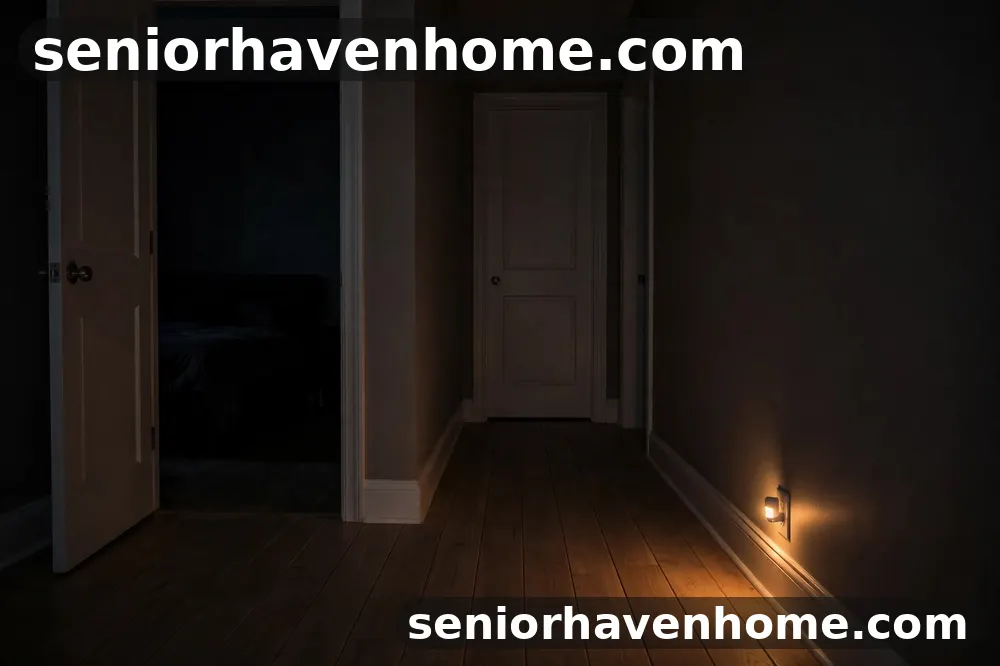
Walk the route your parent walks half asleep at 2 a.m.: bedroom to bathroom. It must be completely clear — no shoes, boxes, cords, or laundry baskets — with light at both ends, reachable without crossing a dark room. Stairs need a rail on both sides where the house allows it, solid and running the full length; the NIA advises holding the rail even when carrying something, and never letting what you carry block your view of the steps. Stair edges should be easy to see: contrast tape on each nosing is a cheap fix.
Light switches belong at the top and bottom of every staircase and at each end of a long hall. Where wiring does not allow that, motion-activated plug-in lights that switch on when someone walks past do the same job — the NIA names these directly. Keep walking areas tidy: books, papers, clothes, and shoes live off the floor and off the stairs. Check that all carpets are fixed firmly to the floor, put no-slip strips on tile and wooden floors where the route turns, and follow the NIA's bluntest line: do not use throw rugs or small area rugs. Pull hallway furniture back until a person using a walker can pass, and never walk on a slippery, newly washed floor — wait for it to dry.
Living areas: where the day is spent
The living room is where your parent spends most waking hours, so small hazards here get the most chances to bite. Look at it from the chair, not from the doorway. The favorite chair should be easy to get out of — firm, with arms, not a deep sinker. Low coffee tables are a classic trip point: the NIA advises arranging furniture so nothing stands in the walking line. Cords run along walls, never across walkways; if a lamp needs power in the middle of the room, move the lamp or add an outlet.
Keep the items used most often at waist level or within easy reach — the remote, the phone, the glasses, the water glass. The phone should be reachable from the chair, charged, with family numbers stored; the NIA also advises keeping emergency numbers in large print near each landline phone and saved under favorites on a mobile. A flashlight lives in a known spot for power cuts. If there is a personal alarm pendant, ask the awkward question: is it worn, or living in a drawer? A pendant in a drawer is a decoration, not a safety device. Know where a pet is whenever you stand or walk — the NIA names pets underfoot directly — and keep pet beds and bowls out of the walking line.
Kitchen: heat, knives, and reaching
The kitchen concentrates the risks: heat, water, knives, and everyday things creeping to higher shelves. Everyday items — mugs, plates, the kettle, tins — belong between knee and shoulder height, with nothing used daily stored overhead. The NIA puts it simply: keep frequently used pots, pans, and utensils where they are easy to reach. If something needs a step stool, it needs a new home; if a stool is truly needed, it must be steady with a handrail on top and someone standing next to you.

Clean up spills immediately — the NIA names this one directly — and wipe the floor dry before anyone walks on it. The stove stays clear, with nothing stored on top of it; if forgetfulness is part of the picture, look at stove knob covers or an automatic shut-off device. A fire extinguisher or fire blanket should exist, be in date, and be reachable without reaching over the stove. Knives live in a block or a drawer; cleaning chemicals stay in their original containers. Prepare food while seated where possible, as the NIA advises, because fatigue builds quietly during a long session standing at a counter. The honest test: could your parent make a cup of tea here safely at 6 a.m., half awake, with one light on? Whatever makes you hesitate gets a star.
Bathroom: the room that deserves double time
More serious falls happen in bathrooms than anywhere else in the house: wet, hard surfaces, and no clothing to soften the landing. Give this room double time. Mount grab bars near the toilet and on both the inside and the outside of the tub and shower — the NIA's exact placement — installed by someone qualified, screwed into studs or proper anchors. Never trust a suction-cup bar with body weight: suction cups fail exactly when someone grabs them hard, and a towel bar is not a grab bar. If the budget only stretches to one professional job this month, this is the one.

Place non-slip mats, strips, or carpet on every surface that may get wet, and keep the floor dry between uses. A shower chair turns a risky standing task into a safe seated one, a handheld showerhead makes seated bathing practical, and a raised toilet seat helps anyone who struggles to rise. Leave a light on in the bathroom at night, or use a night light that turns on automatically, so the room is lit before anyone steps inside. The door should open outward, or be unlockable from outside, so a fall inside does not barricade the person who needs help. Hot water deserves its own check: the U.S. Consumer Product Safety Commission (CPSC) urges households to set water heaters to 120 degrees Fahrenheit (49 degrees Celsius), because most adults suffer third-degree burns from two seconds at 150 degrees, six seconds at 140, and thirty seconds at 130, while at 120 degrees the same injury takes about five minutes. Check it with a thermometer at the tap, and leave plumbing work to a plumber.
Bedroom: the first ten seconds of standing
Most bedroom falls happen in the first ten seconds of standing up: dizzy, dark, and hurrying. Put night lights and light switches close to the bed, keep a flashlight by the bed, and place a landline or well-charged phone near the bed — all three are on the NIA's bedroom list. The bed should be a height your parent can sit on with feet flat on the floor. The path from bed to door must be bare and clear, slippers by the bed should have backs and grip, and glasses and any mobility aid should live in the same easy-to-reach place every night.
Teach one habit for the standing moment: sit up, let the legs dangle for a count of ten, then stand holding something solid, and wait a few seconds before walking. A phone or medical alert device stays within reach of the pillow, not across the room. Getting up dizzy most mornings is a doctor's conversation, not a checklist item — dizziness on standing has causes a checklist cannot judge.
Laundry, garage, and basement
Laundry rooms, garages, and basements collect the jobs nobody wants to do in the main house: carrying, lifting, and bending, usually down a flight of stairs with arms full. The laundry route needs light, a rail, and a rule: never carry more than you can see over. A basket with handles, carried in two trips instead of one, is a free fix. The washer and dryer should be reachable without bending to the floor or stretching overhead, with heavy boxes on low shelves and nothing heavy overhead.
Basement stairs are the steepest, darkest stairs in many American homes: a rail on at least one side, light switches at top and bottom, visible step edges — and nothing stored on them, ever. In the garage, keep the walking line from car to house door clear and lit, store chemicals in original containers out of the path, and treat damp floors and old wiring as professional jobs, not weekend ones.
Whole-house systems: alarms, water, and power
Smoke alarms belong on every level of the home, inside each bedroom, and outside each sleeping area, with carbon monoxide alarms on every level and near sleeping areas — the standard guidance of the National Fire Protection Association, and the arrangement most local fire codes require. Test every alarm while you walk, check the manufacture date printed on each one (alarms last about ten years), and if your parent cannot hear a standard alarm well, look at strobe or bed-shaker versions. Replace batteries on a fixed date rather than waiting for the low-battery chirp at 3 a.m.
For power, the rule is that no cord crosses a walkway, no outlet is overloaded, and no space heater sits near curtains, bedding, or anything that can burn. Space heaters need three feet of clear space on every side and must never be left running unattended or while anyone sleeps; a heater with tip-over shut-off is the only kind worth owning. Extension cords are temporary: if a cord has become permanent, have an electrician add an outlet. In summer, the house needs one room that can be kept cool, with a check-in plan for heat waves — older adults may not notice they are overheating, so the check-in matters more than the thermometer. In winter, the heating needs its annual service and the power-cut kit needs writing down: flashlights, charged phones, blankets, and a neighbor who checks in.
The 10 essential safety devices
Ten devices cover nearly every home on this list, and most of them are cheap. Buy the bathroom three first if the budget is tight: grab bars, a non-slip surface, and a night light on the route.
| Device | What it does | Best for |
|---|---|---|
| Grab bars, anchored into studs | Something solid to hold in the tub and at the toilet | Every bathroom; anyone who has ever grabbed a towel bar for balance |
| Non-slip mats and strips | Grip on wet tub, shower, and bathroom floors | Every bathroom |
| Motion-activated night lights | Light the bedroom-to-bathroom route without fumbling for a switch | Anyone who gets up at night |
| Shower chair and handheld showerhead | Seated bathing, no standing on a wet surface | Anyone with balance, stamina, or leg-strength limits |
| Raised toilet seat | Less effort sitting and standing | Sore knees and hip replacements |
| Bed rail or support handle | Something to hold rolling over, sitting up, and standing from bed | Anyone who needs a hand getting out of bed |
| Reacher grabber tool | Pick things up and reach shelves without climbing or bending | Anyone tempted to stand on a chair |
| Smoke and carbon monoxide alarms | Early warning, including strobe and bed-shaker versions | Every home; essential where hearing is reduced |
| Medical alert device | A button that calls for help after a fall | Anyone living alone |
| Fire blanket or extinguisher | Smother a small kitchen fire without reaching over the stove | Every kitchen |
The shopping links below are search links, not recommendations of a specific brand or model. Use them to compare types, read the measurements, and check the current listing before you buy — sizes vary, and the right size is the one that fits your parent's bathroom. Where a device needs installation into studs, wiring, or plumbing, the installer is half the purchase.
Search grab bars for the bathroom Search non-slip bath mats Search shower chairs Search raised toilet seats Search motion-sensor night lights Search bed rails for seniors Search reacher grabber tools Search smoke and CO detectors Search medical alert systems Search non-slip grip socks Search kitchen fire blankets Search handheld showerheads
Medicines: the quiet fall risk
Medicines are the fall risk nobody sees on a walk-through, because the bottles live in a cabinet and the side effects live in the body. Several common kinds raise fall risk: anything that causes dizziness, drowsiness, or a drop in blood pressure on standing, including some blood pressure medicines, sleep aids, anxiety medicines, and pain medicines. The CDC's STEADI materials include a medicines-risk fact sheet, and the NIA lists reviewing medicines among its first tips for preventing falls. The action is not to stop anything — never stop a prescribed medicine because of a checklist. Bring the full list, including over-the-counter medicines, vitamins, and supplements, to the doctor or pharmacist and ask: does anything on this list make me dizzy, sleepy, or unsteady?

Storage is the part the checklist can judge. Medicines belong in one place, in their original labeled containers, with a printed list kept beside them: name, dose, time, and what it is for, in large print. A weekly pill organizer helps only if it is filled carefully and checked — a wrongly filled organizer is worse than bottles, because the error repeats all week. Expired medicines go back to a pharmacy take-back program. Keep a night-time dose, if one is prescribed, where it can be taken sitting up with water in reach. Treat the first two weeks of any new medicine as a reassessment trigger: new medicines change balance before anyone notices.
Living alone: check-ins and getting help
Living alone changes the checklist's center of gravity. The house can be perfectly arranged and still fail its owner at the one moment that matters: the fall nobody sees. The NIA's advice starts with the simplest system — an emergency response system, a button that alerts 911 — and is honest about its limits: there is a fee, and it is usually not covered by insurance. The device only works if it is worn, charged, and tested, so test it together on the walk. If they refuse one, ask why: cost, appearance, pride, and fear of false alarms all have answers.
Carrying a well-charged phone through the house is the NIA's second option, with close friends and family on speed dial — and a smartwatch can add a third layer, since some watches detect sudden fall-like movements and call for help automatically. None of these replaces the human layer: a daily check-in, at an agreed time, by an agreed person, with an agreed escalation if nobody answers. Write it down: who checks, when, and what happens after two missed check-ins. Keys and access complete the picture: a trusted neighbor with a key, a lockbox code shared with family, and a phone list with the neighbor, doctor, and pharmacy. If your parent uses a medical alert device, confirm the monitoring company has the current address, gate or building code, and key location.
When memory changes: dementia-aware safety
When memory changes are part of life, the checklist gains a second layer: the house must be safe for someone who may not remember the rules, may wander at night, or may use the stove and forget it. Start with the stove: knob covers, an automatic shut-off device, or a breaker the family can switch off when nobody is supervising cooking. Remove interior door locks that could trap someone inside a room, add door chimes on exterior doors, and lock away firearms, power tools, medicines, and cleaning chemicals.
Water needs a second look too: a person with dementia may run a bath and forget it, or turn the hot tap and not register the temperature. Label rooms and drawers with large-print words or pictures where that helps, and keep the layout stable — furniture that moves weekly is a map that keeps changing for someone navigating by memory. Simplify choices rather than removing independence: two outfits laid out instead of a full closet. The Alzheimer's Association publishes a home-safety guide for families living with dementia; ask the doctor or the local chapter for the current version. And when wandering, falls, and missed medicines outrun what fittings can fix, bring the starred list to the doctor and the Area Agency on Aging and let the assessment decide the next step.
Walkers, wheelchairs, and pets underfoot
A home that fits a walker or wheelchair is a home with width, turning room, and somewhere to park the equipment. The walking lines need to be wide enough for the equipment your parent actually uses, with turning space in the bathroom and bedroom where transfers happen. Do not guess at widths: an occupational therapist measures the person's equipment and the house together. Thresholds are the usual pinch point — a low-profile ramp or beveled strip turns a daily bump into a smooth roll — and doorways too narrow for a wheelchair are a professional job. Keep the equipment in the same place every night, charged if powered, with brakes checked and tips or tires in good repair.

Furniture earns its place by helping a person stand, sit, and turn. Chairs need firm seats and sturdy arms; a chair that tips, slides, or sinks is a transfer hazard. Rugs, runners, and thresholds are the enemy of wheels and walkers alike: remove them or fix them flat, and never let a rug edge curl up in a doorway. If your parent uses oxygen, the tubing route needs the same treatment as any cord — along walls, never across a walkway. Feed bowls and pet beds live out of the walking line, and the leash hangs by the door rather than trailing across the hall.
When to walk it again
Walk the house again after any of these: a fall, even a minor one; a hospital stay or surgery; a new medicine or a changed dose; a new diagnosis affecting balance, vision, memory, or strength; a move; the start of using a cane, walker, or wheelchair; and each change of season. Put the next walk in the calendar before you leave the current one. Between full walks, keep a monthly five-minute check: test the alarms, check the night lights, look at the night route with fresh eyes, confirm the phone is charged and the emergency card is current. Write down near-misses — a near-miss written down becomes a starred item, and one laughed off becomes the next fall's backstory.
What it costs, and who pays
Most of this checklist costs nothing or next to nothing. The free tier — clearing routes, moving cords, shifting items, testing alarms, writing the fridge card — prevents the most falls and is available to every home on the day the checklist is printed. The small-purchase tier — night lights, mats, strips, cord covers, batteries, a reacher — is hardware-store money, and it is worth buying the decent version: a mat that slides is worse than no mat. The professional tier needs two or three local quotes as a rule.
Does Medicare pay for any of this? Mostly no, with one important exception. Original Medicare generally does not pay for grab bars, ramps, shower chairs, raised toilet seats, or other home modifications — it treats them as home improvements rather than medical care. What Medicare Part B may cover, when a doctor orders it, is an occupational therapist's home safety evaluation: the assessment itself, not the modifications. Some Medicare Advantage plans offer supplemental benefits for certain safety devices — check the plan's Evidence of Coverage, because coverage varies widely and the only reliable answer is the one in writing. Medicaid waiver programs, VA benefits, and local Area Agency on Aging programs may also help; the Eldercare Locator at 1-800-677-1116 connects families to the local agency. Ask the doctor for the occupational therapy referral first, and ask the Area Agency on Aging about funding before paying out of pocket. Never sign a full-remodel proposal on the strength of a fall scare: the checklist asks for fittings, not a renovation.
The printable checklist
Print this section and take it room by room. Tick what is already safe, star what needs fixing — one star means this week, two stars mean before anything else — and write the owner's name and date beside each star. Print it large enough to read at arm's length.
| ☐ | Check | Priority | Done / notes |
|---|---|---|---|
| ☐ | Night route bed to bathroom: clear, lit at both ends, nothing on the floor | ★★ | |
| ☐ | Motion night lights on the night route and in the bathroom | ★★ | |
| ☐ | Grab bars by toilet and in tub/shower, anchored into studs | ★★ | |
| ☐ | Non-slip surface in tub/shower and on the bathroom floor | ★★ | |
| ☐ | Smoke and carbon monoxide alarms tested, in date, on every level | ★★ | |
| ☐ | Fridge card filled in and on the fridge door | ★★ | |
| ☐ | Phone charged, within reach of bed and chair, numbers stored | ★★ | |
| ☐ | Throw rugs removed or fixed flat; no rug on the night route | ★ | |
| ☐ | Cords along walls, never across walkways | ★ | |
| ☐ | Stair rails solid, both sides, full length; step edges visible | ★ | |
| ☐ | Light switches at top and bottom of stairs and both ends of halls | ★ | |
| ☐ | Entry steps even and solid; handrail firm; porch light works; house number visible | ★ | |
| ☐ | Water heater 120°F at the tap, checked with a thermometer | ★ | |
| ☐ | Shower chair and handheld showerhead fitted | ★ | |
| ☐ | Raised toilet seat if standing up is difficult | ★ | |
| ☐ | Bed height: feet flat on the floor when seated on the edge | ★ | |
| ☐ | Lamp, flashlight, glasses, and mobility aid within reach of the bed | ★ | |
| ☐ | Kitchen daily items between knee and shoulder height; no step-stool habit | ★ | |
| ☐ | Stove clear; fire blanket or extinguisher in date and reachable | ★ | |
| ☐ | Favorite chair firm with arms; walking lines clear of low furniture | ★ | |
| ☐ | Medicines in one place, labeled, with a printed list; expired ones returned | ★ | |
| ☐ | Medical alert device worn and tested, or phone-carrying habit agreed | ★ | |
| ☐ | Daily check-in agreed: who, when, and what happens after two missed check-ins | ★ | |
| ☐ | Neighbor with a key; lockbox code shared with family | ★ | |
| ☐ | Winter plan: who clears snow and ice; ice melt or sand bought | ★ | |
| ☐ | Next walk date in the calendar | ★ |
The caregiver version of this table is identical except for the last column: it records who owns each fix and the date promised, and it travels home with the visiting family member. If a professional assessment is booked, hand the assessor this sheet with the stars marked — it saves the first half hour of their visit.
The fridge card: numbers that matter
Copy this onto a card for the fridge door. In an emergency, nobody should be scrolling a phone with shaking hands. Fill it in together, in large print.
EMERGENCY CARD — [Name]:
Emergency (police, fire, ambulance): 911
Poison Control: 1-800-222-1222
Doctor: ______________ Pharmacy: ______________
Family contact 1: ______________ Family contact 2: ______________
Neighbor with a key: ______________
My address (for callers): ______________
Medicines and allergies: ______________
Add any building or gate code responders need, and any local non-emergency number that matters. A card paramedics can read from the doorway is worth more than a phone full of contacts nobody can unlock.
How this guide was put together
This guide was written from the published guidance of the U.S. agencies that own this subject, read on October 31, 2026: the National Institute on Aging's room-by-room fall-prevention guidance (reviewed September 12, 2022, updated January 25, 2026), the CDC's STEADI fall-prevention materials (updated September 4, 2026), and the U.S. Consumer Product Safety Commission's scald-prevention guidance on water-heater temperature. The fall statistics here come from those CDC pages and are attributed there. The additions — the three fix-first ladders, the cost bands, the dementia and living-alone sections, the printable table, and the fridge card — are the gaps the current top results leave open.
Nothing in this guide was tested at home. No product was bought, installed, or used by the author, and no product is recommended by brand or model: the shopping links are search links, so readers can compare types and check current listings themselves. Prices appear only as planning bands. Where a rival guide or product page disagreed with a government source, the government source won; where a claim could not be verified on a source read for this guide, it was left out. This guide is general information, not medical advice, and health questions belong with your parent's doctor. It is the United States version of a home safety checklist: SeniorHaven also publishes an Australian version, written for Australian homes, emergency numbers, and housing rules, and no passage was copied from it.
After the walk: keeping it safe
Safety in a house is a maintenance job, and maintenance has a calendar. Test the alarms monthly and replace their batteries on a fixed date. Walk the night route again after dark once a month and look for the things that creep back: the rug that returned, the cord that migrated, the chair that drifted into the path. Re-check the water-heater temperature after any plumbing work, and the grab bars' firmness every few months by leaning on them the way a person would in a real slip.
Before winter: the snow and ice plan, the heating service, the space-heater check, and the power-cut kit. Before summer: the cool room, the fan and air-conditioning check, and the check-in plan for heat waves. After any fall, hospital stay, new medicine, or new diagnosis, the full walk happens again. And once a year, sit down together and ask the question the checklist cannot ask: does this house still fit the person living in it? Asked early, that conversation is a plan. Asked late, it is a crisis.
The bottom line
Print the checklist, walk the house with the person who lives there, and fix the night route first: a lit, clear, supported path from bed to bathroom, with something solid to hold in the bathroom itself. Sort everything else into tonight, this weekend, or hire a professional, and put a date on every star. The free fixes prevent the most falls, and the professional fixes must not be improvised. The walk happens again after every fall, hospital stay, new medicine, or change of season — because the house changes, the person changes, and the list is only true on the day it was walked.
If you do one thing today, do the night walk. Wait until dark, walk the bedroom-to-bathroom route at your parent's speed, and fix what you find before you leave: the light, the rug, the cord, the phone. It takes twenty minutes and costs nothing.
Frequently asked questions
- What should a home safety checklist include?
- Every room walked in order — entry, stairs and hallways, living areas, kitchen, bathroom, bedroom, and laundry or garage — plus whole-house systems, medicines, and a plan for getting help. Each item needs a priority and an owner.
- What are the 10 essential safety devices to have at home?
- Grab bars anchored into studs, non-slip mats and strips, motion-activated night lights, a shower chair with a handheld showerhead, a raised toilet seat, a bed rail, a reacher grabber tool, smoke and carbon monoxide alarms, a medical alert device, and a fire blanket or extinguisher. The bathroom three come first.
- What are the 10 safety rules at home?
- Clear every walking path; light the night route; hold the rail on stairs; never use throw rugs; keep daily items at waist height; never stand on a chair; clean spills at once; keep the phone charged and within reach; test the alarms monthly; and tell the doctor about every fall.
- Does Medicare cover home safety assessments?
- Sometimes, for the assessment itself. Medicare Part B may cover an occupational therapist's home safety evaluation when a doctor orders it as part of medically necessary care. A self-referred assessment is generally not covered. Ask the doctor for the referral first.
- Does Medicare pay for grab bars?
- Generally no. Original Medicare does not pay for grab bars, ramps, shower chairs, or other home modifications, which it treats as home improvements. Some Medicare Advantage plans offer supplemental benefits — check the plan's Evidence of Coverage, because it varies by plan.
- What should a 70-year-old be doing every day at home?
- Moving a little, on purpose: walking the house, standing and sitting without rushing, and doing whatever balance or strength activity the doctor has approved. Plus the daily habits: a lit path at night, medicines taken as prescribed, a charged phone within reach, and a daily check-in.
- How often should an 82-year-old shower?
- There is no medical rule that fixes a number. Shower as often as it can be done safely and comfortably — for most people a few times a week — using a shower chair and handheld showerhead when standing is tiring, and never rushing. If showering has become frightening or exhausting, change the setup, not the washing.
- How much does it cost to make a home safe for a senior?
- Most of it costs nothing: clearing routes, moving cords, shifting items, testing alarms, and writing the fridge card are free. Small purchases such as night lights and mats are hardware-store money. Professional work needs two or three local quotes.
- Who can do a professional home safety assessment?
- An occupational therapist is the usual professional: they assess how the person actually moves through the home and recommend changes in order of importance. Ask the doctor for a referral, which Medicare Part B may cover when medically necessary. The Area Agency on Aging, via the Eldercare Locator at 1-800-677-1116, may offer free or low-cost assessments.
- What is the most dangerous room in the house for seniors?
- The bathroom. Wet floors, hard surfaces, and nothing soft to land on make bathroom falls the most serious. Grab bars anchored into studs, a non-slip surface, and a light that is on before anyone steps inside are the three fixes that matter most.
- How do I make a home safe for someone with dementia?
- Add a second layer: stove knob covers or an automatic shut-off, no interior door locks that can trap someone inside, door chimes on exterior doors, firearms and medicines locked away, the water heater at 120 degrees, and a stable furniture layout. Ask the doctor or the local Alzheimer's Association chapter for their home-safety guide.
- What should I do after a parent falls at home?
- Get help and get checked by a clinician, even if the fall seemed minor — falls can have delayed effects. Tell the doctor about it, because most falls go unreported. Then re-walk the whole house with this checklist, not just the room where it happened.
- Are suction-cup grab bars safe?
- No, not as a support for body weight. Suction cups can fail without warning, exactly when someone grabs them hard during a slip. Use grab bars screwed into wall studs or proper anchors, installed by someone qualified. Suction-cup handles are fine for holding a washcloth. They are not grab bars.
- What temperature should a water heater be set to for seniors?
- 120 degrees Fahrenheit (49 degrees Celsius) at the tap, the setting the U.S. Consumer Product Safety Commission urges for all households. At 150 degrees, most adults suffer third-degree burns in two seconds; at 120 degrees, the same injury takes about five minutes. Check it with a thermometer at the tap.
- How often should I re-check the house?
- A full re-walk after every fall, hospital stay, new medicine, new diagnosis, move, or change in mobility equipment, plus a seasonal walk before winter and before summer. Between full walks, a monthly five-minute check: alarms tested, night lights working, night route clear, phone charged, emergency card current.