
Best Adjustable Beds in Canada for Seniors
Adjustable bed prices in Canada: weight limits, battery backup, hi-lo bases, and Ontario ADP versus Alberta AADL funding — checked 31 October 2026.
Affiliate disclosure: As an Amazon Associate I earn from qualifying purchases. The prices and programme details in this guide come from research into Canadian retailer and programme pages checked on 31 October 2026 — check the current listing before you buy. It costs you nothing extra and keeps this site free. Read our affiliate disclosure.
The short answer
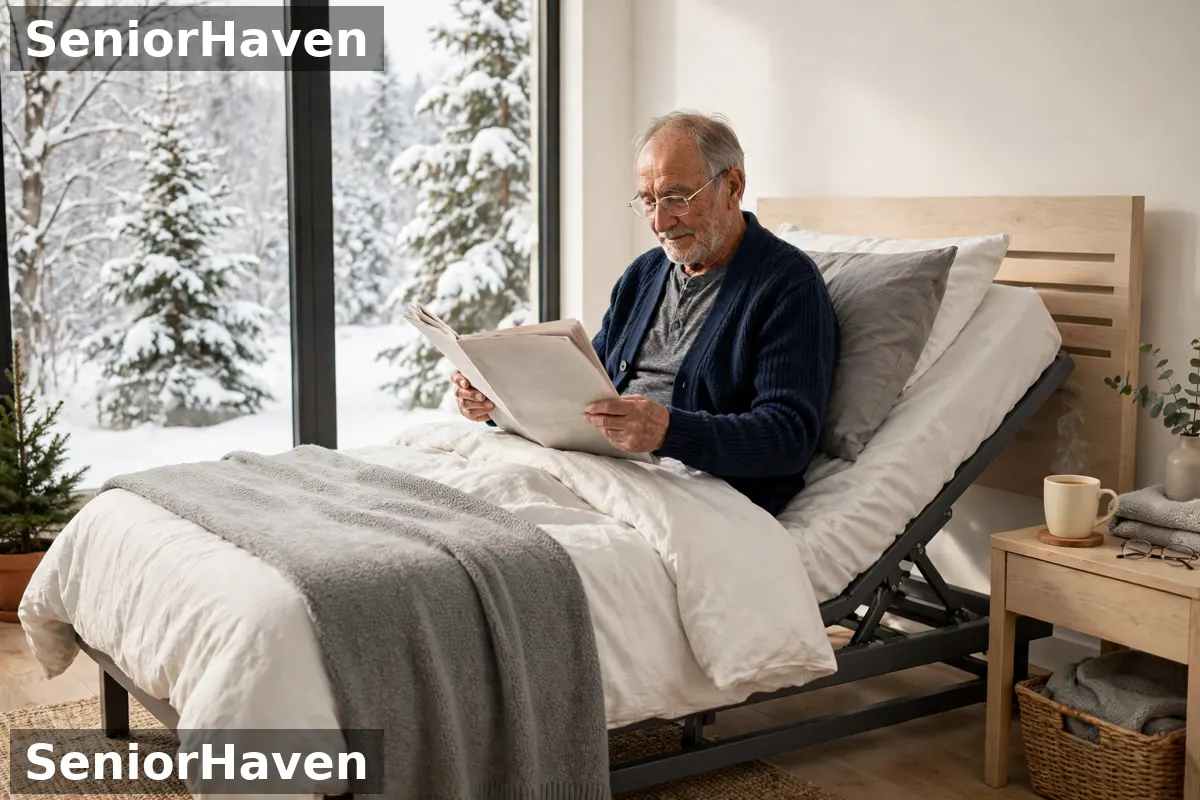
If you only read one paragraph, read this one. For most Canadian seniors, a standard motorised base that raises the head and feet — bought as a base plus a flexible mattress, in Queen or Split King — is the right starting point, and the honest all-in cost for a Queen system is roughly $2,500 to $4,000 before tax, once a mattress, bedding, and any setup fee are added. A hi-lo base that raises and lowers the whole bed is a different machine for transfers and caregiver working height, not just comfortable reading. And no retail adjustable base should be bought on the hope that a provincial programme will pay for it — check with the programme before you buy.
Figures come from the Canadian pages opened on 31 October 2026; conflicts show both figures, and unverified figures are not quoted as prices.
The bases at a glance
Standard bases vs hi-lo bases: which mechanism do you actually need?
This distinction is the first decision to get right, because the two mechanisms solve different problems — and no national rival page in this research explains it.
A standard, or lifestyle, base moves only the sleeping surface: head rises, foot rises, presets such as Zero-G tilt both. The whole bed does not rise or lower; height is set by the legs.
A hi-lo, homecare, or medical-grade base also raises and lowers the whole bed. The Orthex Sophia 4 (Healthcare Solutions retailer page, Edmonton) moves from 7.0 to 30.0 inches high, with 68 degrees of head tilt, 9 inches of foot elevation, 16 degrees of Trendelenburg and reverse tilt, and 4 inches of lumbar adjustment — letting a person lower the bed to sit and raise it to stand, and a caregiver to work without back strain. If transfers are difficult, a caregiver helps you, or a clinician has raised bed height, get a homecare assessment first. A "low profile" lifestyle base cannot rise for a transfer and is not hi-lo; ask for the height range in inches, in writing.
Sizes: Twin XL, Queen, Split Queen, Split King
Canadian sizes match the familiar North American sizes, and every source here agrees on the inches. Centimetres vary by about an inch between retailers on some sizes — measure in inches.
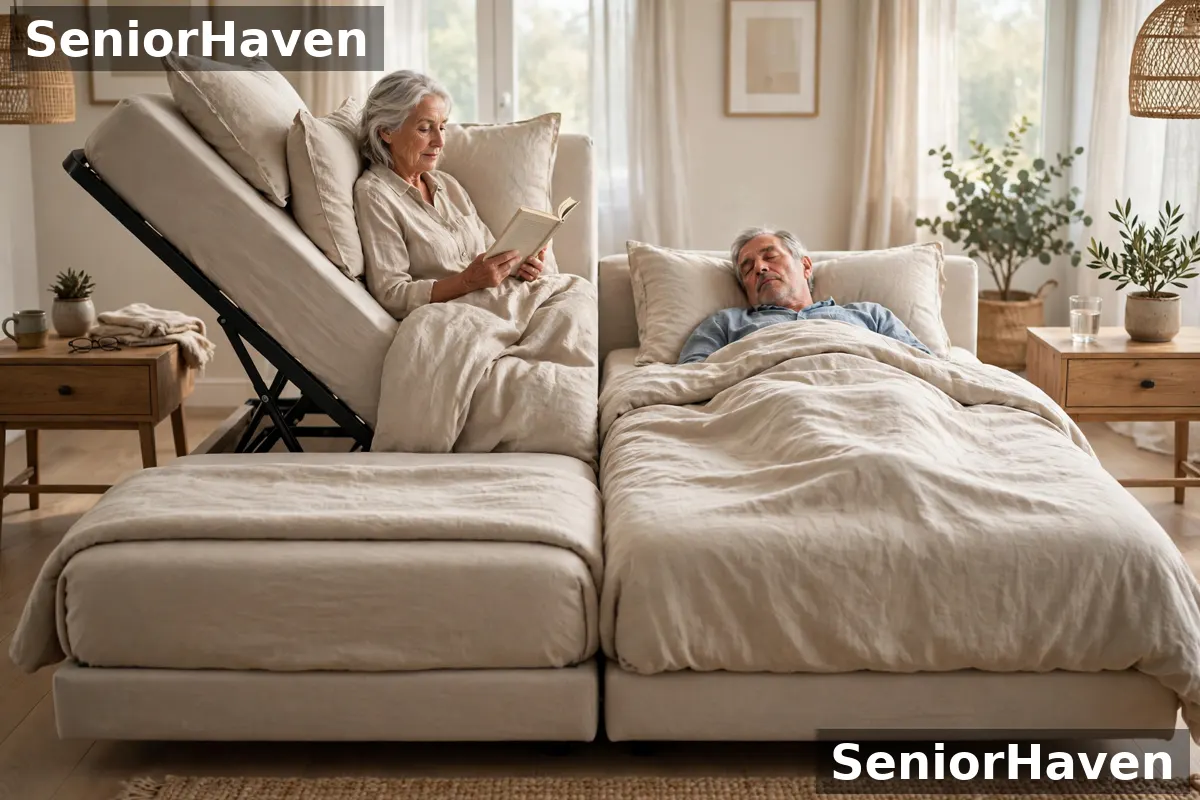
Split Queen suits smaller rooms — and rivals barely explain it. Two 30-by-80-inch halves make a 60-by-80-inch bed with independent controls. Leva calls it a "true Split Queen." It is not a standard mattress size, so halves, sheets, and protectors are purpose-built: confirm 30-by-80 bedding availability in writing.
Measure the room before ordering. A Split King needs roughly 76 inches of wall space against a Split Queen's 60 inches, per Leva. The Douglas Queen base weighs 130 lb and the Twin XL 96 lb (GoodMorning); the GhostBed Queen frame weighs 127 lb (Costco). Measure doorways, turns, and stairwells, and the bedroom with nightstands in place. Mattress Miracle describes setup as a two-person job taking about 45 minutes. Ask whether the base fits your existing frame or headboard.
What an adjustable bed costs in Canada: same-criteria prices, conflicts shown
There is no single Canadian price: "the price" is quoted four ways — base only, base plus mattress, "starting at," and sale price. This section keeps them apart, with the source of every figure. "Was" prices are 31 October 2026; taxes, delivery, and setup are extra unless stated.
Base-only prices, Queen unless stated
| Base | Price seen, CAD | Source and status |
|---|---|---|
| Hush L200 (Sleep Country) | $1,799 (was $2,399) | Sleep Country product page, fetched. 750 lb. 2 years full, 10 years frame. |
| Hush L300 (Sleep Country) | $2,099 (was $2,799) | Sleep Country page, fetched. 750 lb. Massage, Zero-G, child lock, app. |
| Hush L500 (Sleep Country) | $2,989 (was $4,599) | Sleep Country page, fetched. 750 lb. Lumbar/neck tilt, snore detection. |
| GhostBed Adjustable Base | $1,699 | MattressReviews review page. No sleep trial; all sales final; 1-year full cover plus limited lifetime, per the review page. |
| Puffy Serenity Adjustable Base | $1,999 | Review page. 101-night trial; limited lifetime warranty; customer pays repair service/transport/labour/shipping. |
| Polysleep Levita | $2,445 | MattressReviews review page. No sleep trial; 2-year limited warranty; head, neck, and foot tilt, per the review page. |
| Endy Adjustable Bed Frame | $2,810 | Review page. Includes upholstered frame (not comparable with bare bases). 30-night trial; 5-year warranty; no massage, lighting, or adjustable leg height. |
| Tempur-Pedic Ergo 3.0 | $2,999 | Review page, via Sleep Country. No trial; 3-year full + limited 25-year warranty; described as final sale. |
| Casper Adjustable Base Max | $3,799 | MattressReviews review page. 30-night trial; 10-year limited warranty; wall-aligning technology, 4-zone massage, under-bed lighting, per the review page. |
| Silk & Snow Premier Adjustable Bed | $3,300 or $3,600 — see conflict note | Brand snippet: "starting at $3,300"; review page: Queen $3,600. 30-night trial; 10-year warranty. Verify Queen price on brand page. |
| Orthex Sophia 4 | $3,749.99 — sold out | Mattress Miracle product page, fetched. Base only; mattress not included. A second retailer, MedNation, lists a $3,700–$4,200 range. |
| National Mattress category listings | Queen $495–$1,506; Queen Split $980 | Category page, fetched. Unnamed listings — no names, features, or trial/returns/warranty. Twin XL from $395; King to $1,723. |
The Douglas base-only price is not presented as settled. MattressReviews (30 October 2026) lists $1,399 for a Queen, 120-night trial, 10-year limited warranty including 2 years full service, parts, and labour. It was not confirmed on the manufacturer's own pages: the GoodMorning bundle page lists bundles only, and no standalone Douglas page was opened. Leva's blog, secondary and self-interested, claims $1,199–$1,399 with Twin XL from $1,199. Treat $1,399 as unverified until the manufacturer page is checked.
The Douglas Split King price is in outright conflict. One Leva blog page lists $1,399; another $2,398; a third lists a bundle with a mattress at $2,896 — all from the same seller's blog, which ranks its own product first. Do not budget on any single figure until the manufacturer's page is checked.
Three prices could not be verified at all on 31 October 2026, and none is quoted. No Logan & Cove standalone page was opened, so no Logan & Cove base-only price is stated. No National Mattress model names (NM 1.0, 3.0, 5.0) appeared in the fetched category text, so no model prices are attached to those names. No Saatva Canada price or specification was fetched, so no Saatva figure appears.
Bundle prices: base plus mattress
The Douglas bundle, on GoodMorning's own fetched page, runs $1,848 to $4,845 across Twin XL, Full, Queen, King, and Split King sizes and the Original, Alpine, and Summit mattresses, foam and hybrid. Trial terms are split: 120 nights for the base, 365 nights for the mattress, returns free with a full refund as stated, free shipping across most of Canada with a fee in the territories and remote areas. The Douglas Original mattress alone is $799 for a Queen on the review page. Mattress Miracle (Brantford, local): package $2,200–$5,500; Kings from $1,299; split kings from $2,499; German-motor bases $899–$2,499.
The honest total: base, mattress, bedding, setup, and tax
A base-only price excludes the mattress, split bedding, delivery/setup fees, and tax. From verified lines only: a Hush L300 at $2,099 plus a Douglas Original Queen mattress at $799 is $2,898 before tax, setup, and bedding — an illustration from two sellers' lines, not a bundle, so delivery would be charged twice. A Douglas bundle from $1,848 includes a mattress and free shipping across most of Canada. Allow for split bedding and tax (13% HST in Ontario is one retailer's example). Never compare base-only with bundle, or sale with regular, without saying which is which. The Hush L400 ($2,719, Leva only) was not fetched on Sleep Country and is unused here; the L200 table/text disagree on massage — confirm with Sleep Country.
Costco Canada: the GhostBed bundles, checked 31 October 2026
Costco.ca listed two GhostBed mattress-plus-base bundles on 31 October 2026, and both were out of stock at fetch: the Gel Memory Foam bundle at $3,299.99 and the Fusion Hybrid bundle at $3,999.99, each with an 11-inch mattress. Listed features: independent head/foot adjustment with massage, LED lighting, USB charging. Delivery 7–10 days (Gel), 3–10 days (Fusion), online only.
No trial, warranty, or weight-capacity terms were stated on either Costco page in the fetched text, and the headline price does not map to size — so neither price is quoted per size here. No Sealy Reflexion Plus listing was found on costco.ca on 31 October 2026; secondary $600–$900 estimate tables are not Costco listings, and no Sealy price is quoted. Check availability and returns wording at checkout, in writing. Do not budget on a 90-day return: no clear evidence was found that any 90-day electronics rule applies to a base, and it does not clearly apply to mattresses either. Separately, MattressReviews lists the GhostBed Fusion mattress alone, Queen, at $1,399, no sleep trial, Costco return process, 25-year limited warranty per the review page — a mattress-only figure, not a bundle or base price.
Weight capacity: subtract the mattress first
| Base | Capacity as fetched | Source |
|---|---|---|
| Hush L200 / L300 / L500 | 750 lb each | Sleep Country product pages, fetched |
| Silk & Snow Premier | 750 lb, including mattress and sleeper(s) | Brand snippet, secondary — re-verify |
| GhostBed Adjustable Power Base | Up to 750 lb per base | Costco GhostBed FAQ, snippet — re-verify |
| Casper Adjustable Base | Maximum weight 750 lb | Casper US bundle snippet — re-verify on Casper Canada |
| Orthex Sophia 4 | Twin XL 800 lb; Queen 900 lb; Split King 900 lb | Healthcare Solutions page, fetched; corroborated by Mattress Miracle/MedNation |
| Douglas Adjustable Bed | Not stated | Not stated in fetched GoodMorning text — check manufacturer page |
| Logan & Cove Adjustable Bed | Not fetched | No manufacturer page opened in this research — check before buying |
One claim must not be used: Mattress Miracle's collection page calls the Sophia series "rated for 1,000 lbs," conflicting with the 800–900 lb specification figures; this guide uses the specification figures. Its seniors page advises 150% of user-plus-mattress weight (guidance, not a standard). Fetched mattress weights: Douglas Original Queen 65 lb, Alpine 69 lb, Summit 76 lb (GoodMorning); GhostBed Queen 89 lb, Split King 144 lb total (Costco). If your total approaches the rating, step up — the Sophia 4's 900 lb Queen rating is the highest documented here. If no rating is stated, as with Douglas, ask in writing before paying.
Battery backup, remotes, and living alone
Mattress Miracle's seniors page calls battery backup "the single most important safety feature for seniors living alone."
Battery backup: what is documented. The Orthex Sophia 4 lists battery backup on its Healthcare Solutions retailer page — the only named base here with backup documented on a fetched page. The Douglas bundle page, Hush pages, and Costco GhostBed pages do not state backup status. Ask in writing what the backup does and how it is tested. Test it on delivery day, unplugged.
If the power fails while the bed is raised, do not force the bed flat by hand — motorised bases are not designed to be pushed, and forcing one risks injury and damage. Use battery backup to return to flat. Without working backup, stay put if safe, use a phone or personal alarm to call for help, and wait rather than climbing out of a raised, tilted bed. Plan before the first cut: charged phone within reach, a check-in contact, an alarm that works from the bedroom. Leva flags "no manual override" on cheap bases. Rule out a base with neither backup nor override if you live alone.
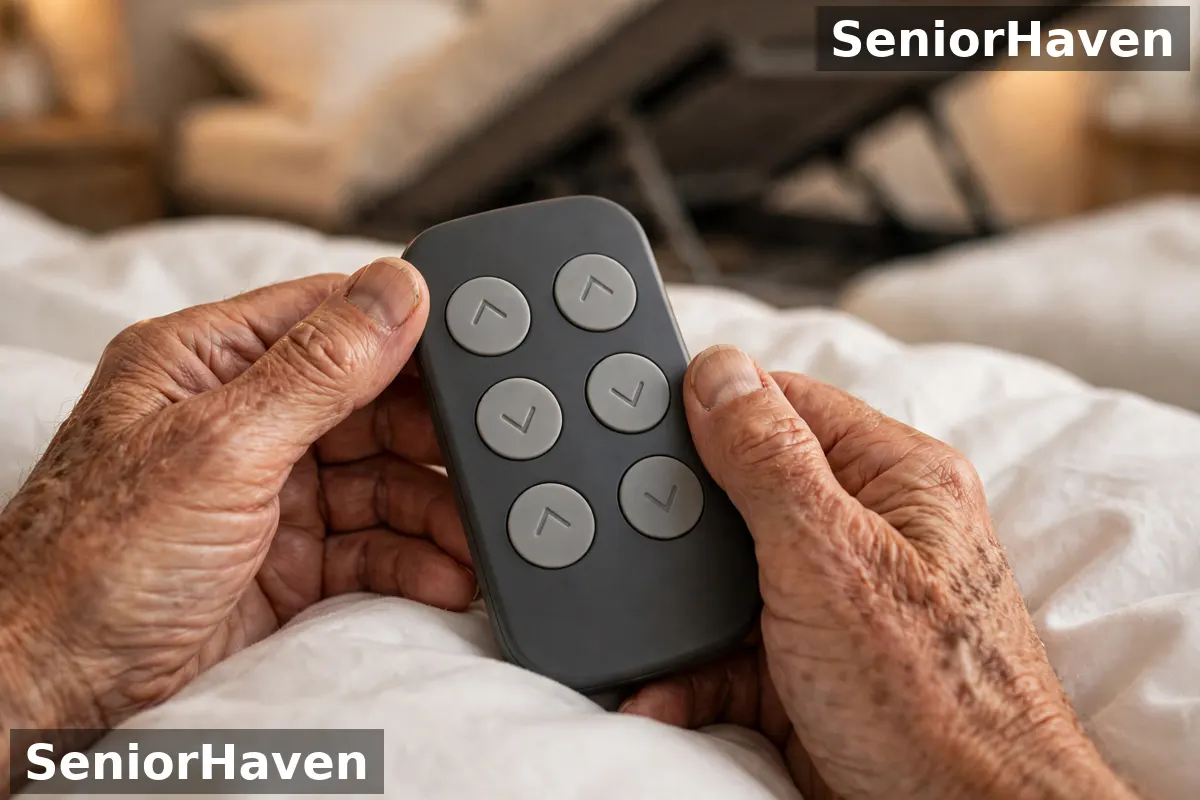
Remotes. Mattress Miracle names large buttons and backlighting as senior features; Leva mentions dexterity in one line. No rival compares remotes across bases. Handle the actual remote before buying, if you can: buttons findable by touch, in the dark, with arthritic hands? Backlit? Separate, clearly shaped head/foot buttons, or a flat panel where every button feels the same? A child lock — the Hush L300 lists one? A one-press "flat" button findable without looking? And if the remote is lost or dead: a second remote, an app, or a base control — and replacement cost? Hush bases list app control — a fallback only for phone users. An app-only base is a poor choice if you live alone without a phone at night.
Search Amazon.ca for adjustable bed base replacement remotes · Search Amazon.ca for bed remote holder pockets — accessories only; the major bases here are bought from Canadian retailers and clinics, not from Amazon.Getting in and out: measuring the right height
The method. Sit on the edge of your current bed, or a firm chair, feet flat on the floor. Measure floor to the crease behind your knee. The top of your mattress, base flat, should sit at about that height: knees at roughly a right angle, feet flat. Then add base height at its leg setting plus mattress thickness. A Douglas platform at 7, 10, or 13 inches (MattressReviews) with an 11-inch foam mattress puts the surface at about 21 inches at the middle setting, before bedding. Work the sum with your actual mattress, and test the movement with your usual support.
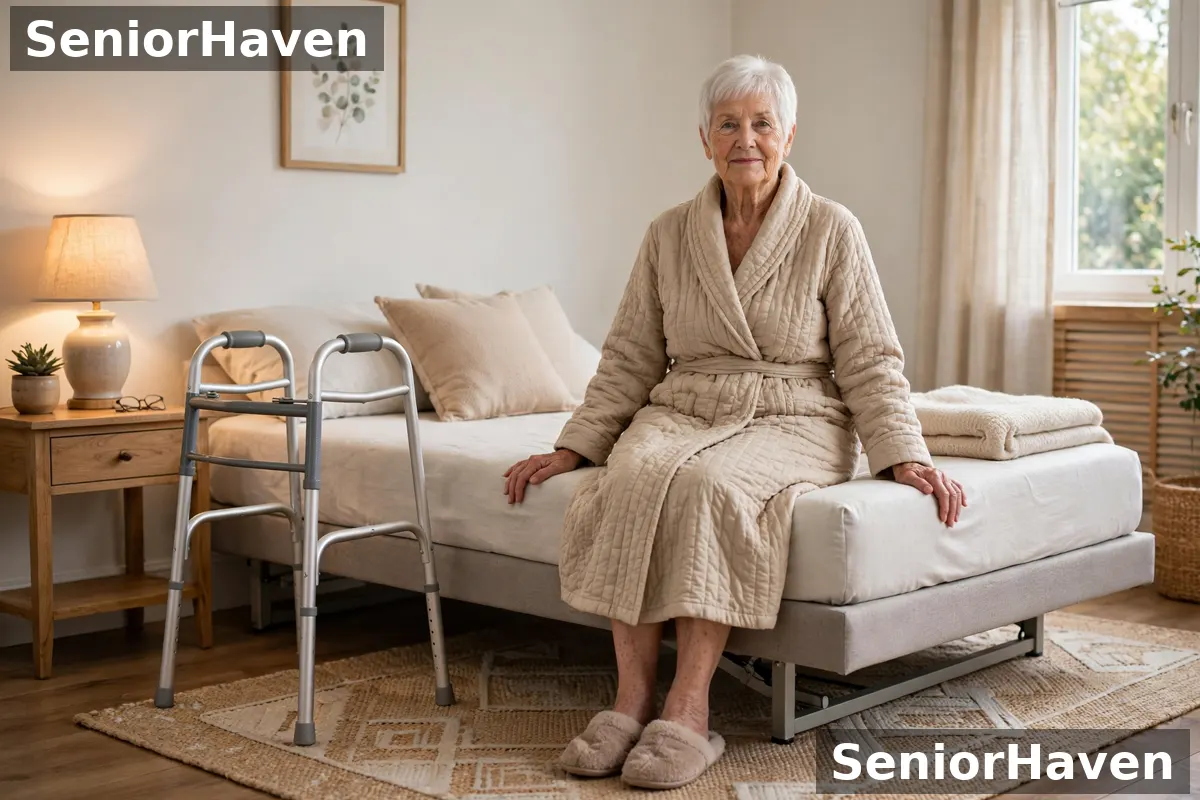
Edge stability and fall risk. A soft mattress on a segmented base can feel less stable at the edge than a flat bed. Test it: sit on the edge as you would to get up, weight over the edge — does it hold you or roll you forward? Test getting out from the raised position too. Wrong height invites falls either way. Keep the bathroom path lit and essentials within reach of the raised position.
When height alone is not the answer. If standing from sitting is difficult, you need help to transfer, or a caregiver assists you, the question becomes whole-bed height — the hi-lo decision. An occupational therapist or physiotherapist can assess transfer height, rails, and layout in one visit. Side rails are options for the Sophia 4 (retailer page), but are not priced or explained nationally here — ask what fits the exact base and what it costs.
Wall-hugger, zero-clearance, and night-time safety
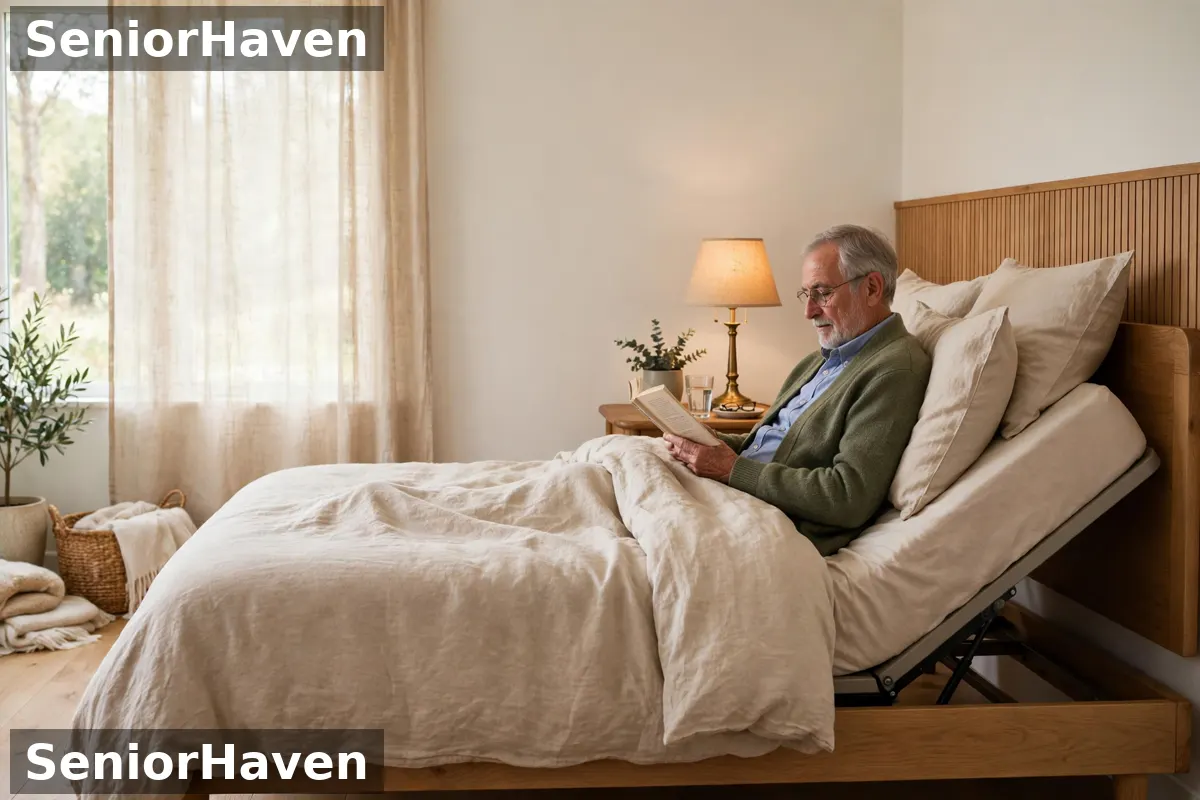
Wall-hugger / wall-saver / wall-snuggler: the platform glides backward as the head rises, keeping the sleeper near the headboard and nightstand. A fixed-pivot base swings the sleeper away: Sleeping Organic's non-Canadian explainer puts the nightstand 12 to 18 inches behind the sleeper at reading angle The honest limit: no Douglas, Hush, Casper, or other named Canadian-sold base had its wall-hugger status verified on a manufacturer page. The Casper Max is described on the review page as having "wall-aligning technology" — a review phrase, not a manufacturer specification. Ask the seller for the exact model: glide distance, and is it in the specification?
Zero-clearance is different: the base can sit on the floor, inside a platform frame, or flush against furniture and still articulate, usually with removable legs. Hush L200, L300, and L500 pages all state zero-clearance. It says nothing about staying near the wall. Ask about both, separately, in writing.
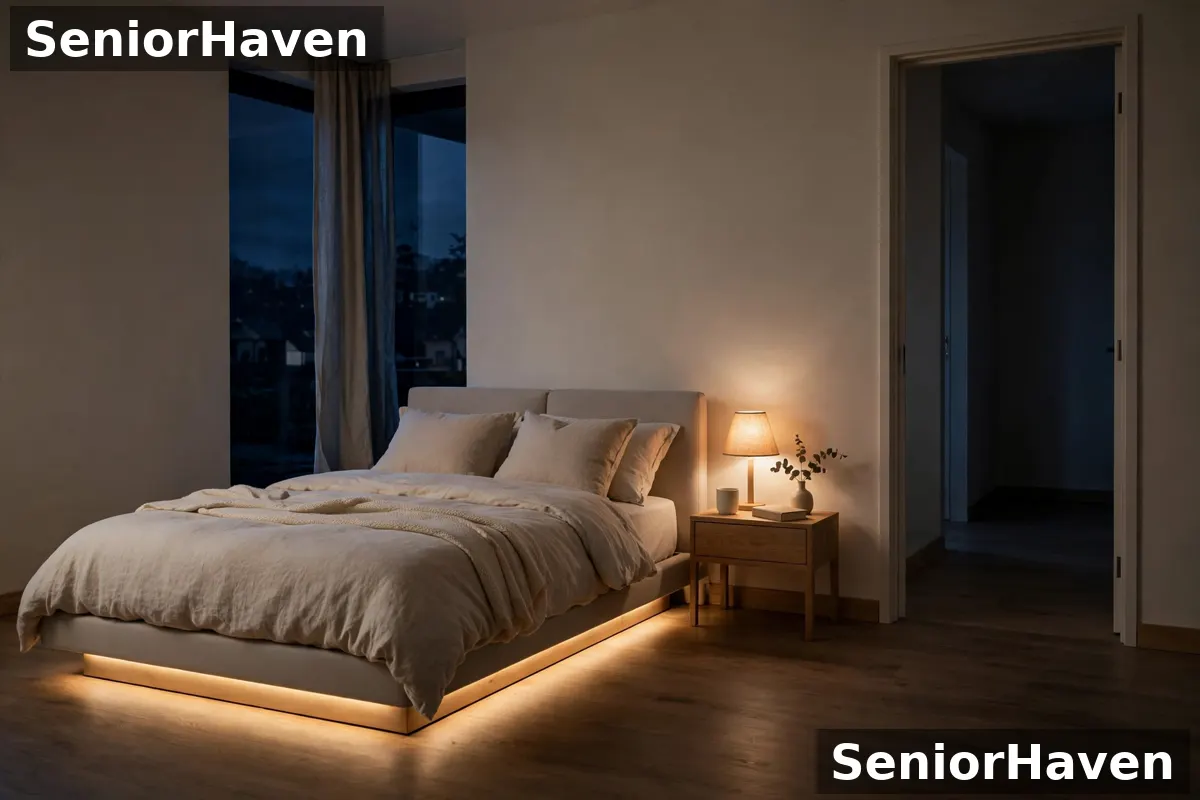
Under-bed lighting. The Hush L300 lists LED lighting; the Casper Max lists under-bed lighting on the review page; Endy notably does not offer it, per the same page. A soft light marking the floor is a genuine safety feature for night-time trips — but check how it switches on. If it works only from the remote or app, it is useless when the remote is across the room. Ask about a motion sensor, a low-level setting, and whether it works when the bed is flat.
Will your mattress work? Compatibility, thickness, and split halves
A mattress that cannot bend fights the base, damages itself, or never reaches the position chosen. The rules below come from manufacturer and retailer pages only.
What works: memory foam, latex, and pocket-coil or hybrid mattresses with individually wrapped coils, per MattressReviews and Mattress Miracle's table. What does not: traditional innerspring with interconnected Bonnell coils, which resist bending and can be damaged (Mattress Miracle); MattressReviews states innerspring mattresses do not normally work. Hybrids usually; flippable check first. An older connected-coil innerspring should be assumed incompatible. GoodMorning and Logan & Cove also list hospital and medically provided bases as incompatible with their mattresses.
Thickness: no universal limit, only per-pairing checks. Leva's Serta-alternatives page gives an ideal 8 to 14 inches, and flags a 15-inch Logan & Cove Pinnacle as at the top of the range "where flex becomes a real question," to confirm in writing. Paired mattresses here: Douglas 10–12 in., Summit up to 14 in., GhostBed 11 in. Split halves must match: buy both halves as a pair, same model and thickness, or the centre becomes a step; on a Split Queen, confirm 30-by-80 mattresses, sheets, and protectors before committing. A sound foam/latex/pocket-coil mattress within the confirmed thickness may transfer; an old innerspring will not.
Search Amazon.ca for memory foam mattresses suited to adjustable beds · Search Amazon.ca for queen mattress protectors for adjustable beds · Search Amazon.ca for split king sheet setsWhat an adjustable bed can and cannot do for health
An adjustable base is a positional and comfort aid, not a treatment. Every health sentence below is attributed: talk to your clinician, physiotherapist, or occupational therapist before buying a bed to manage a condition, and keep using prescribed treatment.
Night-time reflux. Leva Sleep's medical-conditions page, a retailer page citing the 2022 American College of Gastroenterology guideline, states the guideline conditionally recommends head-of-bed elevation for night-time reflux, targeting 15 to 20 centimetres (6 to 8 inches) of whole-torso elevation, roughly 10 to 18 degrees. That is retailer-mediated evidence. Note the detail: whole-torso incline, not bending at the waist or piling pillows. Reflux more than twice a week warrants assessment before any purchase.
Snoring and sleep apnea. Mattress Miracle cites a small study (Srijithesh et al., 2022) in which 7.5 degrees of head elevation reduced the apnea-hypopnea index by 31.8% and raised minimum oxygen saturation from 83.5% to 87%. It was cited by a retailer and not independently verified here. One small retailer-cited study is not a replacement for CPAP in moderate or severe apnea.
Circulation, swelling, back pain, and Zero-G. Retailer and general-health pages describe leg elevation above heart level as assisting venous return and reducing fluid retention, routinely recommended for heart disease, diabetes-related swelling, and post-surgical recovery — no study cited. Check with your clinician, especially for heart or kidney conditions. Zero-G: head/feet above heart, hips ~120°, knees bent. MattressReviews describes it as relieving muscle tension and spinal pressure; Mattress Miracle describes weight distribution and reduced lumbar disc pressure, with people commonly reporting relief for sciatica, stenosis, and chronic low back pain. Those are reports and retailer claims, not proof from the pages fetched. A seller's survey is not a clinical finding, and no survey figure is used as evidence here.
Funding: Ontario ADP, Alberta AADL, PSHCP, and VAC — check before you buy
Several programmes require steps completed before purchase, through a registered vendor or authorised assessor; buy first, and funding may be gone for that purchase. No programme here is presented as covering a retail adjustable base: a medical homecare bed is not a retail lifestyle base.
Ontario: the Assistive Devices Program (ADP)
Ontario's Assistive Devices Program funds personalised assistive devices for Ontario residents with long-term physical disabilities, per the official Ontario page fetched on 31 October 2026. Eligibility: Ontario residence, a valid Ontario health card, and a physical disability lasting 6 months or longer; equipment required exclusively for sports, work, or school is excluded. For many devices ADP pays up to 75% of the approved price; for Ontario Works, Ontario Disability Support Program, or Assistance to Children with Severe Disabilities clients, 100% of the approved price or maximum. Authorisation by a registered professional and purchase from a registered vendor are usually required.
The key finding is what the official list omits. Its funded categories — over 8,000 items including breast prostheses, communication aids, hearing devices, home oxygen, limb prostheses, mobility devices (exemplified by wheelchairs, mobility aids, specialised seating), orthotics, pressure modification devices, respiratory equipment, and visual aids — contain no hospital-bed category and no adjustable-base category. Universal Health Products' 2026 guide states ADP excludes hospital beds and mattresses, does not cover repairs or replacement batteries, and a diagnosis alone does not qualify a product. OHIP does not directly fund home equipment; funding flows through ADP.
A genuine conflict is shown, not resolved. Canada Life's explainer "Does OHIP cover hospital beds?" claims ADP may cover hospital beds, manual or electric, up to 75% of a basic or specialty bed, with prescriber and approved-vendor conditions — an insurer's explainer, not Ontario.ca policy. Leva's hospital-beds page claims hospital-style beds may qualify under "positioning aids" or "mobility" schedules with physician documentation — and in the same page says retail adjustable bases usually do not appear on ADP or AADL schedules, so provincial funding does not apply to them. Leva is a seller; both sentences are unverified until checked with ADP. Do not budget on ADP funding for a retail base. If you need a medical bed, ask your clinician and ADP before buying.
Alberta: Aids to Daily Living (AADL) — a different picture, older evidence
Alberta publishes a homecare-bed approved list — but the list fetched here is dated 2022 (pricing effective January 2022, updated February 2022), and lists change. Check the current Section L/BL lists before relying on anything here. The 2022 Section BL list includes a Homecare Bed Package, bariatric, 42 by 88 inches, 600 lb, height 14 to 24 inches, AADL maximum $3,785.50; and a Homecare Bed Frame, standard, 450 lb, height 15 to 23 inches, maximum $1,412.50;. Criteria: client 80% in bed and/or palliative (six months or less), designated AADL vendor, clinical rationale for pressure-relief/bariatric requests, beds and mattresses as AADL property returned to the Homecare Bed Depot when no longer needed. Eligibility (secondary summaries): Alberta residence, valid health card, 6+ months disability/illness, authoriser assessment; cost-share commonly up to 75%, low-income exemptions. Neither programme, on fetched evidence, funds a retail lifestyle base.
Other provinces, federal programmes, and private plans
British Columbia: no general adult bed-funding programme was verified. The At Home Program covers hospital beds/mattresses for children/youth with complex needs — not adult seniors. Manitoba, Saskatchewan, Quebec, Atlantic Canada, territories: no programme evidence was fetched; this guide asserts neither coverage nor non-coverage — check with your provincial health ministry or home-care programme.
PSHCP (federal): the clearest Canadian statement of the medical-bed line, specific to that plan. It covers 80% of reasonable/customary cost of an eligible hospital bed only if manufactured specifically for medical use, for private-residence use, approved for cost-effectiveness/clinical value, and medically necessary — one purchase per lifetime. It states explicitly: "The Plan does not consider costs for adjustable beds, such as those sold in retail or furniture stores… Adjustable beds, such as Ultramatic, Craftmatic, or Simmons Beautyrest models, are marketed for comfort and lifestyle use." VAC: the Treatment Benefits grid lists "Hospital Equipment — Hospital Bed — Purchase" (code 360304, Program of Choice 13), e.g. Alberta: $4,000 limit, one per 5 years. A retailer summary says VAC may cover a documented base, with pre-authorisation. The grid says "hospital bed" — contact VAC (retailer page lists 1-866-522-2122) to confirm whether a specific base qualifies, before buying. Private plans: Mattress Miracle states some plans cover adjustable beds when prescribed by a physician — check with your insurer, in writing, with prescription and exact model. No tax-credit claim is verified here, and none is made.
Delivery, setup, and returns: the heavy part nobody quotes
"Free shipping" and "carried upstairs, assembled, old bed removed" are different services, and rivals conflate them. GoodMorning: free shipping across most of Canada, fee in territories/remote areas. No removal price was verified: ask what it costs.
Setup and returns. A 130 lb base is a two-person lift; a split pair is two. Delivery should include assembly, legs at your height, and every function tested with you present, including backup unplugged. Base and mattress trials are separate contracts: Douglas splits them (120 nights base, 365 nights mattress, free returns/full refund as stated); Sleep Country's Hush 100-night wording is a "hassle-free exchange," not stated as a full refund for bases — verify refund vs exchange and who pays return freight; Tempur-Pedic Ergo 3.0 is described as final sale and the GhostBed base as all sales final with no trial, per the review page; Puffy 101 nights, Endy 30, Silk & Snow 30, Casper Max 30, per the review page. Mattress Miracle's 60-night guarantee applies to mattresses; do not assume it covers bases. Get base trial and warranty terms in writing.
Search Amazon.ca for split queen sheet sets · Search Amazon.ca for deep-pocket queen sheets for adjustable beds · Search Amazon.ca for wedge pillows · Search Amazon.ca for bed rails for seniorsQuestions to ask, and mistakes to avoid
- Base only or bundle, which size, sale or regular — what is included?
- Capacity for this size, including the mattress — and my mattress weight?
- Battery backup on this model — what does it do; test it unplugged?
- Standard or hi-lo — whole-bed height range in inches, in writing?
- Wall-hugger? Zero-clearance for my frame? Answer both separately.
- Will my mattress work — maker confirmation in writing, thickness range?
- Base trial in writing — length, refund/exchange, return freight, fees?
- Frame, motor, electrics warranties — years each, cost after full cover?
- Remote lost or dead — second remote, app, base control, replacement cost?
- Delivery, upstairs carry, assembly, old-bed removal — cost of each?
- Split: same height both halves, joining, centre gap, 30-by-80 bedding?
- Funding confirmed in writing before purchase, from a registered vendor?
Mistakes to avoid: comparing a base-only price with a bundle price; trusting one Split King figure from a seller whose pages disagree; buying for a health condition without a clinician, or stopping prescribed treatment because a position feels better; buying an app-dependent base without a smartphone at night; buying on massage presets with no stated capacity, backup, or trial; and asking about funding after buying — programme first, purchase second, every time. Skip a retail base for now if transfers need help, a clinician raised homecare equipment, you are largely bedbound, or you live alone without a tested backup plan. Assessment first, purchase second.
The verdict
Our verdict, at the bottom as at the top: buy the mechanism your body needs, on a total cost you added up yourself, from a seller who answered the twelve questions in writing. For most Canadian seniors that is a standard base — a Hush L300 or L200, or a Douglas bundle — in Queen or Split King, with a flexible mattress, split bedding where it applies, and a measured getting-in-and-out height. Needing whole-bed height for transfers or care means a homecare assessment first; the Sophia 4 is the only hi-lo base documented here, sold out when checked, never a substitute for assessment. Check funding, test backup, judge after a month.
General information only — not medical advice. Persistent reflux, sleep apnea, heart failure or swelling, a spinal condition, post-surgical recovery, or fall risk: talk to your clinician, physiotherapist, or occupational therapist before buying. Prices, availability, programme rules, and lineups change; the seller's and programme's own pages are the final word.
Frequently asked questions
- What is the best adjustable bed in Canada for seniors?
- There is no single best base — the right one depends on transfers, living alone, and budget. A standard base such as a Hush L200, L300, or L500 from Sleep Country, or a Douglas bundle from GoodMorning, suits most seniors who want head and foot tilt. Couples wanting independent sides should look at a Split King. Anyone needing whole-bed height for transfers needs a hi-lo base and a homecare assessment first, not a lifestyle base. Prices and availability were checked on 31 October 2026.
- What is the difference between a standard adjustable base and a hi-lo base?
- A standard base moves only the sleeping surface — the head and foot sections rise, and presets such as Zero-G tilt both. The whole bed does not rise or lower; height is set by the legs at installation. A hi-lo base also raises and lowers the whole bed: the Orthex Sophia 4 moves from 7.0 to 30.0 inches high, which helps a person sit down and stand up and lets a caregiver work at a safe height. If transfers are difficult or a caregiver helps you in bed, get a homecare assessment before shopping for a lifestyle base.
- How much does an adjustable bed cost in Canada in total?
- Base-only Queen prices seen on 31 October 2026 ran from $1,699 for the GhostBed base on a review page to $3,799 for the Casper Max, with Sleep Country Hush bases at $1,799 to $2,989 on sale. Bundles with a mattress ran $1,848 to $4,845 for Douglas, and Costco bundles were $3,299.99 and $3,999.99, both out of stock. Add a mattress if buying base-only, split bedding, any setup fee, and provincial tax. Never compare a base-only price with a bundle price without saying which is which.
- How much does a Split King adjustable bed cost in Canada?
- No single figure can be stood behind, because the most-quoted Split King price is in conflict: one Leva blog page lists a Douglas Split King base at $1,399, another lists $2,398, and a third lists a bundle with a mattress at $2,896 — all from the same seller's blog. Do not budget on any one of those figures until the manufacturer's own page is checked. Mattress Miracle lists split kings from $2,499 as local retail prices. A Split King is two Twin XL bases and mattresses, so cost the pair, the bedding, and delivery together.
- Is a Split Queen adjustable bed worth it in Canada?
- For couples in a smaller room, possibly — with eyes open. A Split Queen gives two independent 30-by-80-inch halves in a 60-by-80-inch footprint, the same as a Queen. But 30 inches per sleeper is narrow, Split Queen is not a standard mattress size, and halves, sheets, and protectors are purpose-built and less widely available. Confirm in writing that mattresses, fitted sheets, and protectors exist for the exact base, at what price, before committing. A Split Head, where only the heads move on one mattress, is not a true split.
- What weight capacity do I need in an adjustable bed?
- Subtract the mattress weight from the rated capacity first, because ratings include the mattress unless the source says otherwise. Documented capacities in this research are 750 lb for the Hush bases, the Silk and Snow Premier, and the GhostBed base, and 800 to 900 lb depending on size for the Orthex Sophia 4. No capacity was stated for the Douglas base on the fetched manufacturer page — ask in writing. One retailer advises choosing at least 150% of combined user and mattress weight; treat that as guidance, not a standard.
- What happens if the power goes out while my adjustable bed is raised?
- Do not force the bed flat by hand. If the base has battery backup, use it to return the bed to flat — the Orthex Sophia 4 is the only named base in this research with backup documented on a fetched page, and other bases did not state backup status, so ask the seller in writing and test it on delivery day with the power unplugged. If there is no working backup, stay put if safe, use a phone or personal alarm to call for help, and wait for assistance. People living alone should have that plan, and a charged phone within reach, before the first power cut.
- Will my current mattress work on an adjustable bed?
- Maybe — check compatibility with the mattress maker, in writing, for the exact mattress and base. Memory foam, latex, and pocket-coil or hybrid mattresses with individually wrapped coils are listed as compatible by retailer and review pages. Traditional innerspring mattresses with interconnected coils resist bending and can be damaged, and usually do not work. Thickness guidance found here is 8 to 14 inches, secondary and per-maker; a 15-inch mattress was flagged as a flex question. A worn or sagging mattress should be replaced with the base, not carried over.
- How do I measure the right bed height for getting in and out?
- Sit with your feet flat on the floor and measure from the floor to the crease behind your knee. The top of the mattress, with the base flat, should sit at about that height, so your knees are at roughly a right angle and your feet are flat. Add base height at its leg setting plus mattress thickness to get the sleeping-surface height — for example, a Douglas platform at 7, 10, or 13 inches plus a 10-to-12-inch mattress. Test edge-sitting stability and the stand-up movement with the support you normally use, and get an occupational therapist or physiotherapist assessment if transfers are difficult.
- Does Ontario ADP cover a home adjustable bed?
- On the evidence fetched, do not budget on it. The official Ontario ADP funded-categories list contains no hospital-bed or adjustable-base category, and several Ontario guides state ADP excludes hospital beds and mattresses. One insurer explainer says hospital beds may be considered, and one seller says hospital-style beds may qualify under positioning or mobility schedules — both are shown in this guide as a conflict, not resolved. If you believe you need a medical bed, ask your clinician or authoriser and ADP before buying, and buy only through a registered vendor if the programme confirms the specific device qualifies.
- Does Alberta AADL cover a homecare bed, and is that the same as a retail adjustable base?
- No — they are different things. Alberta publishes a homecare-bed approved list (the list fetched here is dated 2022, so check the current list) with narrow criteria: the client must be 80% in bed and/or palliative with six months or less, supply is through a designated vendor, and beds are AADL property returned when no longer needed. Maximums in the 2022 list include $3,785.50 for a bariatric homecare bed package and $1,412.50 for a standard frame. That is a medical homecare bed, not a retail lifestyle base, and neither programme on fetched evidence funds a retail base.
- Do Veterans Affairs Canada or the Public Service Health Care Plan cover adjustable beds?
- Both draw a medical-bed line, and neither should be assumed to fund a retail base. VAC's grid lists hospital bed purchase, requiring a prescriber and preauthorisation, with an example Alberta limit of $4,000 once per 5 years — veterans should confirm with VAC whether a specific base qualifies before buying. The PSHCP covers 80% of an eligible hospital bed manufactured specifically for medical use, one per lifetime, and states explicitly that it does not consider costs for adjustable beds sold in retail or furniture stores. Check with the programme, in writing, before you buy.
- Are the Costco GhostBed adjustable bed bundles available in Canada?
- Not when checked. Both Costco.ca GhostBed bundles — the Gel Memory Foam bundle at $3,299.99 and the Fusion Hybrid bundle at $3,999.99, each mattress plus base with an 11-inch mattress — were out of stock on 31 October 2026. No trial, warranty, or weight-capacity terms were stated on either Costco page, and the headline price was not mapped to a size, so neither price should be quoted per size. No Sealy Reflexion Plus listing was found on costco.ca. Check current availability and the returns wording at checkout before paying, and do not assume a 90-day return for a base.
- Does an adjustable bed help acid reflux, snoring, or back pain?
- It may help comfort, and no claim here is presented as treatment. A retailer page citing the 2022 American College of Gastroenterology guideline says head-of-bed elevation of 15 to 20 centimetres of whole-torso incline is conditionally recommended for night-time reflux. One small retailer-cited study found 7.5 degrees of elevation reduced an apnea measure, and it is not a replacement for CPAP. Retailers describe Zero-G and leg elevation as commonly reported to ease back pain and swelling, without clinical proof on the pages fetched. Talk to your clinician, and keep prescribed treatment.
- Are trial and returns terms for the base the same as for the mattress?
- No — read them as separate contracts. The Douglas bundle splits them: 120 nights for the base and 365 nights for the mattress, with free returns and a full refund as stated. Sleep Country's 100-night Hush wording is a hassle-free exchange, not stated as a full refund for bases. The Tempur-Pedic Ergo 3.0 is described as final sale and the GhostBed base as all sales final with no trial, per the review page. Get the base trial in writing — length, refund or exchange, who pays return transport, any restocking fee — before you pay, and keep the packaging until the trial ends.