
← Back to Mobility & Daily Living
Mobility & Daily Living · CanadaBest Lift Chairs in Canada for Seniors: Prices, Sizing & Funding
Canadian lift chair prices checked 31 October 2026: Pride and Golden models from named Canadian retailers, the sizing that decides comfort, wall clearance by model, and the honest answers on ADP, AADL, and tax.
Affiliate disclosure: As an Amazon Associate I earn from qualifying purchases. The picks come from research into Canadian prices, provincial rules, and real fitting costs — check the current listing before you buy. It costs you nothing extra and keeps this site free. Read our affiliate disclosure.

The short answer
If you only read one paragraph, read this one. For most Canadian seniors, the best lift chair is a three-position chair in the right size — the Golden Technologies Comforter PR531 (about $2,599 in Canada) or the Pride Evolution LC-435 (about $1,549) — fitted to the person's height, weight, and seat measurements, with a simple two-button control. If the chair will be used for long stretches, for naps, or for sleeping, step up to an infinite-position chair such as the Pride VivaLift Metro 2 (about $1,695 to $1,967) or the VivaLift Tranquil 2 (about $1,799). All prices are Canadian dollars, seen on live Canadian retailer pages on 31 October 2026, and every one varies by size, fabric, and seller — confirm the price for the exact size before you pay.
Our verdict, in one paragraph: measure the person and the room, then buy the simplest chair that fits both. For most seniors, that is the Golden Comforter PR531 or the Pride Evolution LC-435 in the right size. For long days or sleeping in the chair, an infinite-position VivaLift. Do not expect ADP or AADL to pay, and do not expect a tax exemption without a written order. The rest of this guide shows the working.
One honest note. We did not sit in these chairs. We read the live Canadian retailer guides, manufacturer specification sheets, Ontario and Alberta program pages, and the CRA memorandum behind the figures below, all on 31 October 2026, naming the seller wherever figures disagreed. This is general information, not medical advice: if standing or sitting is becoming unsafe, or there is new weakness, pain, dizziness, or a recent fall, talk to a doctor, occupational therapist, or physiotherapist before buying.
The picks at a glance
Every price below is in Canadian dollars, seen on a live Canadian page on 31 October 2026, and varies by size and fabric — the same model can carry two prices at two Canadian sellers on the same day. Ask every seller the same four questions before comparing: is this the price for my size, are taxes extra, what do delivery and setup cost, and how many warranty years and service visits are included?
| Pick | Best for | Price (CAD, 31 Oct 2026) | Watch out for |
|---|---|---|---|
| Golden Comforter PR531 | Best all-round fit; seven sizes | About $2,599 | Not a wall-hugger; needs 16–21 inches behind it |
| Pride Evolution LC-435 | Best value three-position chair | About $1,549 | Back and legs move together |
| Pride VivaLift Metro 2 | Best infinite-position value | About $1,695–$1,967 | One size; needs 14 inches behind it |
| Pride VivaLift Tranquil 2 | Sleeping and long days | About $1,799 | More buttons than a two-button chair |
| Pride VivaLift Ultra | Heat, massage, full positioning | About $4,249–$5,199 | Premium price; most to learn |
| La-Z-Boy lift recliners | Furniture look; in-store fitting | From about $1,899 | Confirm the lift model, not just a power recliner |
| Budget online lift chairs | Tight budgets; short-term needs | About $500–$899 on Amazon.ca | Lower weight ratings; service is the risk |
The wider market runs roughly $990 to $4,400 at mobility retailers, per Vital Mobility's 2026 guide: three-position $990–$1,500, infinite-position $1,450–$4,400, heavy-duty $2,300–$3,000. Budget online chairs below that range are a different class — lighter frames, lower ratings, little or no local service. A $500 chair and a $2,600 chair can look identical in a photograph. What changes is the motor, frame, sizing, warranty, and who answers the phone in year two.
How a lift chair works, and the three recline types
A lift chair looks like an ordinary recliner, but a powered mechanism in the base tilts the whole chair forward and rises, bringing the sitter to standing. It does the work knees and hips can no longer do comfortably — standing up safely, several times a day, without grabbing furniture or calling for help. That is why the right chair changes daily life more than any other piece of furniture.
There are three recline types. Two-position chairs recline only about 30 to 45 degrees. Vital Mobility notes they have largely been phased out and no longer carries them — do not hunt for one unless space truly forces it. Three-position chairs recline to a napping position, one motor moving backrest and legrest together, usually with two buttons: up and down. That simplicity is the appeal, and for sitting, napping, television, and safe standing, a three-position chair is usually right. The Comforter PR531 and Evolution LC-435 are three-position chairs. Infinite-position chairs, also called zero-gravity chairs, use two or three motors so backrest and legrest move independently — legs up with the back upright, fully flat for sleeping, and on some models feet above heart level, plus power headrest and lumbar. They suit long days, naps, and sleeping in the chair, at the cost of more buttons, higher price, and usually more wall clearance.
Two features deserve attention first. Battery backup returns the chair to upright in a power outage; Vital Mobility calls it critical and advises never buying without it. Check whether it uses rechargeable lithium batteries or 9-volt batteries that must stay fresh — dead backups equal no backup — and test it on arrival and every few months. The motor matters more than the fabric: a quiet, smooth lift is safer than a fast, jerky one. In a showroom, run it through its full range twice; grinding, hesitation, or a sudden stop are reasons to walk away. For a first look at Canadian listings, search Amazon.ca for lift chairs for seniors — a starting point, not a fitting.
Fit first: the five measurements that decide everything
A lift chair that does not fit will not be used, and an unused chair is the most expensive kind. Manufacturers share no common sizing language, so take five measurements with a tape measure, in normal home clothes, sitting on a firm chair — never guess from a height label.
Seat height. Sitting normally in a firm chair, measure floor to the bend of the knee. Feet should rest flat, knees at roughly a right angle. Too tall, and feet dangle, the backs of the knees take pressure, and the lift cannot bring the person high enough. Too short, and standing takes more effort, not less. The VivaLift Metro 2 has a 19-inch seat-to-floor height — useful only compared with the person's own measurement. Write it down and take it to the seller.
Seat width. Measure across the hips at the widest point, then add 2 to 4 inches for clothing and movement. Too narrow pinches the hips and makes the arms unusable; too wide leaves the sitter sliding sideways with no lateral support. Standard seats run 19 to 22 inches; heavy-duty and wide models run 22 to 28 inches.
Seat depth. Measure lower back to the back of the knee. The seat should support the thighs without pressing behind the knees. Too deep, and the person slides forward to reach the floor, losing back support. Too shallow, and the seat edge digs in. This matters most for shorter and taller users, and is why petite and tall sizes exist. Some models offer a footrest extension for taller users whose calves would otherwise hang past the footrest.
Back height. Measure from the seat surface to the top of the shoulders for a mid-back chair, or to the top of the head for full head support. A back that ends mid-shoulder leaves the head unsupported during a nap; a back that towers over a shorter sitter pushes the head forward. For naps and long sits, a high back with a headrest is worth the extra inches.
Weight capacity, with a buffer. Standard chairs support up to 300 to 375 lbs; heavy-duty models up to 600 lbs, according to Vital Mobility. The Comforter is rated 375 lbs in most sizes and 500 lbs in the wide sizes; the VivaLift Ultra and Metro 2 are rated 400 lbs; budget online chairs are far lower — HOMCOM 264 lbs (120 kg), Giantex 330 lbs. Operating at or beyond the rating affects safety and motor life. Near the rating, go up a class. Capacity and size interact: the widest Comforter sizes are the 500-lb ones. Pride publishes height ranges by size — for the Evolution LC-435, from 5 feet 3 inches and under to 5 feet 9 to 6 feet — confirm the manufacturer's ladder for the model in writing. Between sizes, the size that gets seat height and depth right usually wins. A showroom fitting settles this in ten minutes; an occupational therapist can measure where a showroom is not possible.
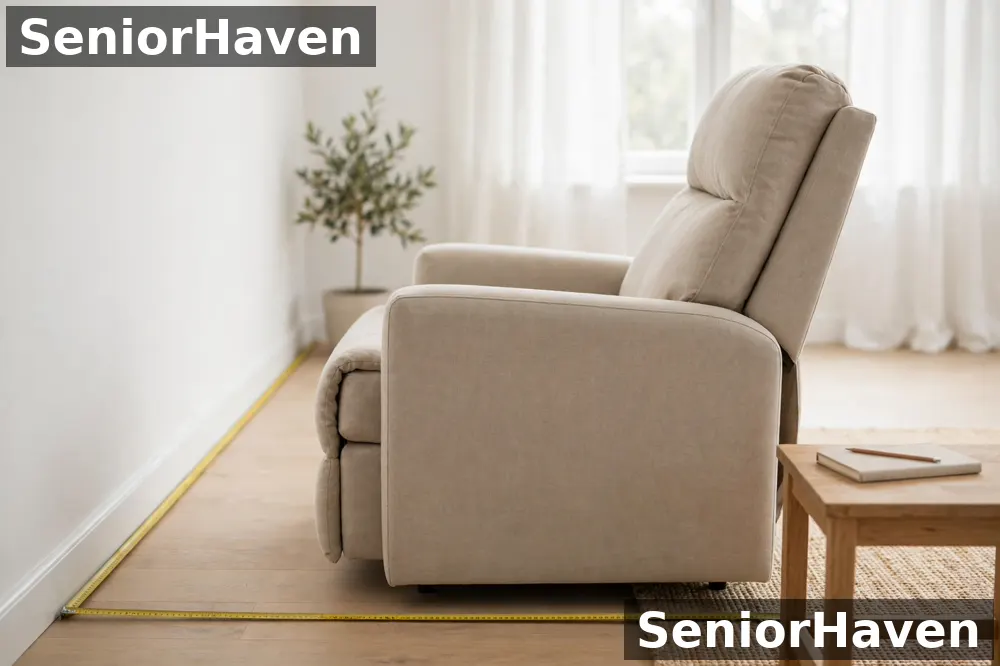
For smaller-framed users, the size ladder matters most: the Comforter PR531 comes in petite and small sizes, and Pride's small sizes suit users 5 feet 3 inches and under. Search Amazon.ca for small lift chairs for petite seniors and compare the specification sheets, not the photographs.
Small rooms and wall clearance: the numbers by model
Lift chairs need space behind them for the back to recline, and in front for the footrest to extend. The numbers by model:
| Model | Distance from wall, reclined | What it means in a small room |
|---|---|---|
| Pride VivaLift Metro 2 | 14 inches | Workable in most living rooms; still needs a measured gap |
| Golden Comforter PR531 | 16–21 inches by size | Larger sizes need more room; smallest need the least |
| Golden Comforter PR535 (large) | 25 inches | Needs a full two feet behind it — measure first |
| Pride Wall Hugger (older model) | About 4 inches | True wall-hugger design, older two-position model; availability unverified |
| Standard three-position chairs | 12–18 inches (guide range) | The usual case; confirm on the specification sheet |
"Wall-hugger" is used loosely in listings. A true wall-hugger slides forward on its base as it reclines, so the back stays close to the wall. Pride's older Wall Hugger model, listed by a Canadian dealer as needing only 4 inches, is a two-position chair, and we could not verify current Canadian availability or pricing for it on 31 October 2026. Do not assume a chair is a wall-hugger because a listing uses the words. The Comforter PR531 is explicitly not a wall-hugger, per a dealer guide. The test: the specification sheet must state a "distance required from wall, reclined" figure. If it does not, the seller has not answered the question.
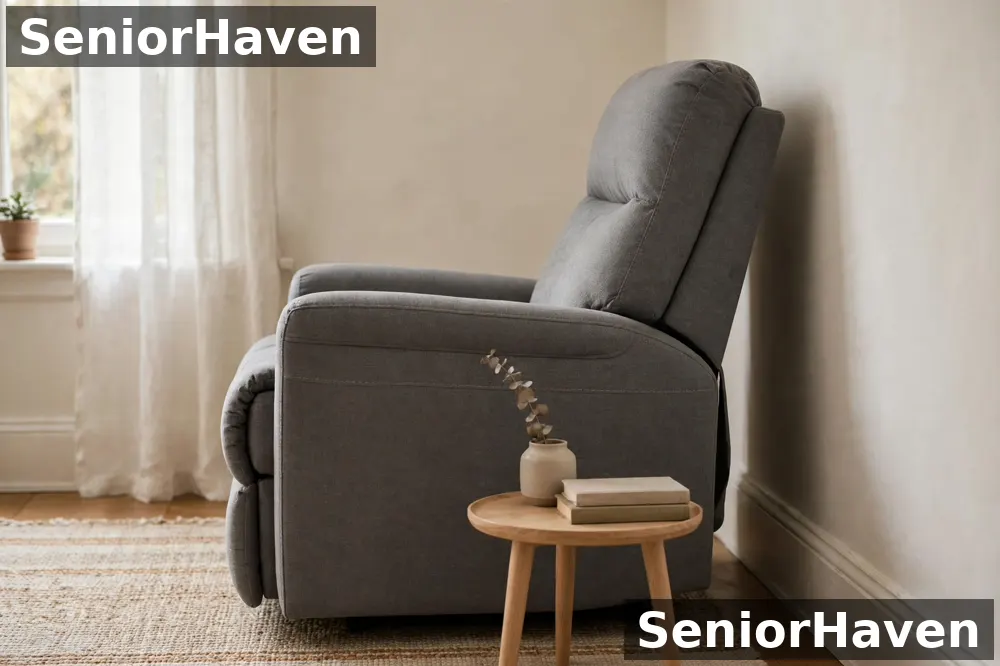
Front clearance matters just as much. When fully reclined, the Comforter's extension runs 40 to 47 inches by size. Measure the reclined footprint with painter's tape before the chair arrives — back of the chair to the tip of the footrest, plus the lift arc — and check the walkway beside it. A chair blocking the bathroom path at night has traded one hazard for another. Check the delivery route (doorways, turns, removable back), the outlet (standard 120-volt, nearby, no long cord across a walkway), and the floor (thick carpet can make the lift feel less steady).
The picks, in detail: Canadian prices checked 31 October 2026
Each pick names the seller and price seen on 31 October 2026. Delivery, setup, taxes, and fabric upgrades are usually extra, so confirm the delivered total in writing. Where two sellers showed different prices, both are given — that is the market, not an error.
Golden Technologies Comforter PR531 — the best all-round fit
About $2,599 at Shop Brant Arts (Ontario), in stock. Its strength is sizing: seven sizes, rated 375 lbs in most sizes and 500 lbs in the wide sizes, per Golden Technologies Canada's specification sheet. Three-position, pocketed-coil seat, fully padded chaise, two-button control, USB port. Wall distance reclined: 16 inches (smallest) to 21 inches (tall). Warranty: lifetime on frame, lift frame, and recline mechanism; three years on electrical parts. Heat and massage are an option; a footrest extension is offered for taller users. Limits: not a wall-hugger, back and legs move together, no independent headrest or lumbar. For daily sitting and napping, this is the first chair to try. Search Amazon.ca for Golden Comforter lift chairs and compare with the dealer price.
Pride Evolution LC-435 — the best value three-position chair
About $1,549 at Healthcare Solutions (Edmonton); Living Well (Ontario) lists Pride chairs from $1,279.20 (Genesis line) and $1,599.20 to $3,039.20 across its Pride range. Three-position, from Pride's Sitting Pretty line, in small through extra-extra-large sizes, with a seven-year pro-rated warranty and lifetime cover on the lift mechanism, shell, and recline mechanism except on the largest size. Confirm capacity and seat width for the size chosen — one dealer's table lists up to 400 lbs with seat widths of 18 to 22 inches. Limit: one motor, back and legs together, no flat sleeping position. Search Amazon.ca for Pride Evolution lift chairs. Closest alternative: the Pride Genesis LC-150, about $1,499 at Med Supplies in Edmonton and from $1,279.20 at Living Well.
Pride VivaLift Metro 2 PLR-925 — the best infinite-position value
About $1,967.27 at Westin Healthcare (Brampton/GTA), in stock, and $1,695.00 at MobilEase Mobility (Vaughan) — get two quotes. Pride's current medium infinite-position chair: 21-by-21-inch seat, 19-inch seat-to-floor height, 400-lb capacity, 14-inch wall distance, footrest extension, Total Comfort seat, lithium battery backup, seven-year pro-rated warranty, per the dealer's specification table. Includes power headrest and lumbar; no heat or massage. Limits: one size only, and a multi-button remote. Search Amazon.ca for Pride VivaLift Metro lift chairs.
Pride VivaLift Tranquil 2 PLR-935 — for sleeping and long days
About $1,799 at Healthcare Solutions (Edmonton). Second-generation Tranquil: four sizes, nine fabrics, waterfall back, Total Comfort seat, memory hand control saving preferred positions, ranging from upward lift to lay-flat including feet-above-heart positions, per the dealer. Delivery on select sizes/colours: two to four weeks. The trade: memory positions help someone who sleeps in the chair; they add learning for someone wanting two buttons. With memory difficulties, a simpler lockable two-button chair may be kinder — see the remote section. Search Amazon.ca for Pride VivaLift Tranquil lift chairs.
Pride VivaLift Ultra PLR-4955 — heat, massage, and everything else
About $4,249.00 at Healthcare Solutions (Edmonton) and $5,199.00 at Aspen Healthcare for the large size — the gap reflects size and fabric, so name the size in any quote. Top of the VivaLift range: three sizes, seven fabrics, three heating pads, air-bladder massage, and VivaLift Tilt, raising the seat front as the chair reclines so knees finish above heart level. Capacity 400 lbs. Per the dealer, the only VivaLift chair combining tilt, heat, and massage. Worth the premium only for someone seated most of the day who will use the full range daily; for help standing up alone, it adds confusion without adding safety. Search Amazon.ca for Pride VivaLift Ultra lift chairs.
La-Z-Boy lift recliners — the furniture-store route
From about $1,899 at La-Z-Boy dealers in Ottawa, Gatineau, and Kingston, per the dealer's cost guide, with the Astor lift recliner from about $3,539. Tiers run Bronze to Platinum, with heat, massage, lumbar, and zero-gravity in the higher tiers, and capacities from 265 lbs to 700 lbs; Bronze is for smaller users at 300 lbs. The appeal: in-store fitting, furniture look, white-glove delivery. The caution: La-Z-Boy also sells power recliners that do not lift — confirm the model has a lift mechanism, and confirm the delivered price with upgrades, since the headrest and lumbar upgrade alone costs about $2,000, per the dealer's table. Search Amazon.ca for La-Z-Boy lift recliner chairs.
Budget online lift chairs — honest about what they are
About $499.99 for the HOMCOM power lift chair on Amazon.ca (264-lb / 120-kg capacity, recline to 150 degrees) and $899.00 for a BEDHOURS power lift recliner with massage and heat (350-lb capacity, 23-inch seat, recline to 160 degrees), both seen on 31 October 2026. A Giantex model (8-point massage, lumbar heat, 330 lbs) was also listed, with no featured offer or price shown. These serve a real need — tight budget, short-term post-surgery use, second chair — but the risks are plain: lower ratings, lighter frames, and a marketplace importer, not a Canadian dealer, so service and parts depend on the listing's terms and on shipping a heavy chair back. If it is the only affordable option, choose a rating well above the user's weight, confirm returns first, and test lift and backup on arrival day. Search Amazon.ca for power lift recliner chairs with massage and heat.
Heat and Massage: Comfort Features, Not Treatment

Heat and massage are comfort features. They do not treat arthritis, back pain, or circulation problems, and no seller's claim should be read that way. Retailers describe the benefit in plain terms: warmth and vibration help relieve tension and support relaxation while seated. That is the whole claim, and it is enough — for someone who sits in the chair for hours daily and finds warmth soothing, heat and massage can make the chair genuinely more comfortable. For someone who mainly needs help standing, they add cost and buttons without adding safety.
Two practical points. First, heat with reduced sensation needs care: people with diabetes, neuropathy, or poor circulation may not feel heat reliably, so ask a clinician first, start on the lowest setting, and never sleep with heat on high. Second, massage in a lift chair is vibration or air bladders, not hands — pleasant pressure and movement, not therapy. If heat or massage is wanted, try it in the showroom for ten minutes, not thirty seconds, and confirm the controls are simple enough to use without help. Heat and massage are usually an option adding a few hundred dollars; on the VivaLift Ultra they are standard. They are worth it only if they will be used daily.
Fabric, Stain Resistance, and Care
Fabric choice is a daily-life decision, not a decoration decision. A chair used all day, by someone who eats, drinks, or naps in it, needs fabric that wipes clean and resists stains. Golden's Sofflex material is described by the manufacturer as stain-resistant and easy to clean; Pride's SensaTex is described as stain-resistant and durable. Ask for the actual cleaning instructions for the fabric chosen — what can be blotted, what needs a cleaner, what voids the warranty — and keep them with the invoice.
Pets and fabric: claws and upholstery are an old argument. Tightly woven, low-pile fabrics resist snagging better than loose weaves; a washable throw or lift chair cover protects the arms and seat where claws land. Colour matters more than people expect: a very light chair shows every mark, a very dark one shows lint and pet hair. A mid-tone, patterned fabric hides daily life best. Ask whether the fabric is removable for cleaning, and whether replacement covers are sold — on a chair kept for a decade, a replaceable cover is worth more than a fashionable colour.
Remote Controls: Simpler Is Usually Better
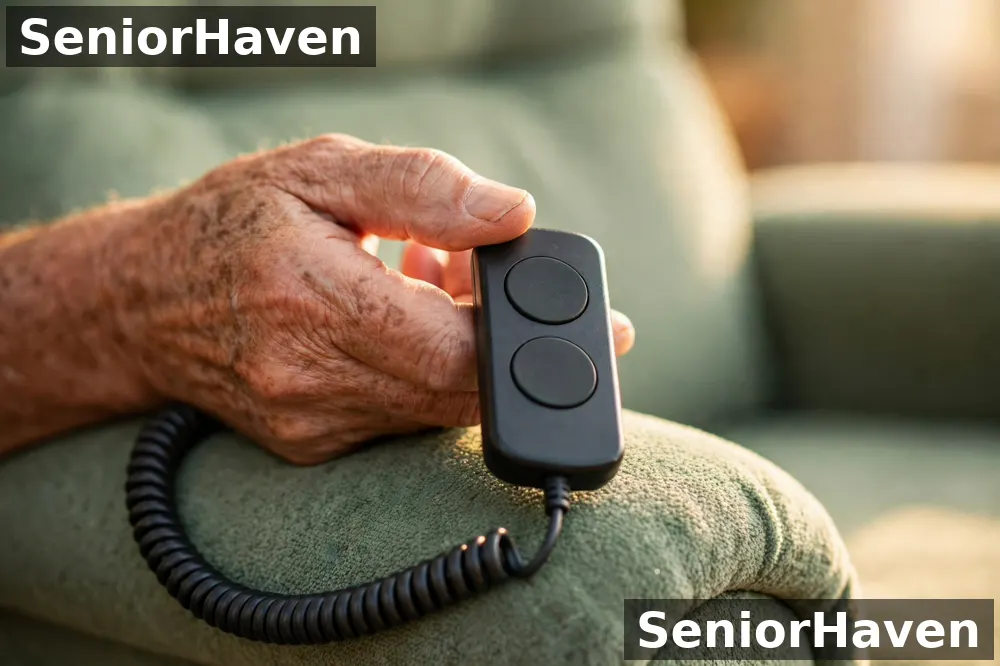
The remote is used every time the chair moves, so it deserves the same attention as the seat. Two-button controls — up and down — suit most users: one motion, no menus, nothing to learn. They come standard on three-position chairs such as the Comforter PR531. Multi-button remotes on infinite-position chairs add independent back, leg, headrest, and lumbar controls, plus memory positions on models like the Tranquil 2. That flexibility is real, and so is the learning curve: more buttons mean more chances to press the wrong one, especially at night or with reduced vision or dexterity.
Three features are worth asking about. First, large, raised, tactile buttons that can be found by touch. Second, a lockable control — Pride's Sitting Pretty line offers a lockable hand control — which prevents accidental movement, a real concern with dementia or curious grandchildren. Third, the cord: a corded remote stays with the chair and cannot be lost down the side; cordless remotes exist but add batteries to manage and a remote to lose. In the showroom, hand the remote to the person who will use it and ask them to raise the chair, recline it, and return it upright without help. If that takes coaching, the chair is too complicated.
What lift chairs really cost in Canada
The sticker price is rarely the whole cost. Delivery, setup, taxes, fabric upgrades, and warranty terms move the total by hundreds of dollars. The table below uses the Canadian guide ranges read on 31 October 2026 as a budgeting frame — not a quote. Get the delivered total in writing, for the exact size and fabric, before paying anything.
| Band | Typical price (CAD) | What is usually included | Watch out for |
|---|---|---|---|
| Budget online | About $500–$899 | Chair only; self-assembly; marketplace returns | Low weight rating; service uncertain |
| Three-position, dealer | About $990–$1,500 | Chair; dealer advice; manufacturer warranty | Delivery and setup often extra |
| Infinite-position, dealer | About $1,450–$4,400 | More positioning; power headrest/lumbar on many | Price varies most by size and fabric |
| Premium / heat and massage | About $3,000–$5,200 | Full positioning; heat; massage; premium fabrics | Confirm heat/massage included, not extras |
| Heavy-duty | About $2,300–$3,000 | Wider seat; rating up to 600 lbs | More floor space; confirm rating per size |
Delivery and warranty are part of the price. A lift chair is heavy — about 125 lbs (Comforter), 142 lbs (Metro 2) — and "free shipping" rarely means carried upstairs, assembled, and tested. Ask in writing who carries it in, assembles it, removes packaging, demonstrates lift and backup, and what happens if it does not fit or work on arrival. Warranties vary: Pride VivaLift, seven-year pro-rated; Golden Comforter, lifetime frame/mechanism with three years electrical; La-Z-Boy, limited lifetime on frame, springs, and mechanisms. Ask: parts only or parts and labour, in-home or depot, who pays for a visit, parts lead times, what voids it. Returns: some dealers state lift chairs are non-returnable once ordered, especially custom fabrics — ask days, shipping payer, and restocking fee before ordering. If it cannot be returned, try it first.
Funding and tax: the honest Canadian answers
This is where most buying guides go vague, and vagueness costs the most money. The summary is short: do not buy a lift chair expecting Ontario's Assistive Devices Program or Alberta's Aids to Daily Living program to pay for it, and do not expect a tax exemption without the right document in hand. What follows is what the program pages and the tax memorandum actually say, read on 31 October 2026. Programs change; the program's own page and staff are the final word — not a seller, and not this guide.
Ontario: ADP does not fund lift chairs. The Assistive Devices Program lists funded categories on ontario.ca — including wheelchairs and mobility aids, hearing devices, and prostheses — with no lift-chair or recliner category. A 2026 Ontario funding guide states the exclusion directly: ADP excludes recliner chairs, stair lifts, ramps, transport chairs, grab bars, and hospital beds, among others. A seller suggesting ADP cover should be asked to show the ADP category and registered-vendor process in writing before ordering; if they cannot, it is a private purchase. The Home and Vehicle Modification Program (March of Dimes Canada) funds home modifications under its own rules; it is not a lift-chair benefit either.
Alberta: no AADL lift-chair benefit was evidenced. Aids to Daily Living helps Albertans with long-term disability, chronic illness, or terminal illness pay for basic medical equipment through assessment and approved vendors, with a general cost-share of 25 percent to a $500 yearly maximum per individual or family. Its manual sections cover hearing aids, footwear, bathing aids, communication benefits, mattress overlays, pediatric equipment, beds and lifters, wheelchairs, respiratory equipment, seating accessories, and walking aids — no lift-chair or recliner section. "Beds, lifters" covers patient lifters, not lift recliners. AADL does not reimburse equipment bought before assessment and authorisation. Get an authorizer's assessment with the chair named before buying. Alberta's RAMP and SHARP fund home modifications, not lift-chair purchases.
Other routes: check the program, not the advertisement. Veterans Affairs Canada may cover lift chairs for eligible veterans — contact a case manager. Private and extended health plans sometimes offer partial reimbursement for a prescribed chair; coverage varies greatly, and the insurer must be asked before purchase, with prescription and exact model named. Workplace or motor-vehicle insurance may apply where the need results from a covered injury. In every case the sequence is the same: assessment and written approval first, purchase second. A seller asking for payment first and promising reimbursement later is asking the buyer to carry the risk.
Tax: the GST/HST position is real but conditional. The Canada Revenue Agency's GST/HST Memorandum 4.2 lists as zero-rated a chair "specially designed for use by an individual with a disability," including motive power. Retailers describe the practical route consistently: a written order or prescription from a physician, nurse practitioner, or occupational therapist at the time of sale can mean zero-rating — saving 5 to 15 percent by province — with a rebate route using CRA Form GST189 where tax was paid. A La-Z-Boy dealer guide states the same, including delivery and warranty charges. Three cautions: the "specially designed" test may exclude an ordinary recliner with a comfort power feature; the written order must name the individual and the need; Quebec QST has its own lists — confirm separately. Ask the seller to confirm zero-rating in writing before paying. Medical Expense and Home Accessibility Tax Credit questions belong to a tax professional.
The practical sequence: get assessed and get the need and chair type in writing; ask the program or insurer, with that document, whether anything is covered, and get the answer in writing; ask the seller to apply any tax treatment at the point of sale on the written order; only then order. Anyone reversing that sequence is asking the buyer to hope. Hope is not a funding program.
Where to buy in Canada: showroom, dealer, or online
Mobility dealers — Vital Mobility (GTA), Healthcare Solutions (Edmonton), Living Well (Bowmanville, Cobourg, Peterborough), Westin Healthcare (Brampton), Mobility 1st, and others across Canada — carry Pride and Golden chairs with fitting advice, delivery, setup, and service. Their prices exceed the cheapest online listing; their value is the fitting, demonstration, and service. For a first chair, complex needs, or uncertain self-measurement, a dealer is the right first call — phone ahead to confirm the model and size are on the floor. Furniture stores (La-Z-Boy and others) add in-store fitting, fabric choice, and white-glove delivery; bring the five measurements, ask for the specification sheet, and confirm the model is a lift recliner, not a power recliner.
Online sellers — Amazon.ca, Wayfair.ca, and brand websites — suit buyers who know the model and size, or who accept the fitting risk knowingly for a lower price. Check the seller (manufacturer, dealer, or marketplace importer), the return terms, and whether the listing is the Canadian model with a Canadian warranty. A US listing shipped across the border can mean duty, different electrical certification, and no local service. Confirm the delivered total, in Canadian dollars, before paying.
Delivery, Setup, and the First Week
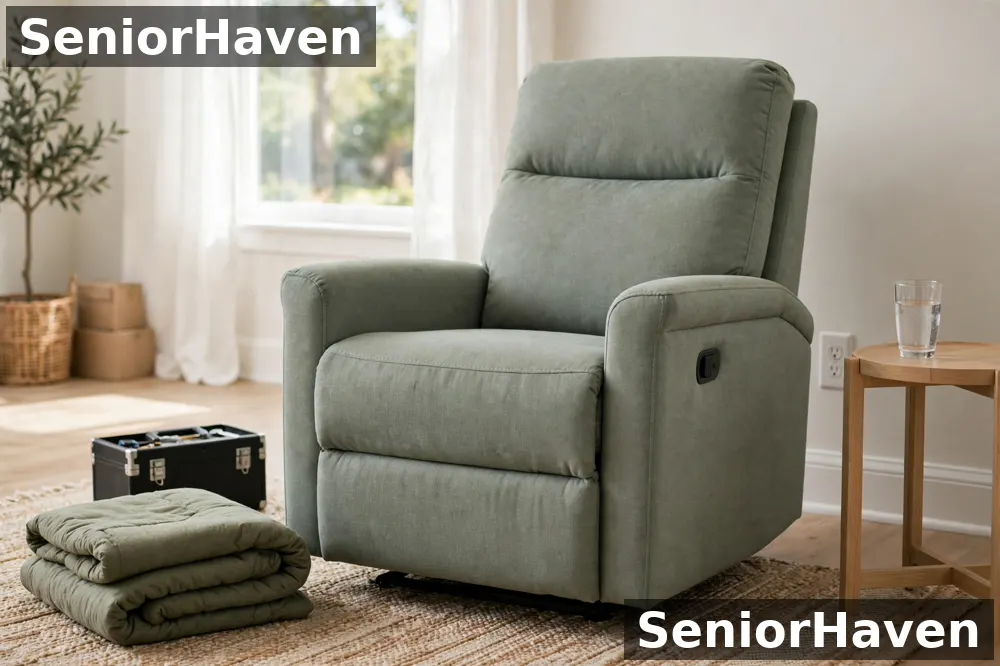
A lift chair is heavy — about 125 lbs for the Comforter, 142 lbs for the Metro 2 — and "free shipping" rarely means carried upstairs, assembled, and tested. Vital Mobility's Toronto-area service, for a fee, includes room-of-choice delivery, assembly, packaging removal, and a demonstration; Canada-wide shipping runs one to four weeks for in-stock models. Ask in writing who carries it in, assembles it, removes packaging, demonstrates lift and backup, and what happens if it does not fit or work on arrival. Returns: some dealers state lift chairs are non-returnable once ordered, especially custom fabrics — ask days, shipping payer, and restocking fee before ordering. If it cannot be returned, try it first.
On delivery day, run the chair through its full range twice, test battery backup by unplugging, check every control, and confirm the reclined footprint clears furniture and walkways. During the first week, judge the chair on real routines: sitting down, standing up, eating, reading, napping, and getting up at night. Feet should rest flat, the back should feel supported without a gap at the lower back, and standing should feel controlled, not launched. If something feels wrong in the first week, call the seller while return and warranty options are open — not in month three.
Five Mistakes to Avoid
- Buying on price alone. A $500 chair and a $2,600 chair can look identical online. The difference is the motor, frame, sizing range, warranty, and service. Price is the last comparison, not the first.
- Guessing the size. "Medium" is not a measurement. Seat height, width, depth, back height, and weight capacity must match the person. A chair two inches too deep leaves feet dangling; two inches too high leaves knees above hips.
- Trusting the listing's wall clearance. "Fits small rooms" is not a number. Get the reclined distance-from-wall figure from the specification sheet, and measure the room.
- Assuming funding or tax treatment. ADP and AADL do not fund lift chairs on the evidence read here, and GST/HST zero-rating needs a written order. Confirm both in writing before paying.
- Skipping the delivery-day test. Run the full lift range, test battery backup by unplugging, and check every control on arrival day — while return and warranty options are still open.
Questions to Ask Before You Pay
Ask these of any seller, dealer or online, and keep the answers with the invoice. A seller who answers clearly is a good sign; a seller who waves questions away is information too.
- What is the seat height, width, depth, and back height for the exact size quoted, and the weight capacity?
- What is the distance required from the wall when fully reclined, and the full reclined footprint?
- Is this a power lift recliner with a lift mechanism — not an ordinary power recliner?
- What does the delivered total include: delivery, assembly, setup, packaging removal, demonstration?
- What battery backup does it have, and how is it tested?
- What does the warranty cover — parts, labour, in-home service — and for how long, for each part?
- Can it be returned, within how many days, who pays shipping, and is there a restocking fee?
- Is GST/HST zero-rating available with a written order, and will the seller confirm it in writing?
- Who provides local service and parts, and how long do common parts take?
- Is the fabric stain-resistant, what are the cleaning instructions, and are replacement covers sold?
The verdict
Our verdict, at the bottom as at the top: measure the person and the room, then buy the simplest chair that fits both. For most Canadian seniors, that is the Golden Comforter PR531 at about $2,599 or the Pride Evolution LC-435 at about $1,549, in the right size, with a two-button control. For long days, naps, or sleeping, the VivaLift Metro 2 at about $1,695 to $1,967 or the Tranquil 2 at about $1,799 earns its extra cost. The VivaLift Ultra at about $4,249 to $5,199 is for buyers who will genuinely use its heat, massage, and positioning daily. La-Z-Boy lift recliners, from about $1,899, suit buyers wanting furniture-store fitting. Budget online chairs at about $500 to $899 are a calculated compromise: acceptable short-term or as a second chair, risky as a sole long-term chair. Do not expect ADP or AADL to pay, and do not expect a tax exemption without a written order. Test lift, remote, and backup on delivery day, and judge the chair after a week of real routines. The goal is not a chair. It is standing up safely, sitting comfortably, and staying in the room where life happens.
General information only — not medical advice. If standing or sitting is becoming unsafe, or if there is new weakness, pain, dizziness, numbness, or a recent fall, seek assessment from a doctor, occupational therapist, or physiotherapist before buying. Prices, program rules, and lineups change; the retailer's and the program's own pages are the final word. Prices in this guide were seen on live Canadian pages on 31 October 2026.
Frequently asked questions
- What is the best lift chair in Canada for seniors?
- The chair that fits the person using it. For most seniors, a three-position chair in the right size: the Golden Comforter PR531 (about $2,599) or the Pride Evolution LC-435 (about $1,549), seen at Canadian retailers on 31 October 2026. For long days, naps, or sleeping in the chair, an infinite-position chair such as the Pride VivaLift Metro 2 (about $1,695 to $1,967) or Tranquil 2 (about $1,799). Measure seat height, width, depth, back height, and weight capacity first.
- How much does a lift chair cost in Canada?
- Three-position chairs run about $990 to $1,500 and infinite-position chairs about $1,450 to $4,400 at Canadian mobility retailers, per Vital Mobility's 2026 guide; heavy-duty models run about $2,300 to $3,000. Named models seen on 31 October 2026: Evolution LC-435 about $1,549, VivaLift Metro 2 about $1,695 to $1,967, Comforter PR531 about $2,599, VivaLift Ultra about $4,249 to $5,199. Budget online chairs run about $500 to $899. Canadian dollars; delivery, setup, and taxes usually extra.
- Does OHIP or Ontario's ADP pay for a lift chair?
- No, on the evidence read on 31 October 2026. OHIP does not cover lift chairs. Ontario's Assistive Devices Program funds listed device categories with no lift-chair or recliner category, and a 2026 Ontario funding guide states directly that ADP excludes recliner chairs. Do not buy expecting reimbursement. Ask any seller who says otherwise to show the ADP category and registered-vendor process in writing before ordering.
- Does Alberta's AADL cover lift chairs?
- No lift-chair benefit was evidenced in the AADL manual sections read on 31 October 2026. The sections cover hearing aids, footwear, bathing aids, communication benefits, mattress overlays, pediatric equipment, beds and lifters, wheelchairs, respiratory equipment, seating accessories, and walking aids — no lift-chair or recliner section. Beds and lifters covers patient lifters, different equipment. Get an AADL authorizer's assessment before buying.
- Can I buy a lift chair GST/HST-free in Canada?
- Possibly, with the right document. The Canada Revenue Agency's GST/HST Memorandum 4.2 lists as zero-rated a chair specially designed for use by an individual with a disability. Retailers describe the route as a written order or prescription from a physician, nurse practitioner, or occupational therapist at the time of sale, with a rebate route using CRA Form GST189 where tax was paid. Ask the seller to confirm zero-rating in writing; confirm Quebec QST separately.
- What size lift chair do I need?
- Match five measurements to the specification sheet for the exact size: seat height (floor to knee bend, feet flat), seat width (hips plus 2 to 4 inches), seat depth (lower back to back of knee), back height (seat to shoulders or head), and weight capacity with a buffer above the user's weight. Use the manufacturer's size ladder. Between sizes, prioritise seat height and depth. A showroom fitting or an occupational therapist's measurement settles it.
- How much wall clearance does a lift chair need?
- From about 4 inches to 25 inches, by model. The Pride VivaLift Metro 2 needs 14 inches, the Golden Comforter PR531 needs 16 to 21 inches by size, and the Comforter PR535 large needs 25 inches. A true wall-hugger slides forward as it reclines; Pride's older Wall Hugger needed about 4 inches, but current Canadian availability could not be verified on 31 October 2026. Trust only a distance-required-from-wall figure on the specification sheet.
- Can you sleep in a lift chair?
- Infinite-position chairs are designed for extended use including sleeping, going fully flat with independent back and leg control. Three-position chairs recline to a napping position, not flat, and are less comfortable overnight. Regular sleeping in a chair should be discussed with a doctor or occupational therapist, especially where breathing, circulation, skin, or pressure care is a concern. A chair is not a hospital bed.
- Are heat and massage features worth it, and do they treat pain?
- They are comfort features, not treatment. Retailers describe warmth and vibration as helping relieve tension and support relaxation, but no lift chair treats arthritis, back pain, or circulation problems. They are worth the cost only if used daily with controls simple enough to operate. With reduced sensation, ask a clinician first, start on the lowest heat, and never sleep with heat on high.
- What weight capacity do I need in a lift chair?
- A rating comfortably above the user's weight. Standard chairs support up to 300 to 375 lbs and heavy-duty models up to 600 lbs, per Vital Mobility. The Comforter is rated 375 lbs in most sizes and 500 lbs in wide sizes; the VivaLift Ultra and Metro 2 are rated 400 lbs; budget online chairs can be as low as 264 lbs. Operating at or beyond the rating affects safety and motor life. Near the rating, go up a class.
- Do lift chairs work in a power outage?
- Quality chairs include battery backup returning the chair to upright, but the type varies: rechargeable lithium batteries built in, or standard 9-volt batteries that must be kept fresh. Dead backup batteries equal no backup. Test it on delivery day by unplugging and returning to upright, and retest every few months. Never buy a lift chair without battery backup.
- Should I buy a lift chair online or try one in a store?
- Try one in a store for a first purchase, complex needs, or uncertain fit — a showroom lets the user sit, run the lift, try the remote, and compare sizes. Online buying suits someone who already knows the model and size, or a tight budget accepted knowingly. Wherever you buy, get the delivered total, return terms, and warranty in writing, and confirm the model is a power lift recliner, not an ordinary power recliner.
- Does Costco Canada sell lift chairs?
- No Costco.ca lift-chair listing was verified in the check for this guide on 31 October 2026, and none is claimed. Costco Canada sells recliners and furniture that change seasonally, but no lift-chair model, price, or specification from costco.ca was verified. Call the warehouse and ask specifically for a power lift recliner with a lift mechanism before visiting. No Sleep Country lift-chair range was evidenced either.
- Can a lift chair help after hip or knee surgery?
- Lift chairs are commonly used in recovery because the powered lift reduces strain on healing joints, but whether one is appropriate, and when, is for the surgeon or physiotherapist — not a buying guide. Ask the care team about timing, weight-bearing limits, seat height, and how long it is needed. For a short recovery, ask a mobility dealer about renting. Do not assume surgery guarantees funding or tax treatment.
- How long does a lift chair last, and what does the warranty cover?
- With proper care, 7 to 10 years for mechanism and motor, per Vital Mobility, with upholstery needing attention sooner. Pride VivaLift models carry a seven-year pro-rated warranty in dealer listings; Golden's Comforter carries lifetime frame and mechanism cover with three years on electrical parts. Confirm in writing what is covered — parts, labour, in-home service — for each part, who provides local service, and what voids the warranty.