
Best Ice Grips for Shoes for Seniors in the UK: 12 Honest Picks for Winter Walking
Most ice-grip lists are written for hikers, runners, or American shoppers. This guide is the UK senior version: grips that fit the boots you own, go on with stiff hands, come off before a tiled floor, and can be bought from a UK stockist in pounds — at prices seen on 31 October 2026.
Affiliate disclosure: As an Amazon Associate I earn from qualifying purchases. The picks come from research into grip types, fit systems, and senior walking needs — availability changes, so check the current listing before you buy. It costs you nothing extra and keeps this site free. Read our affiliate disclosure.

No ice grip makes ice safe. A good grip gives your boot something to bite with on the ground most British winters produce — a thin glaze after frost, packed snow on a side street, the polished patch that looks wet and is not. The wrong grip, or the right grip in the wrong size, gives false confidence and a heavier boot.
The short version: for everyday pavements, a light coil grip is the easiest start. For the worst of winter — glazed frost, black ice, any slope — a full-foot chain grip with diamond beads or steel spikes is stronger. For hill paths and country walks, short steel spikes are a different purchase from a pavement grip. Below: which is which, UK prices, and fitting.
The short answer
If you only buy one pair, buy a full-foot grip from a known brand in the right UK size, and learn the indoor rule before the first frost. A wrong-size grip twists off, a hiking spike feels dreadful on a cleared pavement, and a coil grip perfect for frost is out of its depth on black ice.
Our verdict, up front: the Yaktrax Diamond Grip is the best all-rounder for most UK seniors — it copes with pavements, packed snow, and mixed winter surfaces, sold by UK stockists in UK sizes, price verified at two of them on 31 October 2026. For almost entirely flat pavements, the Yaktrax Walk is the simpler buy. For hills, country paths, or ungritted lanes, step up to short steel spikes such as the Kahtoola MICROspikes.
One more honest note before the detail. We did not test these products on ice ourselves. We read the live UK retailer and brand pages, the test guides, and the manufacturer specifications, and say which claim comes from where. Where a price could not be verified live at a UK stockist, we say so. Treat every price as seen on 31 October 2026 and check before you buy.
The 60-second pavement test
Do this test at home before trusting any grip on a real street. It takes a minute, needs no ice, and catches most sizing mistakes while you can still return the pair.
- Fit them seated. Seated, put the grips on the boots you will walk in, and check toe and heel markers sit the right way round. The grip should sit flat under the sole, the band on the footprint's edge, not riding over the toe or past the heel.
- Stand and walk indoors — carefully, on carpet. Take ten slow steps on carpet. The grip should stay centred and silent. If it twists, creeps, or bunches under your arch, the size or band shape is wrong.
- Take them off standing, holding furniture. Practise removing them holding a worktop or door frame, as at a shop doorway. If removal needs two hands, a hard pull, and full strength, it will be worse with cold hands in January.
- Walk the hall in socks after removal. This is the indoor rule in miniature: grips off at the door, every time, before tile, laminate, or polished wood. If your routine cannot include that step, choose a grip you can remove in seconds.
If a pair fails any step, re-size first: measure the boot, not your foot, and check the chart for that exact model. A grip that fails twice is the wrong grip for that boot. Return it clean and unused, if the seller allows it.
Who this guide is for — and who should skip it
This guide is for older walkers in the UK who go out on foot through winter: the daily walk, the shops, the bus stop, the dog, the school gate. It is written for people in ordinary walking boots, wellingtons, or sturdy shoes, who may have arthritis or weaker hands, and who want to keep walking rather than stay indoors for three months. It assumes pavements and country lanes — not mountains.
It is also for the family member buying the pair: buy one you can fit for them, watch the 60-second test, and leave the grips with the boots by the door, pouch included.
Who should skip this guide: Anyone walking steep, snowy hills or mountains needs proper mountaineering crampons fitted by an outdoor shop, not slip-on grips. Anyone told by a doctor or physiotherapist not to walk on icy surfaces should follow that advice first. And anyone who only walks indoors, or in a climate without frost, does not need ice grips — a good non-slip sole and a walking stick with a sound ferrule are the better spend. A stick with a worn ferrule is a slip waiting to happen: Mark's Mobility lists a Drive Medical walking-stick ice grip at £9.99 for 19–22 mm ferrules. That is a stick accessory, not a shoe grip — sort the ferrule first.
The 12 picks at a glance
The table is the comparison UK retailer pages never give: grip type, what is underfoot, weight, UK sizing, and the price we saw, side by side. Weights are per pair as stated by the retailer or brand page. Prices are as seen on 31 October 2026 at the stockist named, or marked indicative where no live UK price could be verified — check before buying.
| Pick | Grip type | Underfoot | Weight (pair) | UK sizes | Price seen | Best for |
|---|---|---|---|---|---|---|
| Yaktrax Walk | Steel coils | 1.2 mm zinc-coated coils, 360° | About 100–130 g | XS–L (check chart) | About £10–£19 (indicative) | Flat pavements, everyday frost |
| Yaktrax Diamond Grip | Chain + diamond beads | Case-hardened steel beads on steel cable | 360–390 g | S 5–7, M 7–9, L 9–11, XL 11+ | £33.90–£44.95 (verified) | All-round winter walking |
| Kahtoola MICROspikes | Chain + spikes | 8 mm steel spikes | 300–400 g | XS–XL | Check retailer | Hills, trails, country lanes |
| ICEGRIPPER Trek + Work | Chain + spikes | 13 spikes of 15 mm per foot | 460–590 g | S–XL | Check retailer | Rough ground, work use |
| SHEEFLY 19-spike | Chain + spikes | 19 steel spikes | About 420 g | S–XL (check chart) | About £16–£22 (indicative) | Budget chain grip |
| SHEEFLY 12-stud | Studs on frame | 12 steel studs | Not stated | S–XL (check chart) | About £16 (indicative) | Budget stud grip |
| Generic 10-stud grip | Studs on frame | 10 steel studs | Not stated | S–XL (check chart) | About £11 (indicative) | Cheapest first pair |
| Yaktrax Pro | Steel coils, heavy duty | 1.4 mm stainless-steel coils | Heavier than Walk | S–XL (check chart) | Check retailer | Longer, harder pavement use |
| Kahtoola EXOspikes | Chain + spikes | Low-profile spikes | Light | XS–XL | About £49.50 (indicative) | Light trails, running |
| Black Diamond Access Spike | Chain + spikes | 14 spikes (as reported) | Light | S–XL (check chart) | Check retailer | Trail walking |
| Hillsound Trail Crampon | Chain + spikes | Steel spikes, secure fit | Heavier | S–XL (check chart) | Check retailer | Secure-feeling trail grip |
| Portwest FC94 | Studs on rubber frame | Steel spikes | About 150–180 g | L UK 6–9, XL UK 10–12 only | £12.62 (verified) | Work boots, larger feet |
Two patterns matter: weight and aggression rise together — lightest kindest on cleared pavements and weakest on sheet ice; heaviest bite hardest and feel worst on bare tarmac. And every grip here is a slip-on device for ordinary footwear, not a crampon.
The 12 picks, in detail
Each pick says what it is, who it suits, what to watch for, and what we could and could not verify. Read the "watch for" line before you buy.
1. Yaktrax Walk — the simplest pavement grip
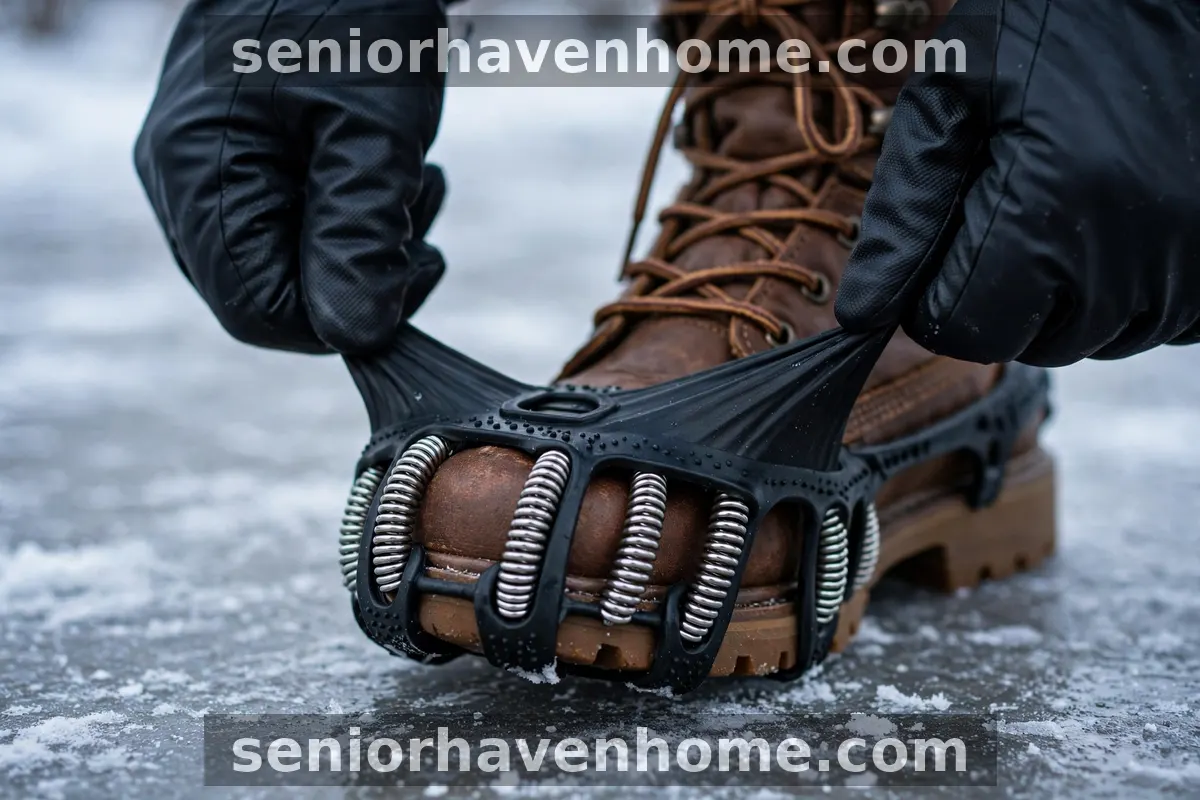
The Walk is the original coil grip: a stretchy rubber band over toe and heel, carrying 1.2 mm zinc-coated steel coils under the whole foot for grip in every direction. It is light — about 100 g small, 130 g the next size — and goes on and off in seconds with a heel tab, exactly what stiff hands need at a doorway. Yaktrax says the coils resist rust and the device is tested safe from breakage down to −41°F. Four sizes, XS to L, on US sizing — check the UK retailer's chart.
Who it suits: anyone walking mostly flat pavements, gritted roads, and short trips in frost or light snow — and anyone who has never worn a grip and wants the least fuss. Watch for: coils are the gentlest grip type. On polished black ice and steep slopes they are out of their depth, and some buyers report coils breaking after hard use — a one- or two-winter purchase; inspect often. No live UK price verified: Amazon UK showed no featured offer, and a £9.99 figure in search results was not confirmed on a live page. Budget around £10–£19.
Search Amazon.co.uk for Yaktrax Walk ice grips
2. Yaktrax Diamond Grip — the best all-rounder
The Diamond Grip is the pick this guide recommends most often. Instead of coils, it carries diamond-shaped beads of case-hardened steel on aircraft-grade steel cable, with a natural-rubber sling. The beads swivel independently, shedding snow instead of packing it underfoot, and tolerate mixed British surfaces — ice to slush to dry pavement and back — better than any spiked grip here. ICEGRIPPER calls it the most adaptable product in its winter-walking test, rates it 90 out of 100, and notes it can be left on across road patches, unlike pronounced spikes.
Specifications, from the live pages: UK sizes S (5–7), M (7–9), L (9–11), XL (11+) at ShoeInsoles.co.uk, choosing the smaller size at a boundary; 360–390 g per pair; zinc-coated steel chains and eyelets; no carry bag. Prices verified on 31 October 2026: £44.95 at ICEGRIPPER in all four sizes, in stock, and £33.90 at ShoeInsoles.co.uk — check both.
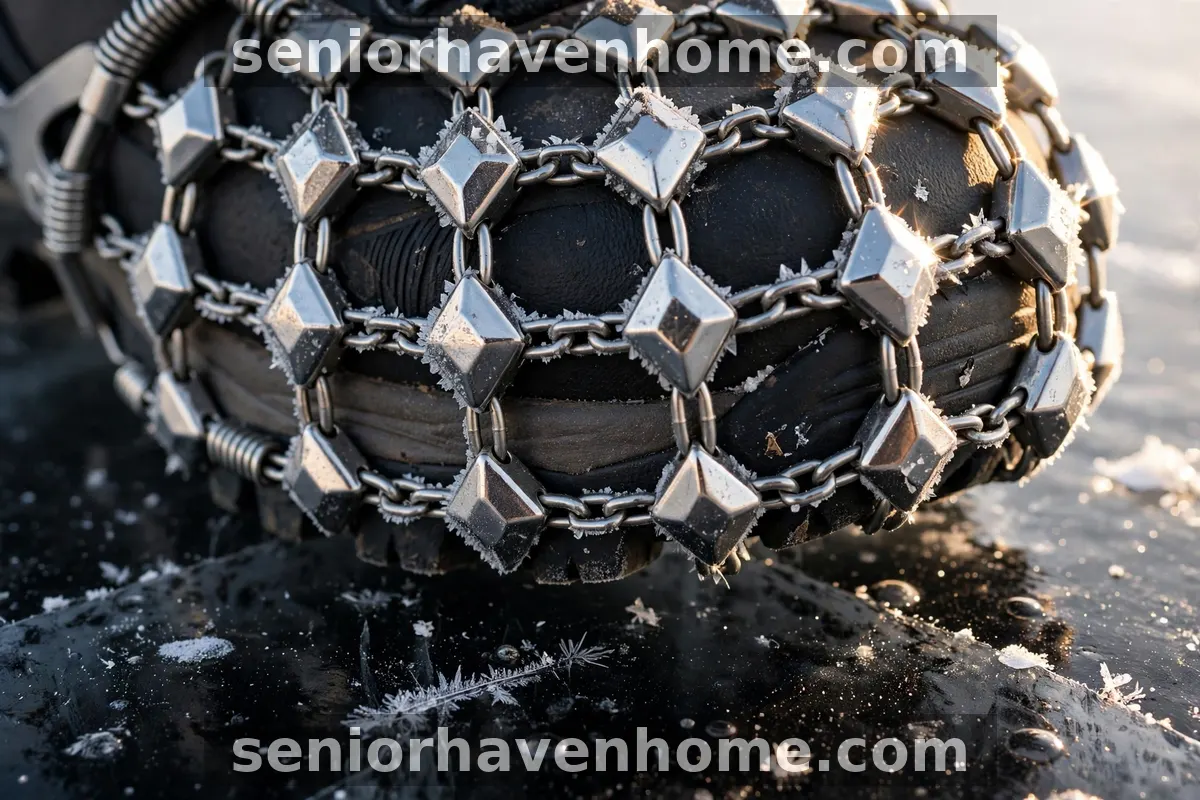
Who it suits: most UK seniors walking a mix of pavements, parks, and lanes, wanting one pair for the worst frost as well as the ordinary. Watch for: the beads are case-hardened steel, not stainless. ICEGRIPPER's test notes say they should not be left on wet boots long and benefit from WD-40 at the start and end of the season. Dry them after every use.
Search Amazon.co.uk for Yaktrax Diamond Grip ice grips
3. Kahtoola MICROspikes — the hill and trail step-up
The MICROspikes are the best-known name in this category: 8 mm steel spikes on a chain harness with a very flexible elastomer sling, and a two-year manufacturer's warranty. ICEGRIPPER's test rates them 95 out of 100, the highest in its comparison, with very good traction on ice, rock, snow, and scree, and a sling soft enough for trainers. Weight 300–400 g; sizes XS to XL.
Who it suits: walkers leaving the pavements — hills, moorland edges, country paths, ungritted lanes. Watch for: the spikes are pronounced, and ICEGRIPPER's test is blunt that they feel uncomfortable on dry road — designed for winter hill walking, not pavements. No live UK price verified; check ICEGRIPPER or Nevisport, and expect a premium over the Diamond Grip.
Search Amazon.co.uk for Kahtoola MICROspikes
4. ICEGRIPPER Trek + Work — the rough-ground workhorse
ICEGRIPPER's own Trek + Work is a micro crampon for outdoor workers in winter: 13 spikes of 15 mm per foot, an inox chain, a tight thermoplastic sling, a removable powder strap for deep snow. At 460–590 g it is the heaviest grip here and makes no concession to town use — ICEGRIPPER's test calls it the most uncomfortable of its products on a dry road, and not really suitable for trainers. It suits rough, snowy, icy, hilly ground: farm tracks, forestry paths, steep lanes, all-day outdoor work.
Who it suits: active walkers on rough country ground, and outdoor workers needing maximum bite — not a first pair for pavements. Watch for: weight, road discomfort, and fit — the tight sling suits boots better than soft shoes. An older 2022 ICEGRIPPER price (£35 on offer, normally £49.99) is not current; check the live listing.
Search Amazon.co.uk for microspike ice grips for boots
5. SHEEFLY 19-spike — the budget chain grip
SHEEFLY is the bestseller name on Amazon UK in this category: a chain grip with 19 steel spikes, in several sizes, with the maker's claim that the spikes will not rust. The 19-spike version is the most substantial budget chain grip, at around £16–£22 by size in the listings seen — far under the branded chain grips.
Who it suits: buyers wanting chain-and-spike grip at the lowest sensible price, accepting a shorter expected life. Watch for: budget grips vary more in quality than branded ones, and the price is indicative, from listings crawled months before this guide — check the current listing, read recent reviews for that exact size, and inspect chains and spikes on arrival. A loose spike or deformed link means return it unused.
Search Amazon.co.uk for SHEEFLY 19-spike ice cleats
6. SHEEFLY 12-stud — the budget stud grip
The 12-stud SHEEFLY is the stud-frame version of the same idea: twelve steel studs on a stretch frame, around £16 in the listings seen. Stud frames are simpler than chains — fewer moving parts, nothing to tangle — and a reasonable cheap option for flat, icy pavements.
Who it suits: flat-pavement walking on a tight budget, or a spare pair for second boots. Watch for: the same budget cautions as pick 5, plus the stud-frame weakness: central studs feel less stable on uneven ground than a full chain. Price indicative.
Search Amazon.co.uk for SHEEFLY 12-stud ice grips
7. Generic 10-stud grip — the cheapest first pair
Several unbranded makers sell a 10-stud grip on Amazon UK at around £11, the cheapest price in this guide's research. The design is the same stud-on-frame idea as pick 6 with two fewer studs — the lowest-cost way to answer: do grips help me, do I wear them, can I put them on?
Who it suits: a trial pair, or a second pair for occasional use. Watch for: quality control varies between makers and batches: buy from a listing with recent reviews for the exact size, inspect on arrival, expect to replace it sooner than a branded pair. Price indicative — never buy a pair whose listing hides the stud count or size chart.
Search Amazon.co.uk for 10-stud ice grips for shoes
8. Yaktrax Pro — the heavy-duty coil grip
The Pro is Yaktrax's heavier coil grip: 1.4 mm stainless-steel coils instead of the Walk's 1.2 mm zinc-coated coils, on a heavy-duty rubber frame with a removable mid-foot strap. Stainless coils resist rust better — worth it if you walk salted slush daily and do not always dry your grips.
Who it suits: walkers who wear grips daily through the winter — long commutes, dog walks, post rounds — and who want coil simplicity with more durability. Watch for: heavier than the Walk, and the strap adds a fitting step — try the fitting test at home first. Coils remain coils: on sheet ice and steep ground, a bead or spike grip is stronger. No live UK price verified; check a UK stockist.
Search Amazon.co.uk for Yaktrax Pro ice grips
9. Kahtoola EXOspikes — the light-trail option
The EXOspikes are Kahtoola's lighter, lower-profile spike grip, designed for trail running and fast hiking, not heavy hill work. Test guides call them the best choice for mixed trail-and-road use. For a fit senior on bridleways and park trails wanting spikes without MICROspike weight, this is the category.
Who it suits: fit, active walkers on trails and bridleways who want spikes at minimum weight. Watch for: light and low-profile means less bite on the steepest, iciest ground — for steep hills, the MICROspikes are safer. Around £49.50 in search results, not verified on a live UK page: indicative; check ICEGRIPPER or Nevisport.
Search Amazon.co.uk for Kahtoola EXOspikes
10. Black Diamond Access Spike — the reported trail pick
The Access Spike is a chain grip reported by test guides with fourteen spikes, recommended in CleverHiker's round-up for general trail use. Its reported spike count sits between the Diamond Grip's beads and the MICROspikes' eight. We could not verify a current UK price or stockist from a live page, so no price is printed and no UK retailer is named.
Who it suits: trail walkers who want a chain-and-spike grip from a mountaineering brand. Watch for: verify UK availability and price before treating this as buyable — if no UK stockist carries your size, picks 3 and 9 are the same category with UK stockists confirmed.
Search Amazon.co.uk for Black Diamond Access Spike
11. Hillsound Trail Crampon — the secure-feeling trail grip
The Hillsound Trail Crampon appears in the same test literature, described by Treeline Review as the most secure-feeling grip it tested: a chain harness with a Velcro strap holding the fit on uneven ground. The point: a grip that cannot shift sideways on a slope. For walkers who have had a grip twist off on a cambered path, a strap-retained harness is worth considering.
Who it suits: walkers on uneven, sloping, or cambered ground who worry about a grip shifting. Watch for: as with pick 10, no live UK price or stockist verified. The strap adds a fitting step — check the fitting test carefully. If UK stock is unavailable, the MICROspikes fill the same role.
Search Amazon.co.uk for Hillsound Trail Crampon
12. Portwest FC94 — the work-boot grip, larger feet only
The Portwest FC94 is different from the rest of this list: a studded grip for work boots and wellingtons, sold by safety and workwear stockists, not outdoor shops. Verified specification: steel spikes on a rubber frame, two sizes only — L UK 6–9, XL UK 10–12. ShoeInsoles.co.uk lists it at £12.62; Health and Care lists it with free UK mainland delivery — both verified on 31 October 2026. For a larger foot in a work boot or wellington, the cheapest verified grip in this guide.
Who it suits: UK size 6 and above, in work boots or wellingtons, at the lowest verified price. Watch for: the size range is absolute: UK sizes 3–5 are not covered. Size 5 or below, and this grip does not fit you, however good the price. Check sole measurements against the chart.
Search Amazon.co.uk for Portwest FC94 ice grips
How to choose: the six checks that actually decide it
Forget brand loyalty and start with these six, in order — the checks that separate a grip you wear all winter from one you wear twice.
1. Grip type against your ground. The master check. Coils for light frost on flat pavements. Diamond beads for mixed surfaces and the worst frost. Short spikes for hills, trails, ungritted lanes. Studs for flat icy pavements at a budget price. Buy for the worst surface you actually walk, not the average one.
2. Stud count and pattern. More contact points bite better, but pattern matters as much as number: a full-foot chain puts metal under the whole sole; a central stud cluster only under the middle. The ICEGRIPPER 10 Stud name covers about £8 to £150. Compare like with like: spikes per foot, length, and whether they sit under toe and heel as well as arch.
3. Sizing by boot, not by foot. Measure the boot you will wear — sole length and width in centimetres — and use the chart for that exact model. Diamond Grip UK sizes: S 5–7, M 7–9, L 9–11, XL 11+, choosing the smaller size at a boundary. The Walk's sizes are listed in US sizes, so use the UK retailer's chart. Too large twists; too small pops off at the heel. Both surprise you mid-step.
4. Ease of putting on and taking off. The check most guides skip and most seniors feel first. A stretch band with a heel tab goes on in seconds. A chain harness with a strap takes longer and needs more hand strength. A tight sling needs a real pull. Do the 60-second test at home, seated, with cold hands if you can, and time the removal. If removal takes more than a few seconds, you will skip it at doorways — where the hazard lives.
5. Indoor and outdoor transition. Ask one question of any grip: what happens in the ten seconds after I step inside? Steel on tile slides, steel on laminate scratches, and a grip left on through a shop is a hazard to you and other shoppers. The best grip for many doorways is one you can remove in seconds and carry in a pouch — the Diamond Grip ships without a carry bag, so buy a small pouch or reuse a zip bag. Plan the transition, not just the grip.
6. Durability and rust. Chains, cables, and beads live in salt and slush. Zinc-coated and stainless coils resist rust; case-hardened steel beads do not, and need drying and a seasonal spray. Rubber slings harden with age — inspect each autumn for cracks. A two-year warranty, like the MICROspikes', beats a rust-proofing claim: it is a promise you can use. Budget grips are a one- or two-winter purchase; inspect monthly.
Three names to search on Amazon.co.uk
On Amazon.co.uk, three brand names cover most honest choices here. Search Yaktrax for the Walk, Diamond Grip, and Pro — coil and bead designs, one maker, all with UK stockists. Search Kahtoola for the MICROspikes and EXOspikes — the spike end, with the strongest warranty we saw. Search SHEEFLY for the budget chain and stud grips topping the bestseller lists. Each pick links to a search for its own name. Avoid listings hiding the stud count, size chart, or brand name: a grip whose listing will not say what is under your foot is a gamble, not a bargain.
Fit by boot and shoe type
Fit is where generic advice fails: a grip perfect on a walking boot can be hopeless on a trainer and dangerous on a wellington. The rule is always the same — measure the boot, use that model's chart, do the 60-second test.
Walking boots are the easiest case. A stiff sole holds the grip flat, ankle support stops the twist. Size by the boot, not the foot; insulated or wide, size up. Trainers need a softer, lighter grip: the Walk or Diamond Grip, wearable on trainers per ICEGRIPPER's test. A heavy spike grip on a soft trainer sole can roll the shoe. Wellington boots are the hardest case: the shaft is smooth rubber, only the sole shape holds the grip. The Portwest FC94 is designed for wellingtons but only from UK size 6; below that, measure the sole against the chart and do the twist test twice — seated, then standing.
Wide feet and swollen feet need the same treatment as insulated boots: measure the boot as worn, with the socks you will walk in, and size up at a boundary. A grip fitting a bare foot but not a booted foot will not be worn. Heels and fashion shoes are not a fit case: grips are designed for flat soles. Heeled boots in winter: different shoes for icy days, not a grip stretched over a heel.
The indoor rule: take them off at the door
The most important safety rule here. Ice grips are designed for snow and ice. On a smooth indoor floor — tile, laminate, polished wood, a supermarket floor — steel slides, and a grip that saved you outside can put you down inside. ICEGRIPPER's page states it plainly: ice grips are not for indoor use, and they are an aid in preventing slips, not a guarantee. Winter-safety guidance says the same: remove anti-slip devices on smooth surfaces.
The routine is boring and physical. Grips live by the door, in a pouch or tray, next to the boots. Arriving home: hold the door frame, take the grips off before the first indoor step, put them in the pouch. Leaving: sit, put them on, stand, check centred, then go. In a shop: off at the entrance if the floor is smooth, or keep to the matted area. Sixty seconds is cheaper than a fall on a tiled floor.
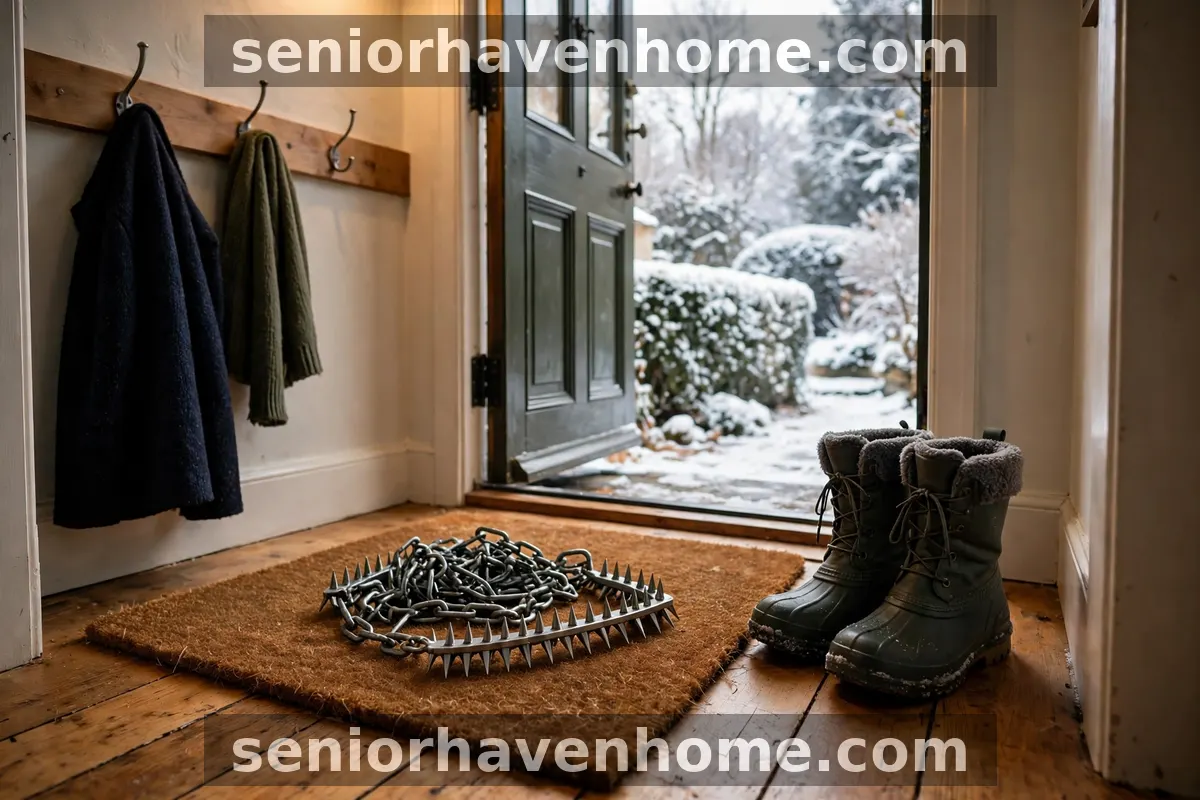
If you cannot reliably manage removal, say so and choose accordingly: the lightest coil grip with a heel tab, fitted seated indoors, and a family member checking the routine in the first week. A grip you cannot take off will be worn indoors.
What grips cannot do: black ice, wet pavement, and slush
Grips are an aid, not a guarantee, and the three surfaces where they help least are the most common in a British winter. Black ice — a thin transparent glaze that looks like a wet patch — defeats every grip type: almost no depth for metal to bite into. Beads and spikes cope better than coils, but no grip holds on black ice as on snow. Slow down, shorten steps, use a stick or rail, take a gritted route if one exists. Wet pavement after rain, with no ice, is a different problem: the grip adds little, and steel on wet stone can itself be slippery. If the pavement is wet but not frozen, boot sole and pace matter more. Slush and deep wet snow lift the grip and hide the kerb edge, and some grips pack snow underfoot — the Diamond Grip's swivelling beads shed snow better than most, but no grip makes deep slush safe.
Two more limits. Grips do not replace a walking stick: poor balance needs a stick plus grips. Grips wear out: a stretched sling, broken coil, or missing spike is a hazard, not a help. Inspect monthly and replace anything deformed.
Arthritis, eyesight, and low hand strength
Most grip marketing shows young hands pulling a stretch band over a boot. The reality for many senior buyers is stiffer fingers, weaker grip, and eyesight that makes small labels hard to read. Choose for the hands you have on a cold morning.
Stretch-band coil grips with a heel tab are easiest to fit and remove, needing the least finger strength. Chain harnesses need more pull and precision to centre. Strap-retained grips need a strap fastened — two hands and a pinch grip. Fit it seated, in good light, wearing the gloves you will walk in, and have someone watch: a second pair of eyes catches a twisted band your fingers cannot feel. Three failed tries in a warm room means the wrong pair — return it for a simpler design.
Two practical aids help more than any feature. First, a readable size label: write it on the pouch in marker pen. Second, a routine: grips, pouch, and boots in the same place by the door, every day, so fitting is a habit, not a puzzle.
Where to buy in the UK — and the delivery truth
UK stockists, verified on 31 October 2026: ICEGRIPPER (London E11, free click and collect) stocks Yaktrax and Kahtoola, showed the Diamond Grip at £44.95 in all sizes in stock, and charges £3.99 untracked (3–4 working days), £4.99 tracked (2 working days), £9.99 next day ordered before noon, free tracked delivery over £100. ShoeInsoles.co.uk showed the Diamond Grip at £33.90, Royal Mail 1–3 working days, free over £40 and £3.95 below, same-working-day despatch before 2 p.m. Monday to Friday, delivering only within the UK, Isle of Man, Jersey, and Guernsey. Health and Care lists the Portwest FC94 with free UK mainland delivery. Nevisport and GO Outdoors carry ice cleats and crampons — worth visiting to try grips on with your own boots; no live prices verified, so none is printed.
Delivery timing matters because demand is seasonal. Buy before the first frost, while your size is in stock, and allow a week rather than hoping for next-day. From a marketplace seller, check the delivery promise separately — "in stock" and "delivered before the frost" are different claims. Check the returns policy before buying, and do the 60-second test indoors on carpet, keeping the pair clean, so a return stays possible.
What ice grips cost in the UK
Verified on 31 October 2026: Diamond Grip £33.90 at ShoeInsoles.co.uk, £44.95 at ICEGRIPPER; Portwest FC94 £12.62 at ShoeInsoles.co.uk. Indicative, seen in listings, not confirmed on a live retailer page: Yaktrax Walk around £10–£19; SHEEFLY 19-spike around £16–£22; SHEEFLY 12-stud around £16; generic 10-stud around £11; Kahtoola EXOspikes around £49.50. No live UK price verified: Kahtoola MICROspikes, ICEGRIPPER Trek + Work, Yaktrax Pro, Black Diamond Access Spike, Hillsound Trail Crampon. Prices move sharply once the first frost arrives.
Judge value by cost per winter, not cost at the till. A £44 grip lasting three winters costs less per winter than a £12 grip replaced yearly, and a grip never worn costs everything and saves nothing. Budget grips suit a first pair or spare; branded grips suit daily walking — the warranty, size chart, and parts are real. Delivery adds £3–£10 unless you collect or pass the free-delivery threshold: a £33.90 grip with £3.95 delivery costs about the same as a £44.95 grip collected in London. Never buy a grip whose listing hides the stud count or size chart.
Problems, wear, and red flags
Twisting and creeping. A grip twisting sideways on a cambered path is almost always the wrong size or band shape for that boot. Re-measure, check the chart, do the carpet test again. If it still twists, return it. Broken coils and stretched slings. Coils break, slings stretch, and both fail without warning if uninspected. Check monthly: pull each coil gently, look for rubber cracks, retire any grip with a deformed link or missing spike. Rust. Salt is the enemy: rinse it off, dry after every walk, spray non-stainless beads seasonally. Red flags on a listing: no stud count, no size chart, no brand name, stock photographs showing a different product, a price far below every other listing for the same design.
Care, storage, and when to replace them
Care is mostly about drying. After every walk, shake off snow, rinse off road salt, dry the grips before they go back in the pouch — never store them wet on the boots: that is how beads corrode and slings perish. ICEGRIPPER's care note for the Diamond Grip: wash in lukewarm water, air-dry away from heat, clean and dry before storage, inspect before each use. Keep them in a pouch or zip bag by the door, with the boots. At the start and end of the season, spray non-stainless beads with WD-40 and check the rubber for cracks.
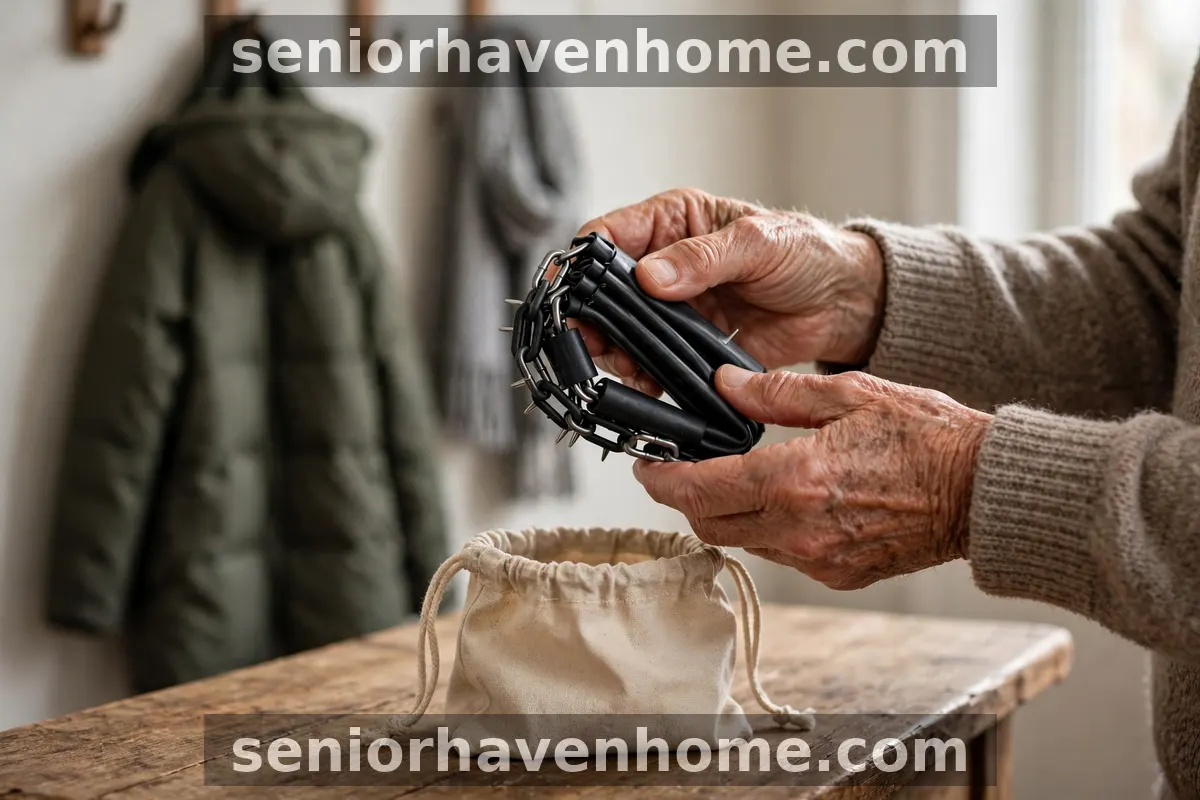
Replace a grip when any of these appear: a broken or missing coil, spike, or bead; a stretched sling no longer holding the grip centred; cracks or stiffness in the rubber; corrosion leaving metal rough. Branded grips with a warranty — two years on the MICROspikes — are worth claiming on within the warranty period. Budget grips are a one- or two-winter purchase: do not stretch a third winter from one that has already failed.
The caregiver setup checklist
Setting this up for a parent? Do it in one visit, in this order.
- Buy the right size for the boot they actually wear. Measure the boot, use that model's chart, buy before the first frost while the size is in stock.
- Fit them together, seated: watch the 60-second test, check the grip sits flat and centred, time the removal.
- Walk the real route together. Pavement, kerb, shop entrance, doorway at home.
- Set up the doorway: pouch, tray, boots, grips in one place, with a chair or rail to hold.
- Label the pouch: size and model in marker pen, large enough to read without glasses.
- Leave a note on the fridge: grips off at the door, every time.
- Check back after the first frost: one call — did they wear them, did they fit?
- Check back after a month: inspect and replace anything deformed.
The verdict
For most UK seniors, the Yaktrax Diamond Grip is the right first pair: the most adaptable grip in the UK test literature, sold by UK stockists in UK sizes, price verified at two of them on 31 October 2026 — £33.90 at ShoeInsoles.co.uk, £44.95 at ICEGRIPPER. For flat pavements, the Yaktrax Walk is the lighter, easier buy. For hills and country lanes, step up to the Kahtoola MICROspikes and accept the weight. For size 6 or above in work boots or wellingtons, the Portwest FC94 at £12.62 is the bargain of this guide.
Whatever you buy, the grip is only half the purchase. The other half is the routine: fitted, tested, removed at every door, dried after every walk, inspected monthly. A £44 grip worn all winter beats a £12 grip in a drawer; a grip you can take off in seconds beats one you cannot. Buy before the frost, fit it at home, walk the route you actually walk.
Related reading: Fall Detection Devices for Seniors · Canadian Ice Grips Guide

Frequently asked questions
- What are the best ice grips for shoes for seniors in the UK?
- The Yaktrax Diamond Grip, for most UK seniors: diamond-shaped steel beads on a chain grip, for pavements, packed snow, and mixed winter surfaces, in UK sizes at £33.90 to £44.95 on 31 October 2026. The lighter Yaktrax Walk suits flat pavements; Kahtoola MICROspikes suit hills and trails.
- Do ice grips work?
- Yes, on snow and ice, within limits. Coils, beads, studs, and spikes give the boot metal points that bite frozen surfaces, and tests agree they reduce slipping on packed snow and ice. They do not make ice safe, help less on wet films and slush, and are a hazard indoors.
- What are the best shoes for icy UK pavements?
- A sturdy walking boot with a deep, flexible rubber tread, plus a slip-on ice grip for frost and ice. Spiked shoes exist, such as spiked winter running shoes, but the spikes cannot come off indoors and wear fast on pavements. An ordinary walking boot plus a removable grip is more practical and cheaper.
- What can I put on my shoes to stop slipping on ice?
- Slip-on ice grips: a stretch frame over your shoe putting steel coils, beads, studs, or spikes under the sole. Coils suit light frost, diamond beads suit mixed surfaces, short spikes suit hills and trails. Also consider a walking stick with a sound ferrule, and a gritted route.
- Are ice grips good in snow?
- Yes. Packed snow is where ice grips work best, because metal points bite through snow to a firm surface. Bead designs shed snow well, as the beads swivel; some stud and coil designs pack snow. In deep, wet slush, grips help less — slush lifts the grip and hides the kerb edge.
- How do I stop my shoes slipping on ice?
- Start with a walking boot with a deep rubber tread, not a smooth sole. Add slip-on grips sized for that boot, fitted seated and tested indoors first. Walk with short, flat steps, weight over your feet, a stick or rail, and a gritted route when you can. Grips off at every doorway: steel on tile slides.
- Are ice grips safe for older people with arthritis?
- They can be, if the design suits the hands fitting it. Stretch-band coil grips with a heel tab are easiest to put on and take off; fitting seated in good light helps. Tight chain harnesses need more pull and can be a struggle with stiff hands. Practise at home while your hands are warm; three failed tries in a warm room means the wrong pair.
- Can I wear ice grips indoors?
- No. Ice grips are a slip and scratch hazard on smooth indoor floors such as tile, laminate, and polished wood. Retailers state this plainly, and winter-safety guidance says anti-slip devices must be removed on smooth surfaces. Take grips off at the door every time, before the first indoor step.
- Will ice grips fit my wellington boots?
- Usually yes, but check sole measurements against the chart for that exact model. Wellington shafts are smooth rubber, so fit depends on the sole shape, and the Portwest FC94, designed for work boots and wellingtons, only covers UK sizes 6 and above. For smaller wellingtons, measure the sole against the chart. A loose grip will twist off.
- What size ice grips do I need?
- By the boot you will wear, not your foot, using the chart for that exact model — sizes differ between brands and models. The Yaktrax Diamond Grip is sized in UK shoe sizes: small 5 to 7, medium 7 to 9, large 9 to 11, extra large 11 and above, choosing the smaller size between two. The Yaktrax Walk is listed in US sizes, so check the UK retailer's chart. Insulated or bulky boot: size up.
- Do ice grips rust?
- Some do. The Yaktrax Walk uses zinc-coated coils that resist rust; the Diamond Grip's case-hardened steel beads are not stainless and can corrode if left wet on boots. Dry grips after every walk, store them dry, spray non-stainless beads with WD-40 at the start and end of the season. Rinse road salt off; inspect monthly.
- Are expensive ice grips worth it?
- Often, but fit matters more than price: a £12 grip that fits beats a £45 grip that twists. Premium grips generally last longer, carry clearer warranties — two years on the Kahtoola MICROspikes — and cope with harder conditions. Budget grips suit a first pair. Divide price by expected winters: a £44 grip lasting three winters costs less per winter than a £12 grip replaced yearly.
- Can I wear ice grips on pavements with no snow?
- You can, but limit it. On bare tarmac, grips wear faster, feel firmer underfoot, and can be uncomfortable, especially spiked grips. Bead and coil designs tolerate cleared stretches best, one reason the Diamond Grip suits mixed British walks. For a cleared route with one icy patch, consider a stick and a careful route instead of spikes.
- What is black ice, and will ice grips help on it?
- A thin, transparent glaze on tarmac that looks like a wet patch. Bead and spike grips bite into it better than coils, but no grip holds on black ice as it holds on snow. Slow down, take short flat steps, use a stick or rail, take a gritted alternative route if one exists. Treat any shiny patch as ice until proven otherwise.
- Where can I buy ice grips in the UK?
- ICEGRIPPER in London stocks Yaktrax and Kahtoola and showed the Diamond Grip at £44.95 in stock on 31 October 2026; ShoeInsoles.co.uk showed it at £33.90 and the Portwest FC94 at £12.62; Health and Care lists the FC94 with free UK mainland delivery. Nevisport and GO Outdoors carry ice cleats and crampons. Order before the first frost.