
← Back to Mobility & Daily Living
Mobility & Daily Living · CanadaBest Walk-In Tubs in Canada for Seniors: Prices, Funding & Small Bathrooms (2026)
Canadian walk-in tub prices in CAD, what an installed quote should include, the federal tax credit and the Ontario and Alberta positions, small-bathroom dimensions, drain times, and scald control — checked 31 October 2026.
Affiliate disclosure: As an Amazon Associate I earn from qualifying purchases. This guide is about installed tubs bought through dealers and installers, not tubs bought online — the Amazon links here are only for bath safety accessories. Check the current listing before you buy. It costs you nothing extra and keeps this site free. Read our affiliate disclosure.
The short answer
If you only read one paragraph, read this one. A walk-in tub in Canada is a major installed purchase, not an online order: budget on written installed totals, not on a tub-only price, and expect the honest range to run from roughly CAD 6,000 for a simple swap to CAD 20,000 or more for a full-service installation with a remodel, with Safe Step Canada's own Canadian page putting fully installed tubs at CAD 10,000–$26,000. The tub is bought through a dealer or installer who visits your home, measures, and quotes. Every price here was read on a Canadian or manufacturer page on 31 October 2026, is labelled with what it includes, and is in Canadian dollars where the source stated CAD.
I did not test these tubs or visit showrooms, and no page I read had tested them either — the Canadian comparison ranks providers by type, not by tested models — so this guide crowns no “best brand.” I show where sources disagree instead of smoothing it away. Snippet-only figures are labelled as such, and where no Canadian price exists, I say so rather than borrowing an American one.
This guide is general information, not medical advice. A walk-in tub is discussed as a way to bathe more independently and safely at home, not as a treatment for any condition. If getting in and out already needs help, or a clinician or occupational therapist has raised equipment options, talk to them before signing. Our companion guide, Best Walk-In Tubs for Seniors, covers the general decision in United States terms, with no prices and American funding framing.
What a walk-in tub is — and what it is not
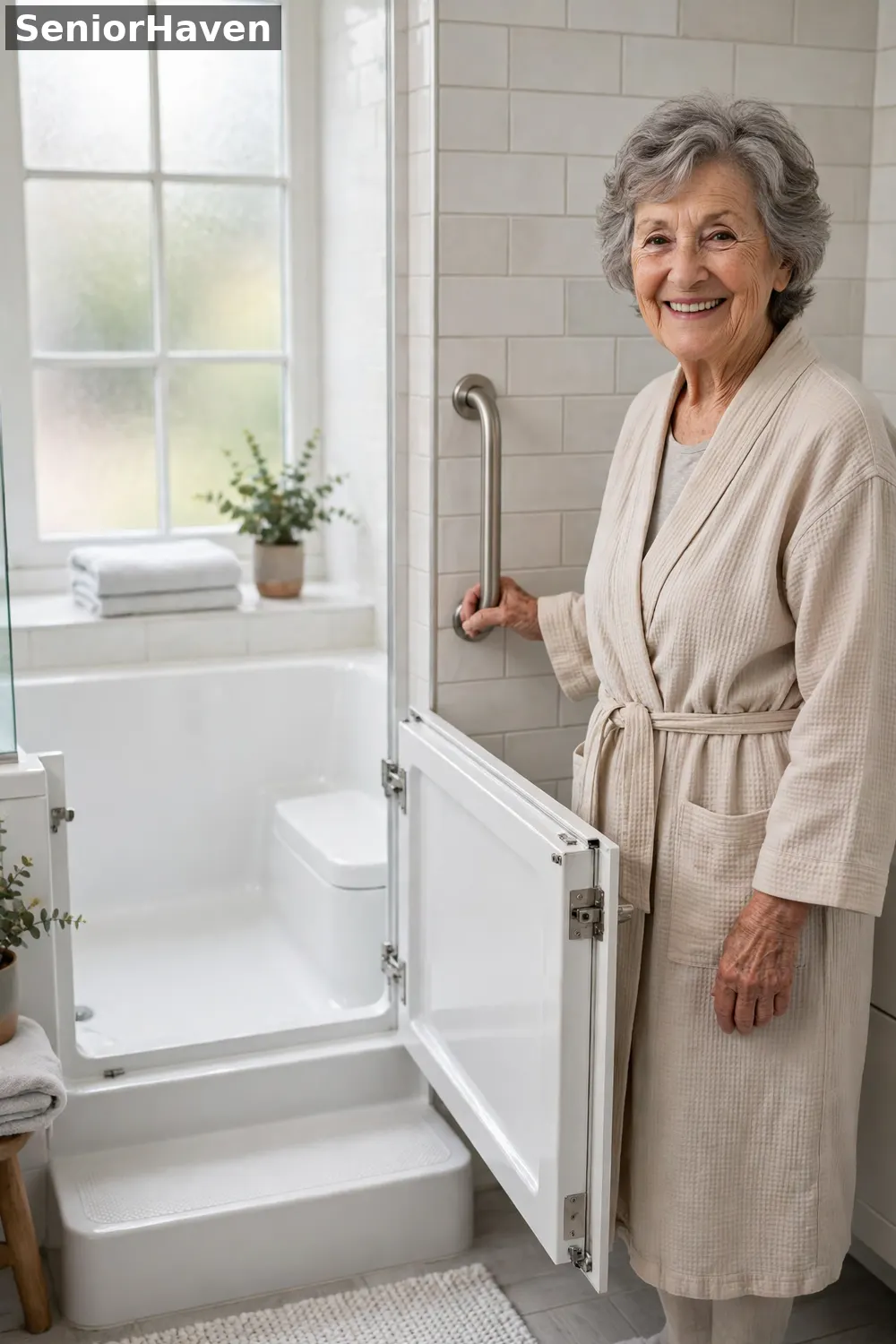
A walk-in tub is a bathtub with a watertight door in its side and a built-in seat. You open the door, step over a low threshold, sit down, close and lock the door, and then fill the tub around you. When you are done, you drain it and stay seated until the water is low enough to open the door safely. That sequence — sit first, fill second, drain before opening — is the whole idea, and the whole adjustment.
The door comes in two kinds. An inward-swinging door is pushed shut by the water itself, which helps the seal, and takes no floor space — but it opens into the tub and must swing past your legs. An outward-swinging door opens into the bathroom, needing clear floor space, but leaves the inside clear and can be opened from outside if someone needs to help you. Neither is simply “safer”: the safer door suits your floor space, your mobility aid, and whether someone may need to reach you.
Most tubs have a fixed moulded seat at about chair height, so you sit upright rather than reclining. The Carefree Yukon has a 17-inch seat, Safe Bathing Canada's bariatric Majestic has a 30-inch-wide seat, its Oasis offers a reclined backrest, and its 43-inch Zen is a deliberately upright Japanese-style soak. Sit on the seat, or a chair of the same height, and check feet, knees, and control reach.
A walk-in tub is not a shower, not a medical device that treats anything, and not a same-day online purchase. Sellers I found — Safe Step Canada and Safe Bathing Canada (full-service), Carefree Bathing in the Greater Toronto Area, and retail sellers such as Home Depot, Rona, and Wayfair — mostly sell by custom quote after a home visit. Safe Bathing Canada and Carefree Bathing publish no prices at all on the pages I read.
What a walk-in tub costs in Canada
Read this section by scope, not by headline: tub-only, before-installation, fully installed, and whole-remodel totals are four different numbers. Every figure keeps its basis attached, states CAD only where the source stated CAD, and names its source. All were read on 31 October 2026.
Tub-only and before-installation prices
Safe Step Canada's Canadian pricing page, which states explicitly that all its prices are in CAD, gives typical market ranges before installation: basic CAD 3,000–$6,000, premium CAD 8,000–$12,000, and premium with a shower CAD 10,000–$15,000 or more. These are framed as typical market ranges, not Safe Step shelf prices — a budgeting frame, not a price for a named model.
HomeStars, the Canadian installer marketplace, gives a different tub-only split in CAD (guide published 30 June 2026, updated 21 August 2026): basic acrylic CAD 2,000–$4,000, mid-range with jets or heaters CAD 5,000–$8,000, and high-end or custom CAD 8,000–$15,000 or more. The sources overlap but do not match, because “basic” and “premium” are not standard grades. Ask every seller what is included: jets, heater, heated seat, quick drain, and warranty are the usual dividing lines.
Safety Bath, a Canadian manufacturer in Lethbridge, Alberta, gives a third set on its cost blog, with a warning: the page does not state its currency. A standard soaker is $3,000–$7,000, a tub with hydrotherapy, heated seat, and quick drain $8,000–$15,000, and a luxury or bariatric tub may exceed $20,000 — reported as published, currency unstated, not as confirmed CAD prices. The same caution applies to a comparison table on Safe Step's Canadian page (Safe Step $3,000–$15,000+, Kohler $3,000–$25,000+, American Standard $3,600–$9,000, Ella's Bubbles $3,800–$12,000, before installation, no currency stated, US sources cited): unverified for Canada.
Fully installed totals — and a conflict you should see
Safe Step Canada's Canadian pricing page states a fully installed range of CAD 10,000–$26,000, twice on the same page, and puts installation itself typically at CAD 8,000–$12,000 within a quote, with plumbing, electrical, and structural work extra. But there is a conflict: another Safe Step page, seen only as a search snippet, gives “typically $5,000 to $15,000 installed, most $8,000–$12,000 for premium with hydrotherapy,” with no currency stated. Same brand, different pages — most likely different scopes or dates. I quote the Canadian pricing page and note the other exists; I do not blend them into $5,000–$26,000.
HomeStars prices projects rather than tubs, in CAD: complete projects CAD 6,000–$40,000 or more — simple swap CAD 6,000–$12,000, moderate remodel CAD 10,000–$20,000, major remodel CAD 20,000–$40,000 or more. The top end is a remodel total, not a tub price. Hidden costs: delivery, old-tub removal CAD 100–$500, electrical work CAD 500–$2,000. A separate HomeStars guide (snippet only) gives $5,000–$15,000 totals, currency unstated — a second scope conflict. Compare scopes, not headlines.
Safety Bath's installation figures sit far below Safe Step's and HomeStars', and the scope difference is the likely explanation, not a bargain: installation typically $2,500–$8,000 (currency unstated), a high-quality tub plus professional installation $8,000–$20,000, with a worked example totalling about $14,000 (tub $4,500, jets $2,500, heated seat and quick drain $1,500, installation $5,000, permits $500). A basic install and a full-service package are different purchases. Ella's US labour-only figure is left out: incomparable with Canadian installed totals.
| What the figure covers | Range (as published) | Source, 31 Oct 2026 |
|---|---|---|
| Tub only, basic acrylic | CAD 2,000–$4,000 | HomeStars |
| Tub only, mid-range | CAD 5,000–$8,000 | HomeStars |
| Before installation, basic / premium / premium + shower | CAD 3,000–$6,000 / $8,000–$12,000 / $10,000–$15,000+ | Safe Step Canada (CAD stated) |
| Fully installed, full-service package | CAD 10,000–$26,000 | Safe Step Canada (CAD stated) |
| Complete project, swap to major remodel | CAD 6,000–$40,000+ | HomeStars (remodel total) |
| Worked example total | About $14,000, currency unstated | Safety Bath blog |
No live Home Depot Canada, Rona, Wayfair, or Bath Depot shelf price is stated in this guide: no retailer listing page was opened, and snippets quoting a sale price for an unnamed model, with no currency or date, are not a price. No American Standard Canada, Kohler Canada, Walk-In Tubs Ontario, or Walk-In Tubs Alberta price is stated either — all were quote-only in every source opened. No Ella's Bubbles Canada price, dealer, or CAD figure was found.
Search Amazon.ca for grab bars for the bathroom — properly fixed grab bars, fitted into solid backing by your installer, matter most around any tub; the tub itself is never bought this way.
Choosing the tub: door, seat, seal, and controls
Choose in this order: how you get in and out, how you sit, how the door seals, and how you control the water. Jets, lights, and music come last. Keep the distinction Seniors Bulletin's Canadian comparison (July 2026) draws: full-service providers who measure, deliver, install, and service the tub, versus retail sellers where you buy the tub and arrange the rest. Comparing a retail tub-only price with a full-service installed price is never right.
Door and threshold, together. Never compare threshold height alone: a low threshold with a narrow door is harder to step through than a slightly higher threshold with a wide door. RetirementLiving puts a low-threshold entry typically at 2–8 inches, and a Seniors Bulletin snippet puts a Kohler threshold at only 3 inches, against a standard tub wall of roughly 15–20 inches — but no source gives a threshold-height table by Canadian model, so no single number here is universal. Ask every seller for both numbers, and try the step with your aid and helper present.
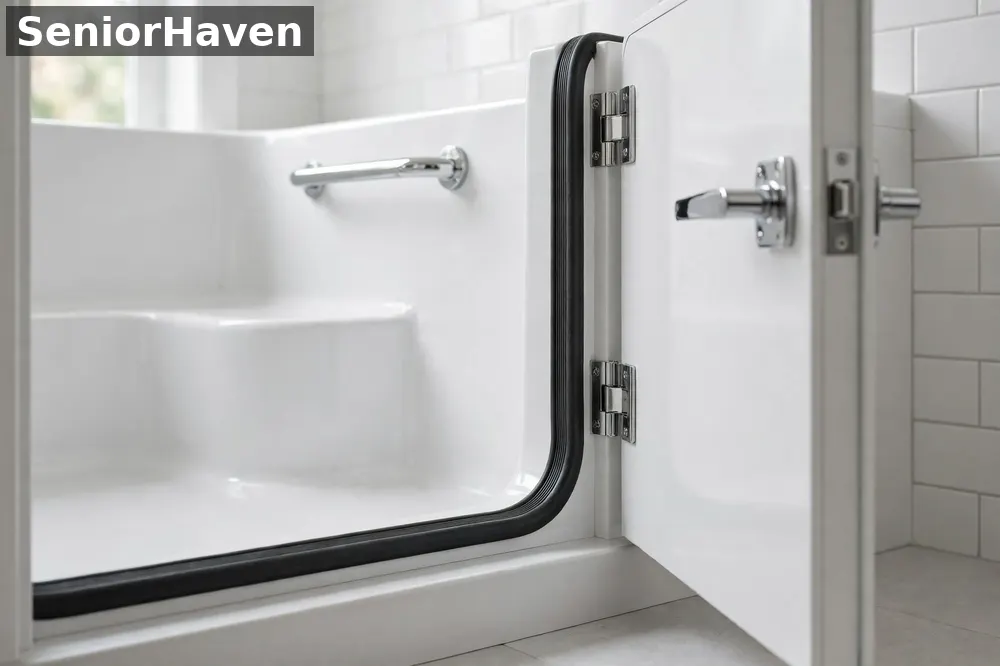
The seal is a maintenance item. Doors seal against water pressure, and seals wear. Ask how the seal works, how often it should be inspected, what a replacement costs, who fits it, and whether the warranty covers the seal and door mechanism separately from the shell. Safe Bathing Canada advertises a lifetime warranty on its aluminium door — a manufacturer claim; read the written terms. Try every handle with stiff, wet hands.
Controls must be reachable from the seat. Faucet, drain, wand, jets, and heated-seat switch should all be reachable without standing, twisting hard, or stretching across hot water. Ask where each sits relative to the seat, whether temperature works one-handed, and whether a remote or keypad — Safe Step's Hybrid offers an LED keypad and floating remote — is included or extra, and what happens when its battery dies. If a caregiver will help, bring them to the demonstration.
Grab bars, backing, and the floor. Grab bars only work fixed into solid backing, not just tile. Ask where backing will go, at what heights, for seated and standing use. The same visit should settle the floor: a filled tub is heavy — Safe Bathing Canada's Oasis holds 70–76 gallons, its Majestic 105–110 — and floor, joists, drain position, and plumbing and electrical routes are installer questions. Say early if the home is older or the bathroom sits above a living space.
Search Amazon.ca for non-slip bath mats · Search Amazon.ca for shower chairs — a mat inside the tub and a chair for shower days support the big purchase; neither replaces the tub decision.
Small bathrooms: dimensions and the delivery route
A walk-in tub is usually shorter than a standard tub and taller, with a seat instead of reclining length — both the opportunity and the trap in a small bathroom. A compact model can fit an existing alcove, but exterior dimensions are not bathing space, door swing eats floor space, and a tub that fits the alcove may not fit through the front door. Measure in this order: the alcove, the door swing, and the delivery route.
Carefree Bathing (Greater Toronto Area) publishes exact compact dimensions: the Nisa at 42 by 26 by 36 inches, the Freedom at 52 by 26 by 41 inches — narrower, for smaller bathrooms — and the Supreme at 52 by 30 by 41 inches. Safe Bathing Canada (Stoney Creek, Ontario) publishes the Guardian and Imperial at 51¼ by 29¾ inches, the Zen at 43 by 29 by 40 inches, the Oasis at 60 by 29¾ by 39½ inches, and the bariatric Majestic at 53 by 35 inches. Safe Step's popular Hybrid size is 28 by 51 by 38.5 inches, in three sizes. Measure your alcove wall to wall, at floor level and tub height.
| Model (maker) | Length × width × height | Door | Capacity / note |
|---|---|---|---|
| Nisa (Carefree) | 42″ × 26″ × 36″ | Inward | Compact |
| Freedom (Carefree) | 52″ × 26″ × 41″ | Inward | Narrower build |
| Supreme (Carefree) | 52″ × 30″ × 41″ | Inward | Wand and grab bar |
| Guardian (Safe Bathing) | 51¼″ × 29¾″ (height not stated) | Outward, 32″ opening | 55–60 gal |
| Imperial (Safe Bathing) | 51¼″ × 29¾″ | Inward | 55–60 gal; jets |
| Zen (Safe Bathing) | 43″ × 29″ × 40″ | Not stated | 55–60 gal; upright |
| Oasis (Safe Bathing) | 60″ × 29¾″ × 39½″ | Not stated | 70–76 gal; reclined |
| Majestic (Safe Bathing, bariatric) | 53″ × 35″ | Outward | 105–110 gal; 30″ seat |
| Hybrid (Safe Step, popular size) | 28″ × 51″ × 38.5″ | Not stated | Three sizes |
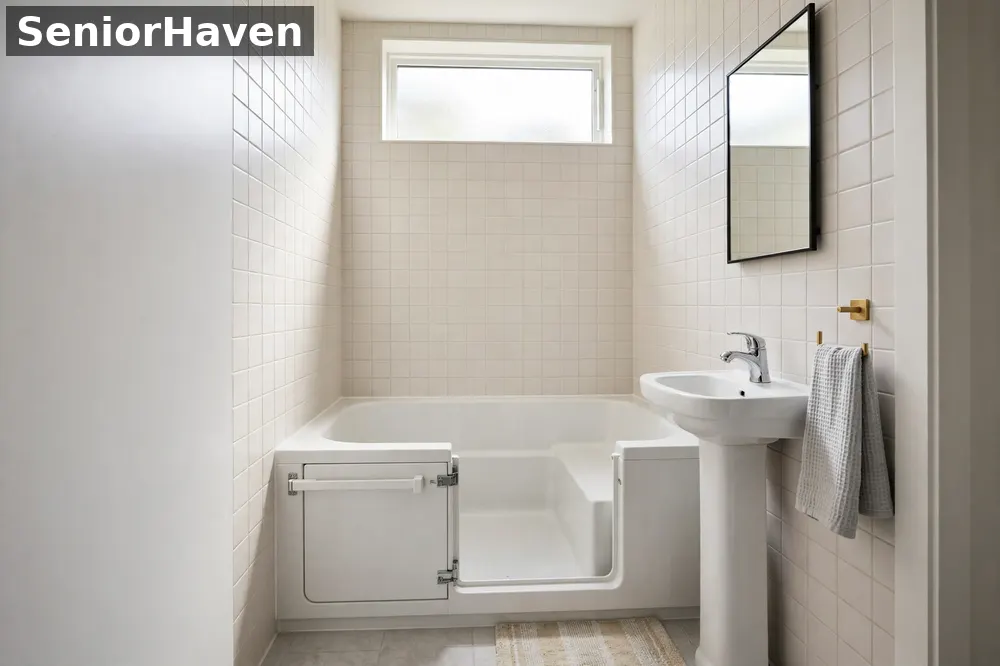
Then the door swing, in the actual bathroom. An outward door needs clear floor for the full swing, your step, and a walker or helper. An inward door needs clear space inside for the door to pass your legs; Carefree notes all its models use inward doors sealed by water pressure. In a five-by-eight-foot bathroom, either can fail. Tape the footprint and the door arc on the floor, put the walker inside the tape, sit on a chair inside it, and reach for where the controls would be.
Then the delivery route. Measure every doorway, hallway turn, and stairwell, and ask whether the tub arrives assembled or in parts, what its largest single piece measures, and who pays if it does not fit. Ask the same about the old tub's way out: removal and disposal should be named in the quote (HomeStars: CAD 100–$500). A dedicated walk-in shower (HomeStars: CAD 2,500–$8,000 installed) may serve daily showering better in the same footprint.
Subsection: the tub–shower combination
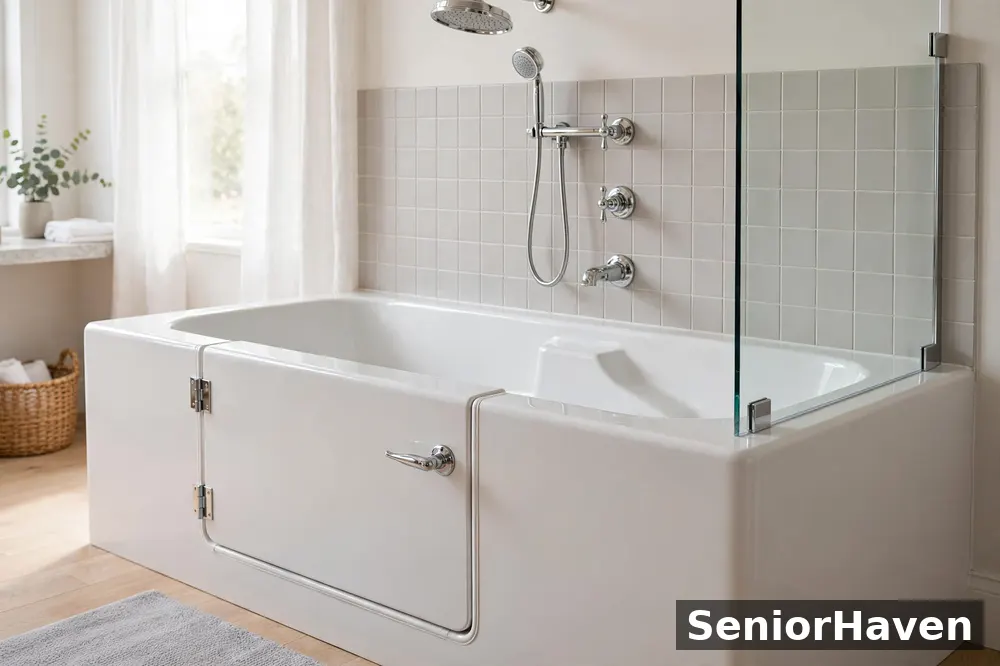
This is a subsection of this page, not a separate guide. A tub–shower combination — a combo, or Hybrid in Safe Step's naming — is a walk-in tub with a shower built over it: a rainfall or adjustable head above, a hand-held wand usable seated or standing, and the same door, seat, and drain beneath. The question is a household one: can one fixture serve the person who wants a seated soak and the people who want a standing shower?
Safe Step Canada's Hybrid page lists a rainfall head, hand-held wand, Quantum quick drain, heated seat and backrest, ten hydro-massage jets, a no-strength locking handle, and an LED keypad with floating remote. Carefree Bathing describes the same seated-or-standing showering on all its models, with an optional slider bar. A North Vancouver contractor blog and Kohler's package (both snippet only) describe the same offer, and that snippet evidence is labelled as such.
The combination costs more than the tub alone: Safe Step Canada puts a premium tub at CAD 8,000–$12,000 before installation and a premium tub with a shower at CAD 10,000–$15,000 or more. No installed total for a combination was published anywhere I opened — the Hybrid page is custom quote only — so any “combo installed price” elsewhere is a quote for a specific home or a guess. Get the installed total in writing.
Test the standing-shower reality in person: feet on the tub floor, higher than a shower floor; walls constraining feet and elbows; grab bars possibly at the wrong height; rainfall-head height suiting the tallest showerer; curtain or screen containing water without fouling the door. Stand in the tub and reach the wand, controls, and grab bar. Ask whether the shower runs with the door closed and how the drain behaves on shower-only days — no source in this pass answers that.
Search Amazon.ca for hand-held shower heads with a hose · Search Amazon.ca for bath transfer benches — a wand you can hold while seated and a bench for getting in and out make any of the three choices easier to live with.
Filling, draining, and the water heater
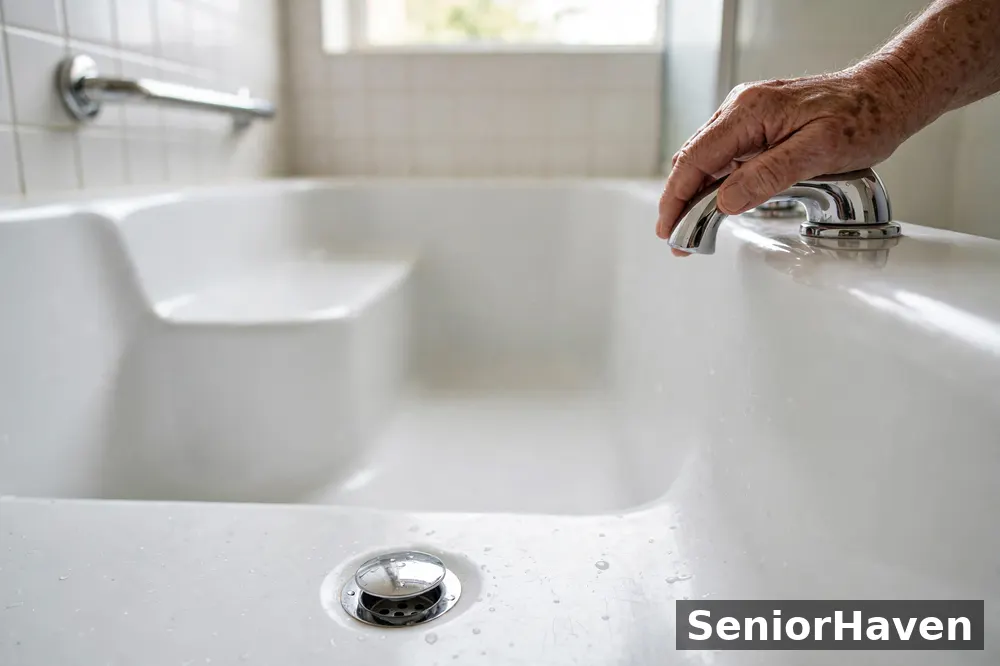
You stay in the tub while it fills, and while it drains. That is not a footnote; for many people it is the experience of the tub, and it should be weighed like the price. RetirementLiving puts filling at 6–8 minutes, draining most tubs at 6–15 minutes, and fast-draining models at 2–4 minutes, varying with pressure, plumbing, and drain. Safe Step's water blog (updated 23 October 2026) claims rapid fill of about 12 gallons per minute on an average household's half-inch plumbing — a manufacturer claim — and its Quantum drain as 38 percent faster than the 6–15-minute baseline, without absolute minutes.
What the minutes feel like: sitting undressed in a dry tub, cooling until the water reaches you; then sitting wet while the water falls, in what may be the coldest room in the house in a Canadian winter. A heated seat and backrest — Safe Step's Hybrid includes both; Safety Bath prices one at $500–$1,000, currency unstated — are comfort essentials if you feel the cold. Ask for the drain time on your own drain lines, not ideal plumbing.
Will your water heater keep up?
A walk-in tub holds more than the standard tub it replaces, and the water must stay hot to the end of the fill. RetirementLiving puts typical capacity at 40–80 gallons (standard tub 25–45), occupied use about 50 gallons standard and 70 larger; Safe Step's standard size holds about 85 gallons empty, 50–70 occupied; Safe Bathing Canada's Majestic holds 105–110 gallons, the Canadian top-end example. The agreed check is the two-thirds rule: tank capacity about two-thirds of the tub's listed capacity — 50-gallon tub, about a 33-gallon tank; 60, about 40; 80, about 53 — estimates, not guaranteed requirements.
| Tub capacity | Tank, two-thirds rule (estimate) | Check as well |
|---|---|---|
| 50 gal | About 33 gal | Recovery; simultaneous use; heater age |
| 60 gal | About 40 gal | Recovery; simultaneous use; heater age |
| 80 gal | About 53 gal | Recovery; simultaneous use; heater age |
For tankless heaters, RetirementLiving says they can work, sized by output and temperature rise, with a plumber to determine sizing — and I add no specification. No tankless size for Canadian conditions was verified here. Put the heater check in the quote with a plumber's name: tank size and recovery, or tankless output and rise, the existing heater's state, and any upgrade cost inside the installed total.
Search Amazon.ca for bath water thermometers — verify the temperature yourself, at the seat, rather than trusting a dial alone. Search Amazon.ca for warm bathrobes — a robe kept on the seat until the water covers you is part of the fill routine.
Scald control: the valve, the stop, and who may change it
Hot water scalds older skin faster: thinner skin, reduced sensation, slower reaction. Temperature control is a safety device, not a comfort preference. This section states what manufacturers publish and stops there. No Canadian plumbing-code temperature was verified here, and none is invented.
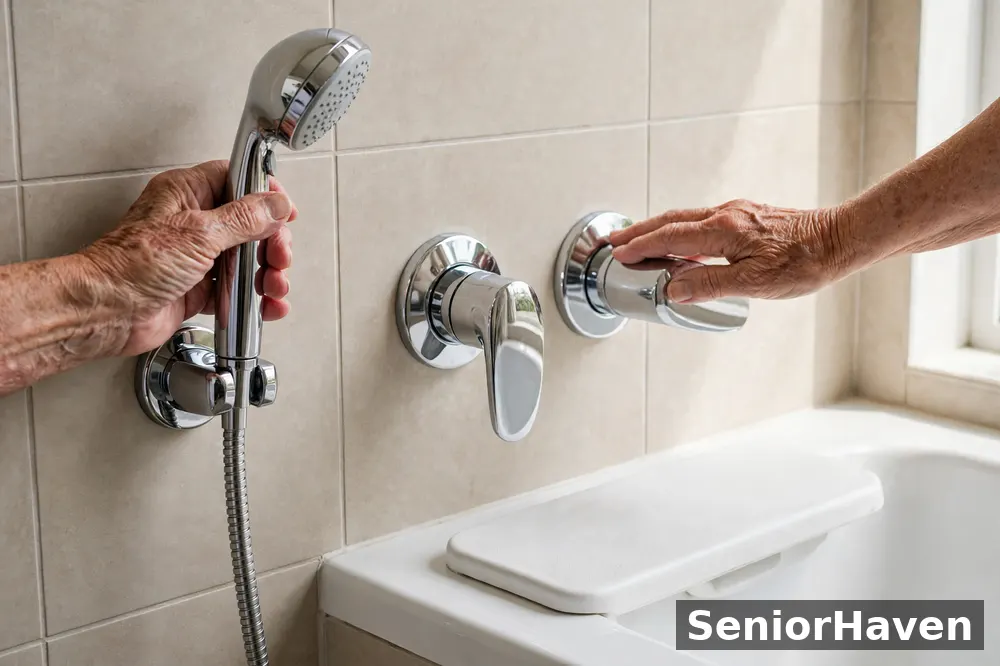
Safe Step publishes the fullest account: an anti-scald valve and hot-water sensor as standard; a safety stop preventing water exceeding 102°F; over 115°F can burn with prolonged exposure; even 105°F can scald sensitive skin; its ideal bath range is 90–105°F; above 102°F requires depressing a spring-loaded handle; above 104°F is noted as only after consulting a physician — a manufacturer note, attributed, not medical advice. The stop cannot be adjusted without professional assistance.
Carefree states twice that its models have “anti-scald thermostatic valves that ensure your water temperature is always safe,” with no temperature. Safe Step's Hybrid page names “Anti-Scald Technology” without detail. That is the full opened-page evidence on other makers. Insist on the routine whatever the valve: stop temperature set at installation and recorded in writing; demonstration with a thermometer at the seat, faucet, and wand; who may adjust the stop and how it is locked; re-check at every maintenance visit.
Funding and tax in Canada
Nothing here promises money, a tax saving, or eligibility. Rules turn on age, tax position, home, and exact work, and several seller figures are marketing summaries or superseded. Facts below come only from official pages opened on 31 October 2026 — CRA and federal pages, Ontario.ca, and Alberta.ca. Check your position with the programme and a tax professional before budgeting on any of it.
Federal: the Home Accessibility Tax Credit (HATC)
The HATC is a non-refundable federal tax credit for eligible renovation expenses. The purpose test (CRA Budget 2025 wording): expenses must allow a qualifying individual to gain access to, or be mobile or functional within, the eligible dwelling, or reduce the risk of harm within it or in gaining access. A qualifying individual is 65 or older at year-end, or eligible for the Disability Tax Credit at any time in the year; eligible family members or supporting relatives may claim in respect of one. The dwelling must be the qualifying individual's principal residence at some time during the year, the work enduring and integral to it.
Two official facts ground tubs under this credit. First, the expense limit is $20,000 per year, doubled from its earlier level in Budget 2022, claimed on Line 31285 (CRA publication RC4064). Second, walk-in bathtubs are named as an example of eligible work in the Budget 2022 announcement and in Federal Tax Expenditures 2025. That is an example of the type of work covered, not a guarantee for any particular tub or invoice — that depends on the person, dwelling, and work.
The current rate and maximum tax saving are deliberately not stated here. The official pages opened state no verifiable current rate or maximum, and secondary sources and sellers disagree. The evidence supports only this: the credit is a percentage of eligible expenses up to the $20,000 limit, and the rate and maximum for your tax year must be confirmed on the live CRA Line 31285 page and with a tax professional.
For 2026 and subsequent years, Budget 2025 proposes amending the Income Tax Act so an expense claimed under the Medical Expense Tax Credit cannot also be claimed under the HATC. Previously the same expense could be claimed under both. The CRA says “proposes” — check current CRA guidance rather than explainers stating it as settled. Seller summaries that the Medical Expense Tax Credit “may allow” a prescribed tub, or that the Multigenerational Home Renovation Tax Credit covers a tub, are seller summaries: the latter is a secondary-suite credit.
Ontario: the Assistive Devices Program does not fund walk-in tubs
The honest answer is a negative finding. The official Ontario.ca Assistive Devices Program page (checked 31 October 2026) lists funded categories — including mobility devices, hearing devices, prostheses, and respiratory equipment, over 8,000 items in total — with no category for walk-in tubs, bathroom renovations, home modifications, or bathing fixtures, and no walk-in-tub form. Walk-in tubs do not appear as a funded category. Do not budget on ADP funding for a tub.
The page's mechanics — up to 75 percent of the approved price for many devices, 100 percent for Ontario Works, ODSP, or Assistance for Children with Severe Disabilities clients, via a registered authoriser and vendor — belong to covered categories and cannot be transferred to tubs. A mobility device in a covered category is a separate ADP matter.
Alberta: SHARP is a loan, not a grant
Alberta's Seniors Home Adaptation and Repair Program (SHARP) names walk-in tubs expressly and must be described as Alberta.ca describes it: a low-interest home equity loan letting seniors use home equity to remain in their homes, for repairs, adaptations, and renovations to a primary residence. “Bathroom or walk-in tubs” is an explicit project example. It lends against home equity; the loan must be repaid.
Terms as fetched 31 October 2026: maximum loan $40,000; income $75,000 or less (senior or couple); at least 25 percent home equity (all charges including the SHARP loan ≤75 percent of assessed value), caveat on title; age 65+ (only one spouse/partner need be 65), registered owner, citizen or permanent resident, Alberta resident 3+ months, income from Line 15000 of the previous return subject to deductions. Interest was 4.45 percent as fetched, reviewed every six months (April/October), simple interest from issue to repayment — check the current rate. No monthly repayments; due on sale, ceasing to own, or ceasing to occupy as primary residence; repayable anytime without penalty; minimum $500; work paid within twelve months before the application package arrives may be funded retroactively, with receipts and a written estimate required. A narrow grant route may be considered only if ineligible for a loan, with single income ≤$32,690 or couple ≤$53,800, for some basic and essential repairs.
Other provinces, insurance, and health plans
No official BC, Quebec, Manitoba, Saskatchewan, Atlantic, or territorial programme page was opened here, so no other province's funding is asserted. Check your province's programme on its official site, and ask the programme — not a seller — whether a tub project is covered and whether to apply before work starts. On insurance: do not assume a plan will pay. Get any coverage confirmation in writing from your own insurer or plan before signing.
Getting quotes you can actually compare
Get three written installed totals, for the same scope, and compare them line by line. Give every company the same brief — models, room, delivery route, heater check, backing and grab bars, surround and finish — then require the same itemised lines: tub and options; delivery; removal and disposal; plumbing; electrical including any dedicated circuit; structural and floor work; surround and finishing; heater work; permits; taxes; warranty labour and parts separately. “Installation included,” without what it includes, has not answered the question.
Ask for the timetable too: days on site, hours, whether the only bathroom will be unusable, and what happens on overrun. Carefree puts installs at one to two days; Safe Step's Hybrid page claims as little as a day — seller framings for straightforward jobs. Ask for service in writing: who to call for a leak, slow drain, or failed control; how quickly they attend; is the visit covered; local technician or distant phone queue? A quote expiring tonight, or a discount requiring an immediate deposit, is a tactic, not a price. Safe Step's page carried a time-limited promotion when read on 31 October 2026 — conditions and end date, not a standing price, until in writing on the quote.
Who should pause — or choose a shower instead
A walk-in tub suits someone who can transfer to a seat safely, sit upright through a fill and drain, and reach the controls — alone or with the help actually present at bath time. Pause and get an occupational therapist's or clinician's view if transferring needs two people or a lift, sitting upright unsupported is difficult, or the bathroom has no room for a helper. For wheelchair users the transfer is the whole decision: Carefree's Trillium Transfer — wide outward door, slide-in design, transfer-lift compatible — is the kind to discuss with a therapist.
Choose a walk-in shower instead if showering is the daily routine and soaking is rare; if the drain wait would leave the bather cold, anxious, or alone too long; if the room cannot give the door its swing; or if the heater cannot be upgraded affordably. A cheaper cousin — a tub cut, where the existing tub's side is cut down and fitted with a step — is worth asking a local installer about, at local pricing, not from online snippets. It gives no seat or sealed door in the same way, and this guide does not price it. Our guides to shower chairs in Canada, grab bars for the bathroom, and shower chairs for seniors cover the smaller purchases that make a shower safer.
Search Amazon.ca for non-slip shower mats · Search Amazon.ca for bath pillows · Search Amazon.ca for long-handled bath sponges — small items for whichever choice you make; the fixture decision is made with an installer, a tape measure, and, where needed, a therapist.
The questions to ask before you sign
- Written installed total for this model, in my bathroom — delivery, removal, plumbing, electrical, surround, permits, taxes — and what is excluded?
- Threshold height and door opening width? Can I try the step and seat with my aid and helper present?
- Inward or outward door — swing space needed, and can it be opened from outside if I need help?
- How does the seal work, inspection interval, replacement cost, and what do door/seal warranties cover including labour?
- Drain time with a full tub on my drain lines? Heated seat included or extra?
- Will my heater fill this model without running cold — who checked, and is any upgrade inside this quote?
- What valve, what stop temperature, who may adjust it, and will it be recorded and demonstrated with a thermometer?
- Grab-bar backing where, at what heights, and what floor support does a filled tub need?
- Largest delivered piece — does it fit my doorways and hallway, and who pays if it does not?
- Days on site, will my only bathroom be unusable, and who provides service locally, how quickly?
- What funding or tax position applies to me, in writing from the programme or my tax professional?
- Payment, cancellation, and quote-expiry terms, and promotion terms — all in writing?
The verdict
Our verdict, at the bottom as at the top: buy the tub that fits your bathroom, heater, and routine, on a written installed total compared like with like — door swing taped out, drain wait understood, heater checked by a plumber, scald stop set and recorded, funding checked before purchase. The combination earns its premium only where the soak will be used often. Where showering is daily, the shower is the smarter, cheaper answer.
General information only — not medical advice. If getting in and out of the bath already needs help, or a clinician or occupational therapist has raised equipment options, talk to them before buying. Prices, programme rules, and lineups change; the seller's and the programme's own pages are the final word. Facts here were read on pages checked on 31 October 2026.
Frequently asked questions
- How much does a walk-in tub cost in Canada, fully installed?
- No single figure is honest — only scope-based ranges. Safe Step Canada states fully installed CAD 10,000–$26,000 (installation typically CAD 8,000–$12,000, plumbing/electrical/structural extra). HomeStars puts complete projects at CAD 6,000–$40,000+, simple swap to major remodel. Another Safe Step page (snippet only) gives lower figures, currency unstated. Get three written installed totals for the same scope. Read 31 October 2026.
- What is included in a walk-in tub installation quote — and what is usually extra?
- A comparable quote itemises tub and options, delivery, removal/disposal, plumbing, electrical, structural/floor work, surround/finishing, heater work, permits, taxes, and warranty labour/parts separately. Often extra or vague: plumbing/electrical upgrades, structural work, permits, heater upgrades. HomeStars: removal CAD 100–$500, electrical CAD 500–$2,000. “Installation included” alone has not answered the question.
- Do you have to stay in the tub while it fills and drains? How long does draining take?
- Yes — sit, close the door, fill around you, and stay seated until the water is low enough to open the door. RetirementLiving: fill 6–8 minutes, drain 6–15 minutes, fast-draining models 2–4 minutes, varying with pressure, plumbing, and drain. Safe Step claims its Quantum drain is 38 percent faster than the 6–15-minute baseline, without absolute minutes. Ask for the full-tub drain time on your own lines.
- Will my water heater fill a walk-in tub without running cold?
- Only if checked against the exact model first. Tubs typically hold 40–80 gallons (standard tub 25–45). The two-thirds rule estimates tank size at two-thirds of capacity: 50-gallon tub, about 33-gallon tank; 60, about 40; 80, about 53 — plus recovery rate, simultaneous use, and heater age. Tankless can work if sized by output and temperature rise, determined by a plumber; no Canadian tankless size was verified here.
- Can a walk-in tub replace a standard bathtub in the same space?
- Often, but measure rather than assume. Compact models (Carefree's 42-inch Nisa, Safe Bathing Canada's 43-inch Zen) are built for standard alcoves, but exterior size is not bathing space, door swing eats floor space, and out-of-square walls and plumbing change the fit. Measure the alcove wall to wall, tape the door arc, and check the delivery route. A tub blocking the bathroom door replaces nothing.
- Are walk-in tubs safe for wheelchair users / for someone who cannot transfer to a seat?
- A standard tub requires a transfer onto its seat — that transfer is the safety question. Transfer models exist: Carefree's Trillium Transfer has a wide outward door, is transfer-lift compatible, with a 17-inch anti-slip seat and dual drain. Discuss the transfer with an occupational therapist or clinician, aid and helper present, before choosing. If transferring needs two people or a lift, get that assessment first.
- Can a walk-in tub qualify for a tax credit in Canada? What is the Home Accessibility Tax Credit?
- It may — no outcome is promised. The HATC is a non-refundable federal credit for eligible renovation expenses letting a qualifying individual (65+ at year-end, or Disability Tax Credit-eligible) gain access to, be mobile/functional within, or reduce harm risk in a principal residence, for enduring, integral work. Walk-in bathtubs are named as an example of eligible work; the expense limit is $20,000 per year, Line 31285. Confirm the current rate/maximum on the live CRA Line 31285 page and with a tax professional. Budget 2025 proposes that from 2026, an expense claimed under the Medical Expense Tax Credit cannot also be claimed here.
- Does Ontario's Assistive Devices Program (ADP) pay for a walk-in tub?
- No, on the official evidence checked. The Ontario.ca ADP page (31 October 2026) lists funded categories — mobility devices, hearing devices, prostheses, over 8,000 items — with no category for walk-in tubs, bathroom renovations, home modifications, or bathing fixtures, and no walk-in-tub form. Its 75 percent mechanics belong to covered categories and cannot be transferred to a tub. Do not budget on ADP funding for a tub.
- Is there Alberta funding for a walk-in tub? Is SHARP a grant?
- SHARP is a loan, not a grant: a low-interest home equity loan up to $40,000 for a primary residence, with “bathroom or walk-in tubs” an explicit example. Terms fetched 31 October 2026: income $75,000 or less, ≥25 percent equity, age 65+, interest 4.45 percent as fetched (reviewed every six months), no monthly repayments, repayable on sale or ceasing to own/occupy. A narrow grant route may be considered only if ineligible for a loan, with single income ≤$32,690 or couple ≤$53,800. Check the current Alberta page and rate.
- What is a walk-in tub and shower combination, and when is it better than a tub alone or a shower alone?
- A combination is a walk-in tub with a shower over it: rainfall/adjustable head above, hand-held wand usable seated or standing, same door, seat, and drain. It beats a tub alone where others need a standing shower in the same fixture, and a shower alone where a seated soak will be used often. It costs more: Safe Step Canada, premium tub CAD 8,000–$12,000 before installation, premium with shower CAD 10,000–$15,000+. If you shower daily and soak rarely, price a dedicated walk-in shower first.
- Will a walk-in tub fit a small bathroom? What do I need to measure?
- Measure the alcove, the door swing, and the delivery route, in that order. Compact models exist (Nisa 42×26×36″, Freedom 52×26×41″, Zen 43×29×40″), but exterior size is not bathing space. Tape the footprint and door arc, put the walker inside the tape, sit where the seat would be. Measure doorways, turns, and stairs, and ask for the largest delivered piece.
- Inward-swinging or outward-swinging door — which is safer, and what space does each need?
- Neither is simply safer; the safer door suits your floor space, aid, and whether someone may need to reach you. Inward: water pressure helps the seal, no floor space needed, but it swings past your legs inside. Outward: interior clear, openable from outside to help you, but needs clear floor for the full swing, your step, and a walker/helper. Compare threshold height and opening width together, aid in the room.
- How does anti-scald protection work, and what temperature should the stop be set to?
- An anti-scald valve limits how hot water can run, with a stop requiring deliberate override to go hotter. Safe Step states its stop prevents water exceeding 102°F, over 115°F can burn with prolonged exposure, even 105°F can scald sensitive skin, and the stop cannot be adjusted without professional assistance. Carefree states thermostatic valves, no temperature given. No universal Canadian code temperature was verified here: have the installer set and record the stop, demonstrate it with a thermometer, and re-check it at every visit.
- How much does a Safe Step walk-in tub cost in Canada, and why won't companies give a price without a home visit?
- Safe Step Canada sells by custom quote after a home visit; no model-level price was published. Its Canadian page gives market ranges in CAD: basic CAD 3,000–$6,000, premium CAD 8,000–$12,000, premium with shower CAD 10,000–$15,000+, all before installation; fully installed CAD 10,000–$26,000. A time-limited promotion was on the page on 31 October 2026, with conditions and an end date. Visits are needed because plumbing, electrics, floor, doorway, and heater scope change the total.
- Is a walk-in tub worth it, or is a walk-in shower the smarter choice for daily use?
- It depends on how you wash. A tub is worth its price, water, and fill-and-drain wait if a seated soak is the bath you can manage and you will use it several times a week. A shower is smarter if you shower most days and soak rarely, if the drain wait would leave you cold or alone too long, or if the room cannot give the door its swing. HomeStars: walk-in shower CAD 2,500–$8,000 installed. Weigh maintenance: seals need inspection and replacement; jets need cleaning.