Senior Falls Statistics: What the Numbers Mean for Your Home
Quick answer: more than 1 in 4 older adults falls every year, falls are the leading cause of injury for this age group, and the CDC counted over 43,000 fall deaths among Americans 65 and older in 2024. This page gathers the key numbers from the CDC, the World Health Organization and the National Council on Aging — each one named beside its source — and then translates them, room by room, into what they mean for an ordinary home.

The Key Numbers, in One Table
Here is the whole picture first. Read down the table, and you will understand why falls prevention workers call this the most fixable injury problem in older age — the numbers are large, but almost every cause underneath them is something a family can change.
| Statistic | The number | Year | Source |
|---|---|---|---|
| Share of adults 65+ who fall each year | More than 1 in 4 | Ongoing | CDC |
| Older Americans who fall each year | 14 million | Ongoing | CDC, via NCOA |
| Fallers who tell their doctor | Less than half | Ongoing | CDC |
| Effect of one fall on the chance of another | Risk doubles | Ongoing | CDC |
| Falls causing an injury that limits activity for a day or more, or needs medical care | 1 in 10 falls | Ongoing | CDC |
| Fall deaths among Americans 65+ | Over 43,000 | 2024 | CDC (WISQARS) |
| Emergency department visits for older-adult falls | About 4.5 million | 2024 | CDC |
| Older adults hospitalised for hip fractures each year | Nearly 319,000 | Annual | CDC |
| Hip-fracture deaths caused by falls | 83% | 2019 study data | CDC |
| Fall death rate per 100,000 older adults | 55.3 → 78.0 | 2012 → 2021 | CDC, via NCOA |
| Health-care cost of non-fatal older-adult falls | About $80 billion a year | 2020 data | NCOA |
| Projected cost of treating fall injuries | Over $101 billion | By 2030 | NCOA |
| Fall deaths worldwide, all ages | About 842,000 | 2023 | WHO |
| Share of those deaths in people aged 60+ | About 71% | 2023 | WHO |
Two honest notes about this table. First, different rows come from different data years, because that is how the official sources publish them — we would rather show you the real year than smooth the table into a fiction. Second, the trend inside the table matters more than any single row: the death rate climbed from 55.3 to 78.0 per 100,000 older adults between 2012 and 2021 (CDC data published by NCOA). Falls are not a static problem. As the population ages, they are growing — which is exactly why the prevention evidence further down this page is worth your time.
What These Numbers Actually Mean
It is easy to read "1 in 4" and feel nothing. So let us make it personal. In a street of forty retired neighbours, more than ten will fall this year. One in ten of those falls will cause an injury serious enough to stop normal life for at least a day or send them for medical care (CDC). And of everyone who falls, fewer than half will mention it to their doctor (CDC) — often because they feel embarrassed, or because they quietly decide it was a one-off.
That silence is where the damage multiplies. Falling once doubles the chances of falling again (CDC). The World Health Organization describes the cycle plainly: a fall shakes confidence, the person moves less to stay "safe," moving less weakens muscles and balance, and weaker balance makes the next fall more likely. The statistics on this page are not really about accidents. They are about a spiral — and a spiral can be interrupted at almost any point, which is the hopeful truth the rest of this page is built on.
One more framing number before we go room by room. Falls are the leading cause of fatal and non-fatal injuries among older adults (CDC; NCOA) — ahead of car crashes, ahead of everything else in this age group. Worldwide, falls are the second leading cause of unintentional injury death overall, after road injuries (WHO, 2023 estimates). When a family spends a weekend on grab bars, lighting and clutter, they are not being fussy. They are working on the single largest injury threat in their parent's life.
The Bathroom: Where Falls Turn Into Fractures
The bathroom earns its own section because of what happens after a fall there: hard surfaces, no soft landing, and water on everything. The CDC's hip-fracture numbers tell the story. Nearly 319,000 older adults are hospitalised for hip fractures every year, and falls cause 83% of hip-fracture deaths and 88% of the emergency visits and hospitalisations for hip fractures. Falls are also the most common cause of traumatic brain injury in older adults (CDC) — the injury that happens when a head meets tile, porcelain or a tub edge.
Read those two facts together and the bathroom stops being a decorating question. A wet tub floor plus a smooth wall with nothing to hold is precisely the setup behind the worst rows in our table. The fixes are boring, proven and mostly cheap: stud-mounted grab bars at the tub entry, along the tub wall and beside the toilet; a shower chair so nobody has to balance on one soapy foot; a real non-slip bath mat instead of a towel on the floor; and, where standing up from a low toilet is a struggle, a raised toilet seat that shortens the distance weak legs have to lift. None of this is medical equipment theatre — it is how you keep the 319,000 from becoming 319,001.
Who should treat the bathroom as urgent? Any home where a senior has already fallen once (remember: the risk of a second fall has doubled), anyone who grabs furniture or towel rails to steady themselves — towel rails are not grab bars and can pull out of the wall — and anyone whose bathroom still has a high tub wall to climb over with wet feet.
The Night Route: Bed to Bathroom in the Dark
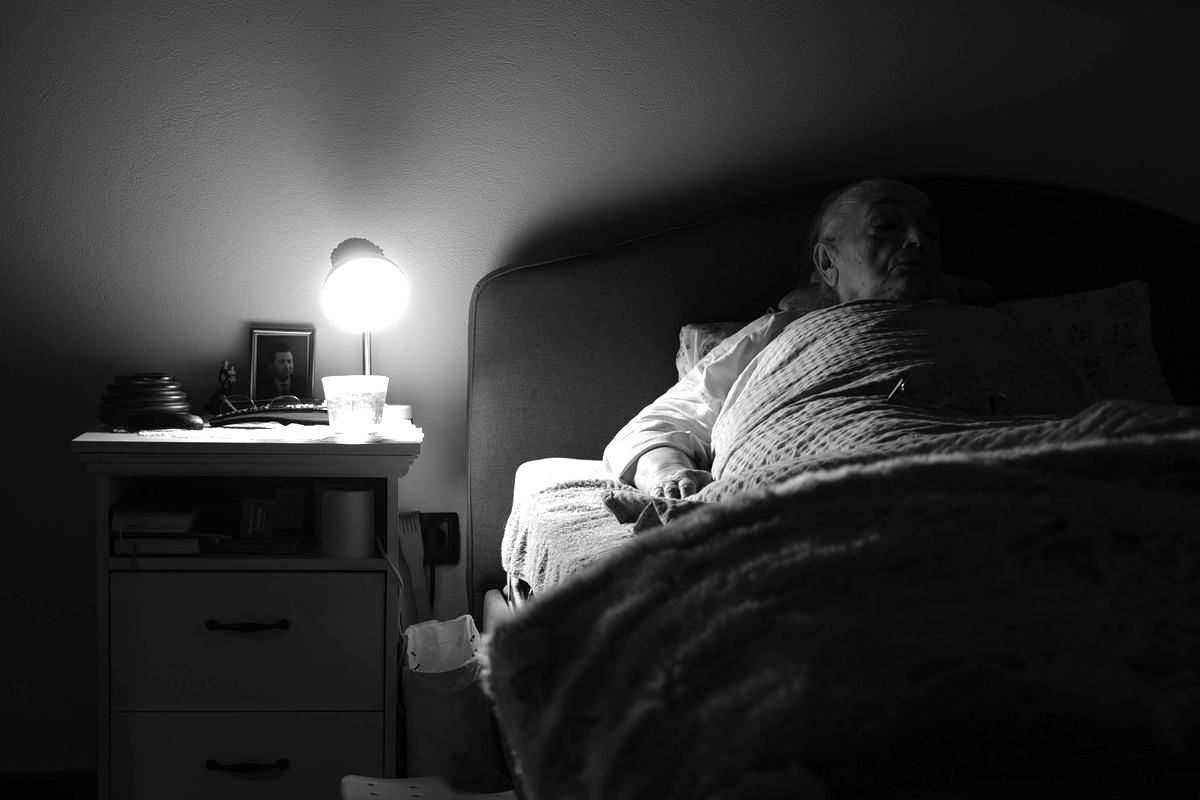
Ask any falls-prevention nurse where she worries most, and the night route comes up immediately. The person is half asleep. Blood pressure dips when they stand. The hallway is dark, the bathroom is urgent, and slippers slide. There is no official percentage for night falls on the CDC page — we checked, and we will not invent one — but the risk factors the CDC and WHO both name (poor lighting, dizziness on standing, medicines that cause drowsiness, hurrying) all stack up on this one short walk.
The countermeasures are wonderfully low-tech. Light the route so nobody has to choose between waking the house and walking blind: our guide to motion sensor night lights for the elderly walks through placement from bed to bathroom door. Keep the path itself empty — no laundry baskets, no charging cables, no grandchild's toy truck. And if getting out of bed is itself a wobble, a bed rail gives a handhold for the sit-up-and-stand that starts the whole journey.
Stairs, Hallways and the Body's Own Balance
Some falls are the house's fault. Others are the body's quiet changes: weaker legs, slower reflexes, a balance system that no longer corrects a trip the way it did at fifty. The WHO is clear that risk rises with impairments in balance, strength, gait and vision — and that these are not fixed facts. Balance and strength respond to training at almost any age, which is why the exercise evidence in the prevention section below is so strong.
At home, the body's changes show up as furniture-walking (a hand trailing along walls and chair backs), avoiding stairs, or dread of uneven ground. Those are signals, not character flaws. The honest responses are a proper walking aid fitted to the person — our walkers for seniors with balance problems guide explains the fit checks — solid handrails on both sides of stairs, and an honest family conversation about which rooms are actually used. A walker that lives in the garage helps no one; a walker adjusted to wrist height and kept by the bed changes the arithmetic of every single day.
Medicines, Eyes and Ears: The Hidden Multipliers
Here is the part of the statistics most families never hear, and it comes straight from the National Council on Aging's published figures. People with vision loss have almost twice the risk of falls as adults without vision impairment. People with hearing loss are nearly three times as likely to fall as those with normal hearing — and wearing a hearing aid consistently is associated with about a 50% lower fall risk (research published in the Journal of the American Geriatrics Society, 2023, cited by NCOA). Add the medicines: NCOA lists medication side effects and interactions — dizziness, fatigue, blood-pressure dips — among the core falls risk factors, and the CDC's STEADI programme exists largely to get those medicines reviewed.
Vision and hearing checks are the cheapest falls prevention nobody markets: an updated glasses prescription, cataract follow-up, a hearing test. And because so many falls go unreported, families who live far away should know there is a technology backstop — devices that notice a fall and call for help even when nobody can reach a button. Our guide to fall detection devices for elderly parents explains the options honestly, including what they cannot do.

What Actually Prevents Falls: The Honest Evidence
This is the section we most wanted to write, because it is where statistics turn into agency. Two findings from the World Health Organization's falls fact sheet, both drawn from Cochrane reviews — the most careful summaries of trial evidence in medicine:
Exercise works. Programmes that challenge balance and build functional strength reduced the rate of falls by about 23% in trial populations (Cochrane review, cited by WHO). Tai chi is named by WHO as another useful option. This is not "stay active" as a slogan; it is a measured effect, roughly one fall in four prevented, from the least medical intervention on this page.
Fixing the home works — for the people at highest risk. A 2023 Cochrane review found that home fall-hazard assessment and modification reduced fall rates by 38% in people already at elevated risk, though the same effect was not demonstrated in unselected, lower-risk groups (WHO). Read that honestly: a grab-bar-and-lighting weekend is not a magic shield for everyone, but for a parent who has already fallen, or who has the risk factors above, it is among the best-evidenced things a family can do.
Everything else follows from the numbers. Review the medicines. Fix the eyes and ears. Light the night route. Clear the clutter that NCOA names among home hazards. And do it as a system, not a shopping list — the CDC's whole STEADI approach, and WHO's Step Safely package, are built on the same idea: safer people, safer environments, safer habits, together.
What a Fall Costs a Family
Money is not the most important part of this story, but it is the part that decides whether a family can afford care afterwards — so here are the NCOA-published figures, plainly. Based on 2020 data, the total health-care cost of non-fatal older-adult falls in the United States is about $80 billion per year, up from $50 billion in 2015. Medicare pays 67% of fall-related costs; families and private payers carry 29% out of pocket. The average fall injury costs about $18,658 per inpatient hospital visit and $1,112 per emergency department visit. And the bill is still rising: the cost of treating fall injuries among older adults is projected to exceed $101 billion by 2030.
Set that beside the cost of prevention — a few grab bars, a shower chair, better bulbs, a home check — and the economics argue themselves. But keep the order of values straight: the $18,658 is the smallest loss in a bad fall. The real currency is independence. The WHO's cycle — fall, fear, less movement, more frailty — is what families are actually buying their way out of when they fix a bathroom.
Check Your Own Home: Two Free Tools
Numbers persuade; checklists finish the job. We built two free tools for exactly the moment a reader finishes a page like this one and thinks, "fine — but what about our house?"
Curators, librarians, clinicians and community groups are welcome to link to this page and both tools — that is what they are for. Everything here is free, and the statistics above may be quoted with their sources named, exactly as we have named them.
Sources
Every figure on this page was read on one of these official pages on 22 October 2026. Where a number comes from a study those bodies cite, we say so beside the number itself.
- Centers for Disease Control and Prevention — Facts About Older Adult Falls (1-in-4, telling the doctor, doubling risk, 1-in-10 injuries, hip-fracture figures, TBI).
- Centers for Disease Control and Prevention — About Older Adult Fall Prevention (over 43,000 deaths and about 4.5 million emergency visits in 2024; WISQARS data).
- National Council on Aging — Get the Facts on Falls Prevention (14 million fallers, 2021 deaths and ED visits, $80 billion cost, per-visit costs, $101 billion projection, vision and hearing risk figures).
- World Health Organization — Falls fact sheet (842,000 deaths worldwide in 2023, 71% aged 60+, exercise −23% and home-modification −38% findings from Cochrane reviews).
Last updated: October 22, 2026. We re-check the figures on this page against the sources above whenever the CDC, WHO or NCOA publishes new data.
Frequently asked questions
- How many seniors fall each year?
- In the United States, about 14 million adults aged 65 and older fall each year — more than 1 in 4 of that age group, according to CDC figures published by the National Council on Aging. Worldwide, falls caused about 842,000 deaths in 2023 across all ages (WHO).
- What percentage of seniors fall each year?
- More than 25% — the CDC puts it as "more than one out of four" older people falling each year. The share rises with age and with risk factors such as poor balance, vision loss and certain medicines.
- How many older adults die from falls each year?
- The CDC counted over 43,000 fall deaths among Americans aged 65 and older in 2024, making falls the leading cause of injury death for that group. In 2021, the figure was 38,000 deaths, with about 3 million emergency department visits (CDC figures published by NCOA).
- Are falls the leading cause of injury for older adults?
- Yes. The CDC and the National Council on Aging both describe falls as the leading cause of fatal and non-fatal injuries among older adults — ahead of every other injury type in this age group.
- What happens after a senior falls once?
- The chance of falling again doubles, according to the CDC. A first fall also often starts a confidence spiral: less movement, weaker muscles and balance, and a higher risk next time — which is why a first fall should always trigger a review, not just recovery.
- Do most seniors tell their doctor after a fall?
- No. Less than half of older adults who fall tell their doctor, according to the CDC — often from embarrassment or assuming it was a one-off. Telling the doctor matters because many causes, including medicine side effects, can be found and fixed.
- How many hip fractures are caused by falls?
- Most of them. The CDC reports that falls cause 83% of hip-fracture deaths and 88% of emergency department visits and hospitalisations for hip fractures, and that nearly 319,000 older adults are hospitalised for hip fractures each year.
- Can a fall cause a brain injury?
- Yes. Falls are the most common cause of traumatic brain injury (TBI) in older adults, according to the CDC. Any head strike during a fall — especially for someone on blood thinners — needs prompt medical attention.
- How much do falls cost each year?
- Based on 2020 data, the health-care cost of non-fatal falls among older adults is about $80 billion a year in the United States, and the cost of treating fall injuries is projected to exceed $101 billion by 2030 (National Council on Aging).
- How much does one fall cost in hospital bills?
- On average, about $18,658 for an inpatient hospital visit and $1,112 for an emergency department visit, according to figures published by the National Council on Aging. Medicare pays about 67% of fall-related costs overall.
- Does exercise really prevent falls?
- Yes — it is one of the best-proven measures. The World Health Organization, citing a Cochrane review of the trials, reports that exercise programmes which challenge balance and build strength reduced the rate of falls by about 23%.
- Do home safety changes actually reduce falls?
- For people already at higher risk, yes. A 2023 Cochrane review found home fall-hazard assessment and modification cut fall rates by 38% in higher-risk groups. The same effect was not shown for unselected lower-risk groups, which is why a risk check comes first.
- Do poor vision or hearing increase fall risk?
- Yes. People with vision loss have almost twice the fall risk of adults without vision impairment, and people with hearing loss are nearly three times as likely to fall — while consistent hearing-aid use is associated with about a 50% lower risk (figures published by the National Council on Aging).
- What is the single most useful first step after reading these numbers?
- Check the home, room by room. Our free Home Safety Score takes about 3 minutes and ranks the fixes that matter most, and our printable aging-in-place checklist covers the same walk-through on paper. Then book the medicine, vision and hearing reviews — the statistics say those checks find risks no product can.