
Best Hearing Aids in Australia for Seniors: Prices, Costco & Funding
Hearing Services Program funding, Hearing Australia tier prices, Costco Australia's $2,199.99 packages, and the TGA rules on over-the-counter devices — Australian prices checked 31 October 2026.
Affiliate disclosure: As an Amazon Associate I earn from qualifying purchases. The picks come from research into Australian prices, Hearing Services Program rules, and real fitting costs — check the current listing before you buy. It costs you nothing extra and keeps this site free. Read our affiliate disclosure.
The short answer
If you only read one paragraph, read this one. For most Australian seniors, the best first step is a diagnostic hearing test with an audiologist or audiometrist, then — before buying anything — a check of whether you may be eligible for the Australian Government Hearing Services Program (HSP), which may provide a fully subsidised hearing device at no cost to you if a device is needed. Buying privately, Costco Australia's four packages, reported at $2,199.99 per pair, are the value anchor, and Hearing Australia's published tiers run from $0 subsidised (Essential) to $7,995 in its "HSP subsidised price" column (Premium), prices correct as of 1 June 2026 — see the label warning in the costs section. The audiogram, fitting, and follow-up matter as much as the name on the device. All prices AUD, seen 31 October 2026 — confirm before buying.
Our verdict, up front: test first, check funding second, buy third. A hearing aid is a TGA-regulated medical device programmed to your hearing loss, not a consumer gadget. No distinct Australian OTC category equivalent to the US FDA framework exists as of 2024; online amplifiers are not hearing aids.
We did not fit or test these hearing aids on patients. Sources were read 31 October 2026; conflicts are shown with scopes. This guide is general information only, not medical advice: sudden hearing loss, one-sided loss, ear pain, discharge, dizziness, or one-sided ringing should be assessed promptly by your GP, an audiologist or audiometrist, or an ENT specialist before you buy anything. HSP eligibility, vouchers, and outcomes are decided by the program, not by this guide or any seller — check eligibility on the official health.gov.au checker.
The picks at a glance
Every pick is a prescription device fitted by a qualified clinician. Prices are per pair unless stated otherwise, approximate, and seen 31 October 2026. Ask every provider: per aid or per pair, inclusions, and later costs.
| Pick | Best for | Price (as stated, AUD) | Watch out for |
|---|---|---|---|
| Phonak Audéo Sphere Infinio | Speech in noisy rooms | $1,895–$4,150 (i30–i90) — scope ambiguous | Scope unstated; get a written quote |
| Oticon Intent | Speech in noise | No verified Australian price found | Get a written quote |
| ReSound Vivia | Comfort, connectivity, tinnitus support | No verified Australian price found | Check current model name |
| Widex / Starkey / Signia | Natural sound; health tracking; discreet fits | No verified Australian price found | Check generation currency |
| Costco Australia | Best value | $2,199.99 per pair, all four packages (secondary report) | Membership; 15 locations; HSP unverified |
| Hearing Australia tiers | HSP-eligible buyers | "HSP subsidised price" $0–$7,995; standard $1,995–$9,995 (1 June 2026) | Label warning applies; in-ear fee extra |
| Specsavers Advance Standard (HSP) | HSP clients, Standard range | $0 out-of-pocket with the HSP, conditions apply | Secondary figures — confirm in writing |
The private market is usually described in bands of roughly $1,000 to $6,000 or more per device — which is why this guide gives no single "typical price". If cost is the barrier, check the HSP first: a fully subsidised device must be offered at no cost to you if a device is needed, and the program states fully and partially subsidised devices are equally effective at amplifying sound.
Prescription vs over-the-counter: the Australian TGA rules
Hearing aids are regulated medical devices. The Hearing Care Industry Association states all hearing devices are vetted by the Therapeutic Goods Administration (TGA) before sale in Australia, classed as medical devices under the Therapeutic Goods Act 1989 and the Medical Devices Regulations 2002. Any product sold as a "hearing aid" must be TGA-registered. Ask whether a device is TGA-registered or listed on the Australian Register of Therapeutic Goods (ARTG), and buy from a registered Australian provider.
There is no distinct Australian over-the-counter category. The Audiology Place (Sydney, updated October 2026) states that as of 2024 there is no distinct OTC category in Australian law equivalent to the US FDA framework. What is marketed as "OTC" or as a hearing amplifier is, in that clinic's account, an imported US FDA OTC device (which may not comply with TGA requirements), an unregulated personal sound amplification product (PSAP), or a grey-market import. TGA agrees: approval is required regardless of channel.
Amplifiers and PSAPs are not hearing aids. EarPros states PSAPs are not regulated as medical devices for hearing loss treatment, cannot be customised to a loss, and may over-amplify sounds, potentially causing further damage. A real hearing aid is programmed to your audiogram, manages feedback, and is fitted and followed up by a clinician. If no clinician will program, verify, and adjust it, do not buy it as a hearing aid. (See the 11 April 2025 Better Hearing Australia advisory on ads misusing its name.)
Online purchase is not one thing. Buying online with local clinician fitting — Hearing Choices describes partner-clinic fitting, a 45-day no-obligation trial with full refund, and the clinician's services included except the initial test (snippet-only; confirm terms) — differs entirely from self-fit devices with no clinician. Only the first involves a diagnostic test, prescription programming, and real-ear verification. The Hearing Care Industry Association warns an unfitted online device may waste money and prove unserviceable here.
What a prescription fitting involves. At The Audiology Place the diagnostic battery takes about 45 minutes: pure-tone audiometry (250 Hz–8,000 Hz), bone conduction, tympanometry, speech discrimination in quiet and ideally in noise, and otoscopy. Programming follows NAL-NL2/DSL targets, verified by real-ear measurement. Follow-up is typically at four to six weeks. Audiologists (Masters-level, all ages) and audiometrists (Diploma/TAFE or Bachelor, primarily adults, non-implantable devices) are both the qualified route. Insist on a qualified clinician, an audiogram copy, and a written quote.
Red flags. Self-fit devices do not suit: no proper test in the past year; asymmetrical loss (more than 15 dB between ears at two or more frequencies, one clinic's criteria); sudden changes; middle-ear disease history; speech-in-noise as the main complaint. Do not treat with amplification first: impacted wax, otosclerosis, chronic middle-ear infection or cholesteatoma, sudden sensorineural loss, vestibular schwannoma, Ménière's disease. Sudden/one-sided loss, ear pain, discharge, dizziness, or one-sided ringing: assess promptly, before any purchase.
Apple AirPods Pro 2: a narrow, approved option. Its Hearing Aid Feature was TGA-approved on 17 December 2024 (Class IIa, ARTG) and enabled in Australia on 26 March 2025, for adults 18+ with perceived mild-to-moderate impairment, using a five-minute Hearing Test, self-fitting. A narrow mild-loss option for tech-comfortable iPhone/iPad users, after a diagnostic test if any red flag exists — never a substitute for assessment of greater, one-sided, or sudden loss, or pain/single-sided ringing. No position is stated here on AirPods Pro 3: reports conflict on its TGA status and no current price is verified.
The styles, and which suits whom
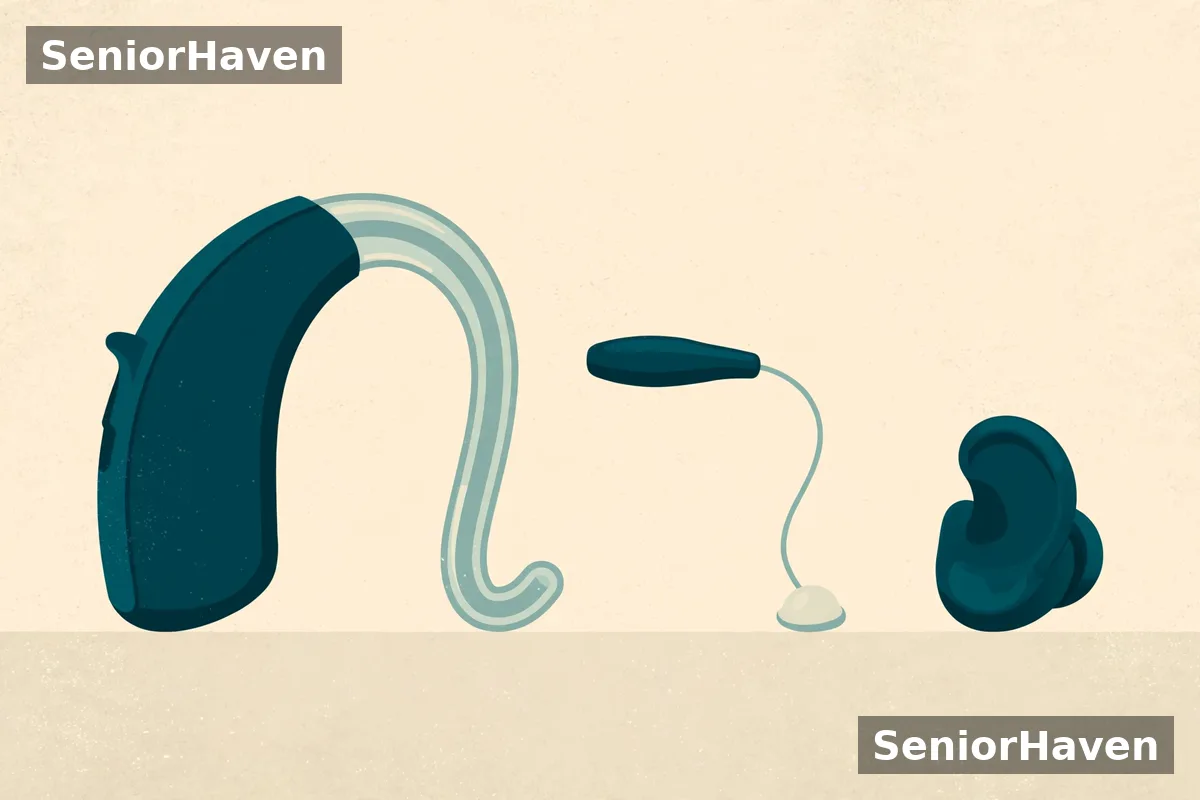
Style decides comfort, handling, discretion, and power — less than fit and programming, but still important. Descriptions follow Hearing Australia's products page.
| Style | How it sits | Best for | Trade-offs |
|---|---|---|---|
| BTE (behind-the-ear) | Behind the ear; tube to earmould/dome | All loss incl. severe; small canals; limited dexterity | Most visible; impressions; easiest to handle, most power |
| BTE Mini | Smaller behind-the-ear unit | Smaller behind-the-ear aid | Shorter battery life |
| RIC / RITE / RIE | Unit behind ear; wire to speaker in canal | Most popular; mild to severe; discreet | Regular cleaning; domes/wax guards need changing |
| ITE / ITC | Custom shell in outer ear/canal | People who dislike behind-the-ear units | Loss range differs by source — ask; less room for features |
| CIC / IIC | Tiny shell deep in canal | Maximum discretion; mild to moderate only | Hard to handle if dexterity is an issue; not for severe loss |
| CROS / BiCROS | Transmitter on poorer ear, receiver on better ear | Single-sided loss (CROS); one ear not aided (BiCROS) | No rival "best of" page covers them; ask your clinician |
| Assistive listening devices | Personal amplifiers; TV headsets | Cannot wear/control hearing aids | Larger controls; HSP-funded for eligible clients |
Dexterity decides: if small batteries and tiny domes are a struggle, a larger BTE or rechargeable RIC will be worn daily, while a discreet aid left in a drawer helps nobody. Power decides: severe loss needs a BTE or powerful RIC; a tiny CIC cannot do that job. Do not rely on claims that CIC suits all loss types. Hearing Australia prices are over-the-ear only; in-the-ear aids add $100 per aid ($200 per pair).
The prescription picks, in detail
No brand is objectively "the best" — Hearing Matters states that plainly. Check generation currency; 2026 snippets name newer models (Reveal, Sensia, Omega AI, Allure AI).
Phonak Audéo Sphere Infinio — best overall, with an ambiguous price
Hearing Matters calls Phonak the most widely fitted brand in Australia. The Audéo Sphere Infinio (i30, i50, i70, i90) has AutoSense OS 7.0, a DEEPSONIC AI chip, Spheric Speech Clarity 2.0, rechargeable power, and accessories including a TV Connector, Roger remote microphone, and PartnerMic (EarPros). Price scope is the problem: EarPros lists i30 $1,895–$1,995, i50 $2,790–$2,995, i70 $3,290–$3,490, i90 $3,875–$4,150 (AUD) without stating per-aid or per-pair, or included fitting/service. Do not read these as per-pair prices. Get a written quote stating scope.
Search Amazon.com.au for Phonak hearing aid cleaning kits — brushes and wax-guard tools for any receiver-in-canal aid
Oticon Intent — best for speech in noisy places
Oticon's BrainHearing philosophy aims for a fuller, more natural soundscape (Hearing Matters, Hearing Choices). The Intent has 4D sensors, tinnitus SoundSupport, Bluetooth LE Audio, and Auracast readiness. Do not take any model as fully subsidised without checking the HSP schedule. No verified Australian price for the Intent was found on an opened page on 31 October 2026. Two snippets conflict: "From $5,495 (per pair)" beside Reveal and Intent headings (cannot be attributed to Intent), and a seller blog's Intent 1 "from A$3,200" (scope unstated). Ask for a written quote.
ReSound Vivia — comfort, connectivity, and tinnitus support
ReSound (GN) is named for comfort, connectivity, and tinnitus support. Jabra Enhance Pro 30 at Costco Australia is GN technology from the same group — but forum equivalence claims to a named ReSound model are anecdote, not manufacturer fact, and no equivalence is stated here. A snippet-only EarPros table lists Vivia 5 $2,700+, Vivia 7 $3,200+, Vivia 9 $3,800+ (AUD, receiver-in-canal), scope unstated. That is not a verified price; none is stated here. Check generation, bundle, and included tinnitus support.
Widex, Starkey, and Signia — ask for the written quote
No verified Australian price was found on an opened page for any of these, so none is stated rather than guessed. Widex: natural, low-delay sound, tinnitus therapy in select models (2026 name Allure AI; Moment is older). Starkey: health tracking, fall detection/alerts, activity monitoring, made-for-iPhone (Edge AI; 2026 snippets: Omega AI). Signia: own-voice processing, earbud-style streaming (Pure Charge&Go IX). Philips HearLink at Costco is made by Demant, Oticon's parent (Hearing Choices Australia). Sennheiser's parent is unstated on the Australian page opened. Insist on a written quote: per-aid or per-pair, bundle, warranty years, trial terms.
Costco Australia: the two questions, answered with named models
Which hearing aids does Costco Australia sell? Hearing Choices Australia's Costco page (opened for this guide) reports four packages, all at $2,199.99 per pair, each with two premium rechargeable aids and one charger: Rexton Reach with travel charger; Philips HearLink 9050 miniRITE with Charger Plus; Jabra Enhance Pro 30 Micro RIE with premium charger; Sennheiser Sonite with premium charger and TV Connector. It states a three-year warranty, member-service appointments, a 180-day guarantee, and 15 locations. Prices may vary; earmoulds extra. Membership is required; the fee was not stated and is not stated here. Reported figures — confirm at your warehouse. Never use US Costco prices for Australia.
Are Costco hearing aids as good as hearing aids from an audiologist? The technology is comparable; the service model is different. Costco aids are prescription devices fitted by hearing specialists, with follow-ups included as a member service, at a flat pair price well below most private-clinic premium quotes. You give up brand choice (four packages; no Phonak, Oticon, Widex, or Starkey) and depend on reaching one of 15 locations. Ask which package suits your audiogram, trial/return conditions in writing, adjustment elsewhere if you move, phone/tinnitus comparisons, and whether Costco accepts HSP vouchers — not verified here; do not assume either way. Complex cases belong with a private clinician first.
Specsavers: the $0 claim with its conditions. Specsavers Australia's own page states "$0* hearing aids" with "no out of pocket costs on Specsavers Advance Standard hearing aids with the Hearing Services Program" — "Conditions apply", "Standard range only". Fuller figures are secondary-only (EarPros snippet): from $500 for eligible HSP customers; non-HSP from $1,495 per pair (Standard range); including assessment/check, a pair of digital aids, 12 months' free aftercare and batteries, four-year warranty on aids/accessories, and a 90-day satisfaction guarantee. Confirm in writing at the store.
What hearing aids really cost in Australia
Clinics bundle different things into the headline figure, so the same technology costs different amounts at different clinics.
Hearing Australia's published tier prices — read the label warning first
Hearing Australia (the government provider) publishes the only complete tier price table found here, correct as of 1 June 2026, for over-the-ear aids only; in-the-ear aids add $100 per aid ($200 per pair) for the mould.
| Tier | "HSP subsidised price" (page label, verbatim) | "Standard price" (page label, verbatim) |
|---|---|---|
| Premium (AI-assisted, rechargeable, Auracast) | $7,995/pair | $9,995/pair |
| Advanced (rechargeable, Auracast, no AI) | $5,795/pair | $7,995/pair |
| Select (rechargeable, Auracast) | $4,195/pair | $6,295/pair |
| Essential Plus (rechargeable, Auracast) | $1,995/pair | $4,295/pair |
| Essential (not rechargeable, no Auracast) | $0 subsidised | $1,995/pair |
The page does not state whether the "HSP subsidised price" is the client's out-of-pocket gap, the subsidy amount, or something else, beyond: "Eligible clients under the HSP receive a voucher which may be used toward a fully/partially subsidised device & related services." Essential at "$0 subsidised", alongside health.gov.au's statement that a fully subsidised device is offered at no cost if needed, is consistent with $0 out of pocket for that tier. Other columns must keep the page's labels and the 1 June 2026 date, plus "check current pricing and get a written quote".
Guide ranges — conflicting, shown separately
EarPros (opened, secondary aggregator). Basic $1,000–$2,500 per device; mid-range $2,500–$4,000; premium $4,000–$6,000+; per pair therefore about $2,000–$12,000. Includes: consultation/test, custom earmoulds, fitting/programming, follow-up adjustments/cleaning, 1–3-year warranty. Excludes: replacement batteries/charging ports, drying kits/dehumidifiers/cleaning tools, extended warranties/premium support.
The Audiology Place, Sydney (opened). Private prescription aids around $1,500–$4,000 per device, usually including initial fitting, first-year follow-ups, real-ear verification, and adjustments; some practices charge separately. Diagnostic test around $80–$150 without bulk-billing. Online/imported OTC-style devices around $300–$2,000 per pair.
Independent Hearing, South Australia (opened). Own-brand tiers including two aids, free fitting/programming, and 12-month aftercare: Standard from $1,495/pair; Plus $1,995; Premium $2,495; Elite $3,495; rechargeable +$500 in every tier. 30-day money-back; 14-day trials. House labels, not brands.
Bundled vs unbundled. Bundled = one price for aids plus service (30 days to lifetime appointments); unbundled = device price separate from service price (Hearing Choices). Inquiry material criticised bundling for obscuring the true device cost. Ask for the quote split — device, fitting, follow-ups, warranty, batteries, accessories — plus your audiogram copy, so a second provider quotes on the same facts.
Then the unquoted costs. Search Amazon.com.au for size 13 hearing aid batteries — consumables are a steady cost for disposable-battery aids; rechargeables bring a charger and eventual battery service. Ask repair costs out of warranty, loss/damage cover, and loaner availability. TV streamers, remote microphones, and drying boxes are often extras. No Australian retail price for batteries, wax guards, domes, cleaning kits, dryers, or streamers was verified on an opened Australian page, so none is quoted; US dollar figures were not converted. The largest hidden cost is buying twice: an amplifier, then a prescription aid.
Hearing Services Program funding: check before you buy
This is the centre of the Australian picture, and no rival "best of" page opened here covers it in full. All of this section is from the Department of Health, Disability and Ageing health.gov.au HSP pages opened 31 October 2026, unless stated otherwise. Eligibility, vouchers, and outcomes are never promised. Check the official eligibility checker. Contacts: 1800 500 726, [email protected].
Official page, verbatim: "A Commonwealth Seniors Health Card does not provide eligibility for the program."
| HSP topic | What the official pages state (31 Oct 2026) |
|---|---|
| Who may be eligible | "You are eligible for the voucher scheme if you are an Australian citizen or permanent resident or live on Norfolk Island, are aged 21 years or older, and are:" a Pensioner Concession Card holder or spouse; Veteran Gold Card holder or spouse; Veteran White Card holder (hearing-specific conditions) or spouse; Australian Defence Force member (all permanent/continuous full-time service); or a person referred by an Inclusive Employment Australia provider. Clinic pages saying 26+ conflate pathways; 21+ governs. |
| Voucher | Valid five years from issue. One fitting and one assessment every five years, unless circumstances change; further services need "revalidated service" approval. Covered: assessments, fitting, follow-ups, maintenance, extra rehabilitation, specialist services, annual reviews. |
| Fully vs partially subsidised | The program might cover the full cost (fully subsidised, you pay nothing) or part of it (partially subsidised, you pay the rest). Both amplify equally; partially subsidised devices might have extra non-essential features. If you need a device, your provider must offer a fully subsidised option at no cost to you. For a partially subsidised device, the program subsidises what a fully subsidised device would have cost and you pay the rest — a gap that "can be substantial". The provider must quote model/style, maintenance/repair costs, returns policy, trial period, warranty period, and subsidy amount. Commissions/targets must be disclosed. |
| Threshold | Minimum 23.3 dB three-frequency average (0.5, 1, 2 kHz), per ear; exceptions exist. Assessment decides. |
| Maintenance agreement | Must be offered when fitting an approved device. You pay a small annual fee; the program pays the provider a subsidy. Fully subsidised: about $50 a year, indexed annually. Partially subsidised: a higher fee may be set, negotiated with you, stated in advance. Supplies batteries for the term plus earmould cleaning/renewing/repair, aid cleaning, thin tube, dome, wax-guard, microphone, and ear-hook replacement, battery-compartment checks, and adjustments. Rechargers are not covered. Ask about charger cost and postal batteries/parts. Not included: wax removal, balance assessments/treatment, tinnitus assessment/treatment, repairs/maintenance without an agreement, extra home-visit costs. |
| Veterans, DVA, NDIS | DVA pays the maintenance cost for Gold/White (hearing loss) holders if a device is fitted and follow-up attended — in full for a fully subsidised device only; part only (you pay the gap) otherwise. Your provider claims it; you do not apply. Veterans may also get DVA assistive listening devices/tinnitus treatment via provider-sought approval. Do not buy first and claim back: DVA prior approval must precede supply. NDIS participants who meet HSP requirements access hearing support through the HSP, not the NDIS; additional supports might come via the NDIS — check with the NDIA/planner. Hearing-aid banks (e.g. HCIA, working-age/low income) supply reconditioned devices under specific criteria. |
| Devices and replacements | Beyond hearing aids: CROS, BiCROS, assistive listening devices (personal amplifiers, television headsets — program-funded), and remote controls at no cost if you cannot manage controls and have no smartphone app access. Lost/damaged: give the damaged device to your provider for manufacturer assessment, or complete a Commonwealth statutory declaration for loss, and pay a small replacement fee (a fraction of actual cost — amount not stated on official pages opened, not stated here). No fee for DVA Gold/White (hearing loss) holders, facility/hospital loss, courier/Australia Post loss, or dementia. |
| Community Service Obligations (CSO) | Hearing Australia also serves under-26s, Aboriginal or Torres Strait Islander people 50+ or in the Community Development Program, and voucher-eligible people in remote areas (Modified Monash Model 6–7) or needing specialist services. Eligible for both? Either may be chosen. |
| How to apply | Online (name, date of birth, eligibility number e.g. Centrelink/DVA reference, contact details) — the system tells you straight away if successful. Or via a provider (directory; provider applies for you), or by post/email (paper: 3–4 weeks). Reconsideration within 28 days; review within 90 days. Confirm whether a GP medical certificate is required. |
Private health insurance and Medicare — check your fund, not a headline figure
Hearing-aid benefits sit under extras cover, not hospital cover. Fund summaries show: commonly a 12-month waiting period; replacement cycles of three years (some funds) or five years/60 months (others); example caps $400–$1,600 by fund/level (Bupa up to $1,200/3 years at 80%; Medibank up to $1,200, 36-month waiting period — fund-specific). One Sydney clinic: often $500–$1,500 per aid by cover level (unattributed). Health.gov.au adds only that private health might cover some of the partially-subsidised gap. No single figure is "what you get". Check fund, level, waiting period, sub-limit, and replacement cycle in writing. Medicare: routine adult aids and most private audiology consultations are not covered (clinic summaries). Diagnostic tests may attract a rebate with a doctor's referral (GP referral sufficient since 1 March 2023, per clinic summaries); bulk-billing varies; a gap may apply. No item numbers/rebate amounts were verified officially; none are quoted.
The hearing test: what actually happens
You need an audiogram before buying: a professional test mapping loss across frequencies, deciding suitable aids and whether program thresholds are met. A free 15-minute hearing check (Specsavers; Hearing Australia adult check) is a screening that flags a problem. A comprehensive assessment (about an hour; about 45 minutes for the diagnostic battery at one Sydney clinic) examines the ear, measures thresholds, and tests speech understanding. Confirm which you are booking.
Expect case history, otoscopy, pure-tone audiometry, bone conduction, tympanometry, and speech discrimination (quiet and ideally in noise). The clinician explains the audiogram — which pitches are affected, whether ears match. Ask for a copy: it is yours, and any second clinic needs it. A GP visit first is the safe route: referral to ENT/specialist audiology where needed, medical issues checked, and (per clinic summaries) Medicare rebates for diagnostic audiology supported by GP referral. Ask before booking whether the test attracts a rebate or is bulk-billed, and what gap applies. Online screenings are a first flag, not a diagnosis. Assess promptly if: sudden loss; one-ear loss; ear pain, discharge, or dizziness; one-sided ringing; rapidly worsening hearing. See a GP, audiologist/audiometrist, or ENT specialist first.
Trial periods and fitting: where good outcomes are made
Trial periods are not one standard — each provider sets its own:
| Provider / route | Trial stated | Source |
|---|---|---|
| Hearing Australia | 55 days, full refund | Own products page (opened) |
| Costco Australia | 180-day money-back guarantee | Hearing Choices report (secondary) |
| Specsavers | 90-day satisfaction guarantee | EarPros secondary summary only |
| Independent Hearing (SA) | 30-day money-back; 14-day trials | Own price page (opened) |
| Hearing Choices online | 45-day trial, full refund | Snippet-only |
| HSP devices | Period noted on the quote | Official health.gov.au wording |
Never buy without a trial; calendar the end date the day you take aids home and book the follow-up before leaving. Ask in writing: what it covers, full refund or not, restocking/fitting fees, and what happens if you need a different model or remake. Check trial period, end date, and conditions before paying.
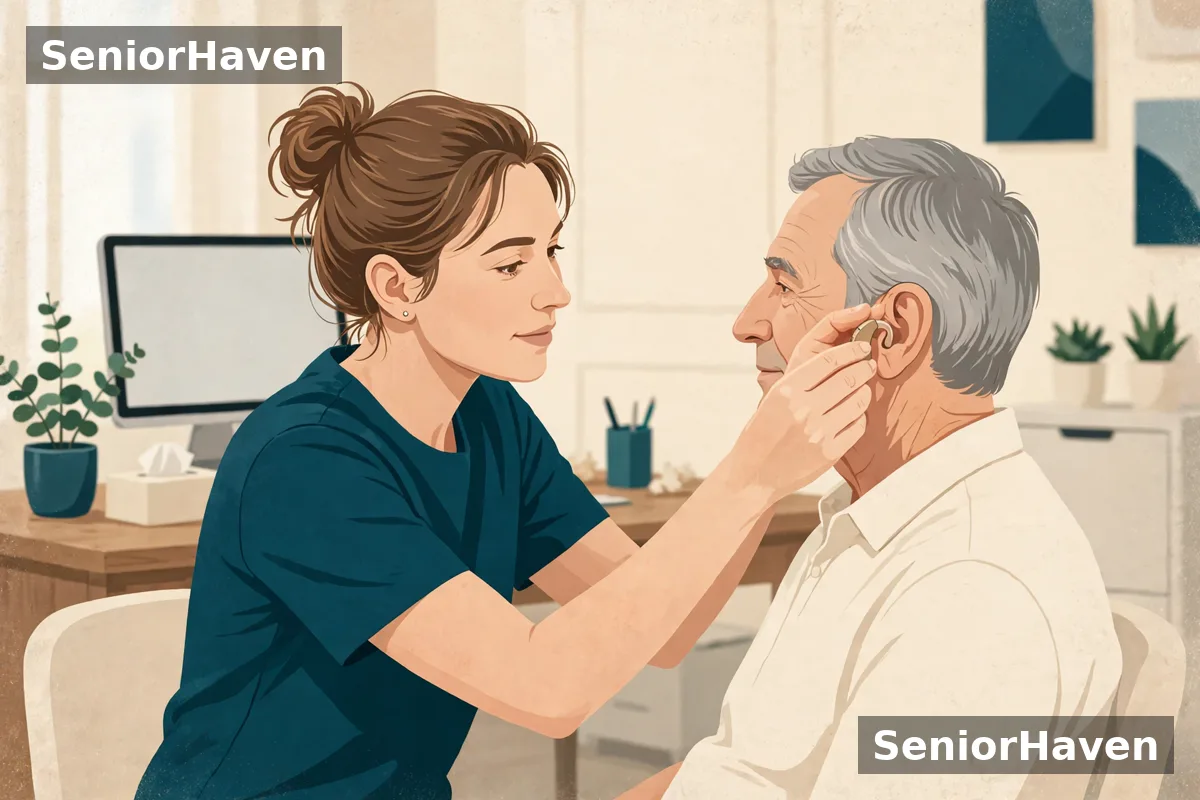
Fitting is programming. A good fitting includes real-ear verification (probe microphone measuring what the aid delivers against the prescription target) plus follow-ups as your brain adapts. If a provider will not verify or schedule follow-ups, that says something about the provider, not your ears.
The features that actually matter for seniors
Rechargeable vs disposable. Rechargeable: charge overnight, no tiny cells, no mid-day failure. Disposable zinc-air (sizes 10, 312, 13): roughly 4–10+ days per set by size/use (one Sydney clinic), instant swap, spares to carry — but tiny tabs trouble some hands. Rechargeable suits most seniors, especially with limited dexterity; disposables suit long days away from power, off-grid travel, and spare-cell preferrers, and some in-the-ear styles still favour them. Ask hours per charge for the exact model. HSP: batteries are supplied under the maintenance agreement; rechargers are not covered — ask the charger cost explicitly.
Speech in noise, directionality, feedback. Daily satisfaction turns on separating speech from background noise — directional microphones, noise processing, automatic environment detection (e.g. Phonak AutoSense). Feedback (whistling) is fixed by programming and fit; a dome/earmould remake often fixes what settings cannot.
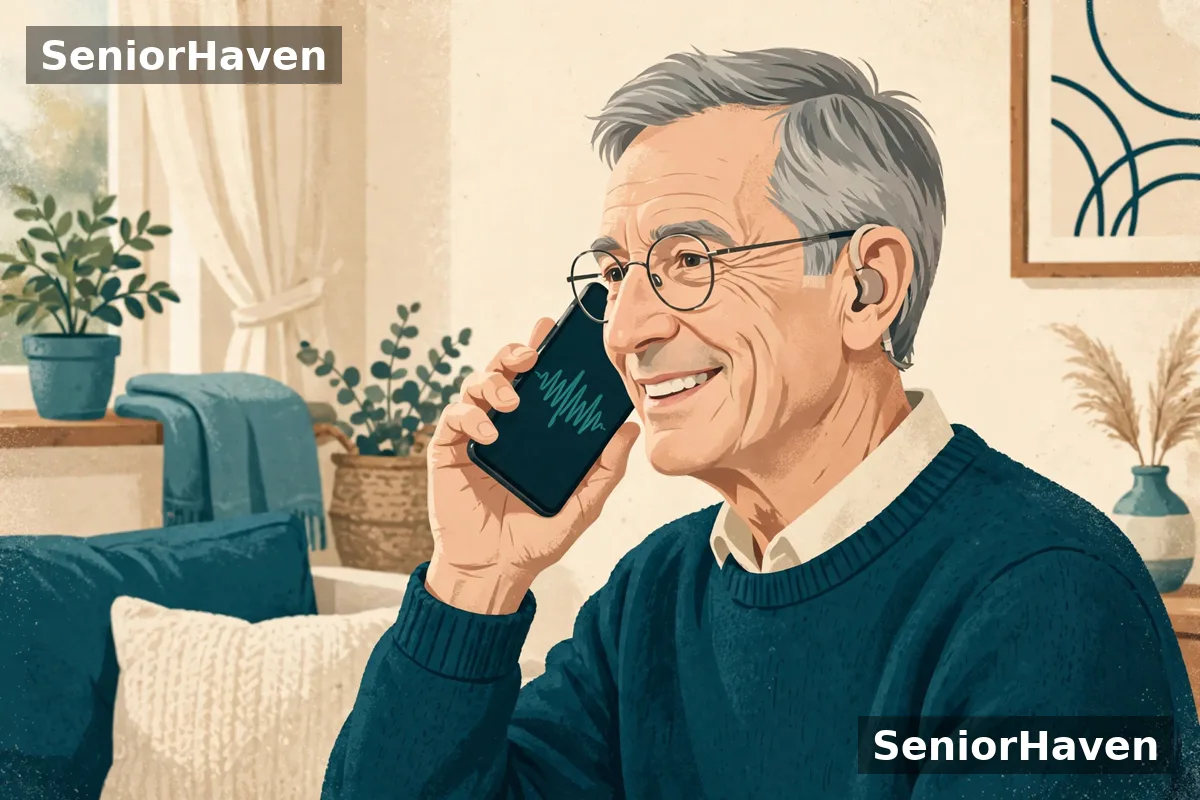
Streaming, LE Audio, Auracast — check the phone. Streaming sends calls, TV, and music to the aids. Most stream from iPhones; Android varies by brand/model — confirm the exact combination in clinic, phone in hand. LE Audio/Auracast readiness appears on newer models and Hearing Australia tiers (all but Essential).
Tinnitus. Built-in sound therapy (gentle tones/nature sounds) and restored amplification can make ringing less noticeable. No aid cures tinnitus; tinnitus assessment/treatment is not on the HSP voucher — separate GP/audiologist/ENT pathway. One-sided, sudden, or worsening tinnitus: assess before buying. Search Amazon.com.au for hearing aid remote microphones
Apps, streamers, remote microphones, remote care. Apps allow volume/program changes and sometimes remote clinic adjustments — useful for tech-comfortable wearers, optional for others; every aid must work from its button alone, demonstrated before you leave. A TV streamer is often the highest-value extra; a remote microphone helps in restaurants, groups, and at distance. Search Amazon.com.au for size 312 hearing aid batteries · Search Amazon.com.au for hearing aid cleaning kits and wax guards · Search Amazon.com.au for hearing aid dryers — accessories are the fitting Amazon purchases; aids are bought through a clinic, Costco, Specsavers, or Hearing Australia.
Realistic expectations: what a hearing aid will and will not do
A hearing aid will not restore normal hearing. Aids are not glasses for your ears: they improve audibility and, well fitted, speech understanding. A well-fitted aid makes speech clearer and everyday sounds audible, programmed to your audiogram. It will not restore normal hearing, remove all noise, cure tinnitus, or treat any condition.
Adaptation takes time. The Hearing Care Industry Association advises starting slowly — one or two hours a day — with adjustment over days (some), weeks (most), or months (some); speech comprehension may keep improving for months. Build from quiet to noisy settings; return for adjustments.
Reassurance from official sources: the HSP states fully subsidised devices help you hear just as well as partially subsidised ones — fewer extras, not inferior amplification. On lifespan/warranty, discuss a range, not a promise: one aggregator says most devices last around five years; the industry association frames a 4–5-year investment (product, services, warranty, care) with warranties up to three years; EarPros includes 1–3 years. Confirm in writing what the warranty covers (repairs, remakes, loss/damage, loaner) and post-warranty repair costs. Success: TV at household volume; conversation without repeats. Not a whisper across a crowded hall — anyone promising that is selling, not fitting.
Mistakes to avoid, and who should skip what
Buying an amplifier online. A cheap amplifier/PSAP is not a hearing aid — the commonest wasted purchase, and it may over-amplify and risk damage.
Buying before the funding check. Check HSP eligibility and complete required steps before purchase; same for private health — benefit in writing before paying.
Choosing on price alone. A low headline price with no follow-ups, a one-year warranty, and no verification is usually dearer within a year. Compare identical-inclusion written quotes, including the device/fitting/follow-up/warranty/batteries/accessories split.
Skipping the trial end date. Calendar it; book follow-up before leaving; decide deliberately. Under the HSP, the period is the one on your quote.
Ignoring ear health. Wax, infection, and eardrum problems change results and fit. Never fit an aid into an unexamined, painful, or discharging ear. Sudden/one-sided/rapidly worsening loss: GP/ENT first.
Accepting a top-up without seeing the fully subsidised option. The fully subsidised option must be offered if a device is needed; the gap "can be substantial". Take the quote home, compare providers, decide without pressure. The ACCC's 2017 report recorded commissions as high as 15 per cent in surveyed cases (generally undisclosed then), price/performance debate, and vulnerable-consumer treatment. HSP/industry rules now require disclosure of targets, commissions, and preferred-supplier arrangements — ask why this aid/brand, whether incentives apply, and whether the range is ownership-limited. Asking is not accusing any named provider. ACCC tips: compare offers, second opinion, take someone along, quote with type/cost, keep paperwork.
Who should skip online/self-fit devices: loss beyond mild-to-moderate; sudden, one-sided, or rapidly worsening loss; ear pain, discharge, or dizziness; no proper test in the past year; frustration with smartphone apps.
Daily care, batteries, and maintenance
Routine below follows Ear Science Institute Australia and Bloom Hearing Specialists guidance; intervals are one provider's guidance — follow your clinic's schedule.
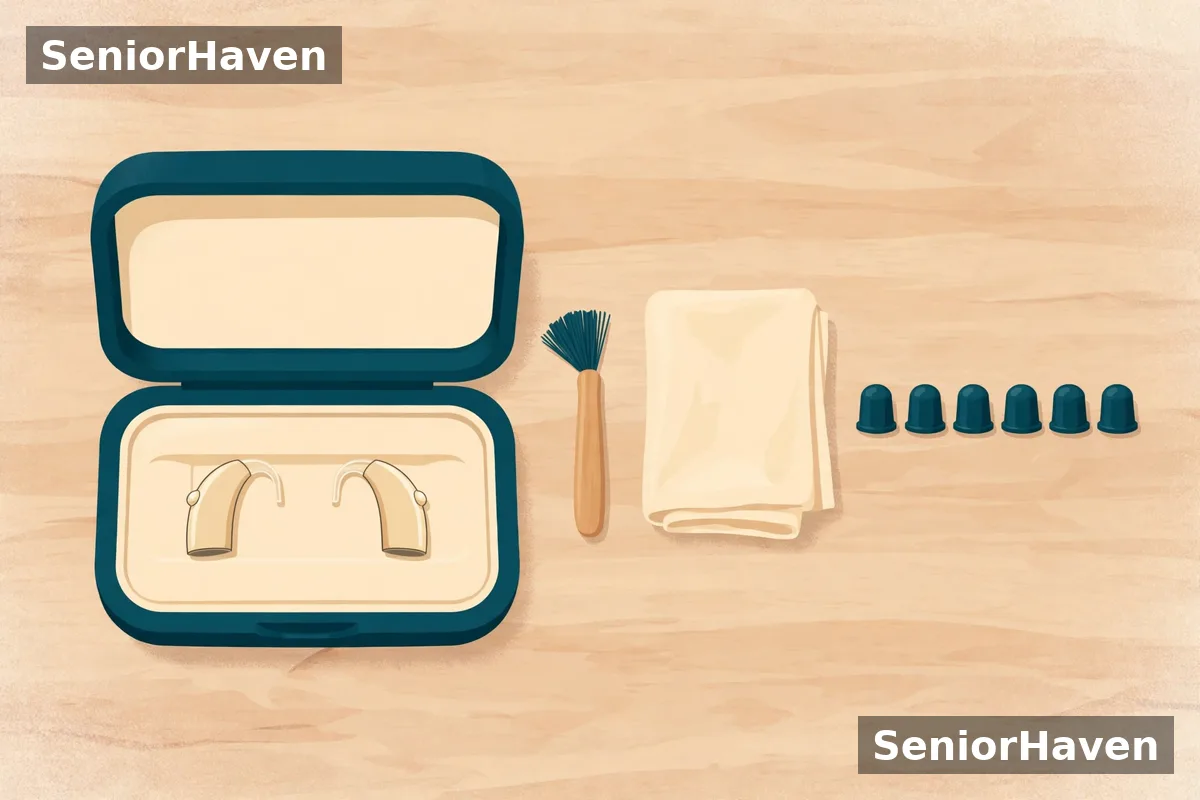
Wipe aids nightly with a soft, dry cloth; check for debris. Store in case/charger, dry and cool, away from moisture, debris, and hairspray. Disposable-battery aids: leave the battery door open overnight. Rechargeables: charge nightly, keep contacts clean. Replace domes/wax-guard filters as needed (clinic will show you); wash hands before handling. For wax build-up, ask your doctor/audiologist; avoid cotton buds. If an aid fails: check charge/battery, inspect for wax/debris, clean the mould or replace tube/dome/wax filter, then contact the clinic. Whistling/beeping is commonly wax, low battery, poor insertion/fit, or microphone debris; quiet aids are commonly blocked tubing/microphones, dead batteries, or blocked filters/domes.
Bloom guidance: visit 4–6 monthly; tubing 3–6 monthly; tips 4–6 weekly. Under an HSP maintenance agreement, batteries and listed parts/services are supplied for the term; rechargers are not covered; wax removal, balance, and tinnitus services are excluded. Private buyers: no verified AUD consumables price table exists in this research — ask the annual consumables cost in writing.
Search Amazon.com.au for hearing aid wax guards and domes · Search Amazon.com.au for hard hearing aid cases · Search Amazon.com.au for hearing aid clips and lanyards · Search Amazon.com.au for hearing aid battery testers · Search Amazon.com.au for hearing aid dehumidifier jars
If you live regionally or remotely
Follow-up access matters as much as the first fitting. HSP Community Service Obligations cover voucher-eligible people in remote areas (Modified Monash Model 6–7) or needing specialist services — ask Hearing Australia/your provider. Hearing Australia reports ~180 centres plus hundreds of visiting sites and home visits; confirm what reaches your town. Teleaudiology can cut drives for adjustments — ask if your provider offers remote follow-ups. Under an HSP maintenance agreement, ask about postal batteries/parts.
The questions to ask before you pay
Take this list to the appointment.
- Per aid or per pair? Extra fees? What is included — test, fitting, follow-ups, cleanings, warranty years?
- Quote split (device, fitting, follow-ups, warranty, batteries, accessories) and my audiogram copy?
- Real-ear verification done — can I see the result against the target?
- Trial terms in writing — length, full refund, restocking/fitting fees, different model, exact end date?
- HSP-eligible? Fully subsidised option, subsidy amount on the quote, gap for a partially subsidised device?
- Maintenance agreement: annual cost, coverage, charger/recharger covered?
- Streaming from my exact phone, demonstrated here? LE Audio/Auracast if relevant?
- Rechargeable or disposable: hours per charge; replacement battery/service cost?
- Wax guards, domes, out-of-warranty repair costs; loaner provided?
- Locked to this provider, or serviceable elsewhere if I move?
- Remote/teleaudiology adjustments? Postal batteries/parts?
- Tinnitus support features — what do they actually do?
- Telecoil, if church/hall loops matter?
- Why this brand/model for my audiogram? Any incentive/commission or preferred-supplier arrangement?
- Private health benefit in writing — fund, level, waiting period, sub-limit, replacement cycle?
- Lost/damaged: replacement process and fee?
The verdict
Our verdict, at the bottom as at the top: test first, check HSP eligibility before buying, choose the provider before the brand. For most Australian seniors: a prescription aid fitted by a qualified audiologist/audiometrist — Phonak Sphere Infinio for speech in noise (scope clear in writing); Oticon, ReSound, Widex, Starkey, Signia where quote/bundle justify them; Hearing Australia tiers; Specsavers Advance Standard at $0 where HSP-eligible; Costco's four $2,199.99 packages where membership, location, and follow-up line up. No price here should be relied on without a written quote in the same scope. The goal is not a device; it is hearing your family again without asking them to shout.
General information only — not medical advice. We did not fit or test these aids on patients. Prices/program details were read 31 October 2026 and change — confirm price, inclusions, and eligibility before buying. Sudden/one-sided loss, ear pain, discharge, dizziness, or one-sided ringing: assess promptly with your GP, an audiologist/audiometrist, or an ENT specialist before buying. Check HSP eligibility on the official health.gov.au checker — eligibility, vouchers, and outcomes are decided by the program, not by this guide or any seller. Related guidance: Seniors Card guide, Support at Home guide, home safety checklist.
Frequently asked questions
- What is the best hearing aid in Australia for seniors?
- No brand is objectively the best. For most seniors, the best aid is a prescription device fitted by a qualified audiologist or audiometrist after a diagnostic test, chosen from the audiogram. Sphere Infinio (noise), Intent (speech), Vivia (tinnitus support) lead.
- How much do hearing aids cost in Australia?
- Ranges conflict by bundle; no single typical price is given. EarPros: $1,000–$2,500 per device basic, $2,500–$4,000 mid-range, $4,000–$6,000+ premium (about $2,000–$12,000 per pair). A Sydney clinic: $1,500–$4,000 per device. Hearing Australia: $0–$7,995 subsidised column, $1,995–$9,995 standard, per pair, 1 June 2026. Costco: reported $2,199.99 per pair. All AUD, seen 31 October 2026.
- Can pensioners get free hearing aids in Australia?
- Possibly, with conditions, via the Hearing Services Program — never as a seller's promise. If aged 21+, resident, and Pensioner Concession Card holder (or another official category), you may get a five-year voucher. If a device is needed, your provider must offer a fully subsidised device at no cost to you. A maintenance fee of about $50 a year applies for fully subsidised devices (indexed), except where DVA pays it.
- Does a Commonwealth Seniors Health Card qualify for the Hearing Services Program?
- No. The official health.gov.au page states verbatim: "A Commonwealth Seniors Health Card does not provide eligibility for the program." A Pensioner Concession Card holder or spouse may be eligible, subject to age and residency conditions, but a Commonwealth Seniors Health Card alone does not qualify.
- What does the Hearing Services Program cover, including the maintenance agreement?
- Assessments, fitting, follow-ups, maintenance, rehabilitation, specialist services, annual reviews — one fitting/assessment per five years unless revalidated. It may cover the full device cost or part of it; the gap for a partially subsidised device can be substantial. The maintenance agreement costs about $50 a year for fully subsidised devices (indexed) and covers batteries plus tube, dome, wax-guard, microphone, and ear-hook replacement. Rechargers are not covered. Wax removal, balance, and tinnitus assessment/treatment are not included.
- Are Costco Australia hearing aids as good as hearing aids from an audiologist?
- Technology comparable; service model different. Costco aids are prescription devices fitted by hearing specialists, with a reported three-year warranty, member-service appointments, and 180-day money-back guarantee at $2,199.99 per pair (secondary report). Trade-offs: four brands only (Rexton, Philips, Jabra, Sennheiser), 15 reported locations, HSP acceptance not verified.
- Which hearing aids does Costco Australia sell, and what do they cost?
- Per Hearing Choices Australia (secondary report): four packages at $2,199.99 per pair, each two premium rechargeable aids plus a charger — Rexton Reach, Philips HearLink 9050 miniRITE, Jabra Enhance Pro 30 Micro RIE, Sennheiser Sonite. Membership required (fee not stated on the page read). Prices may vary by region/state; custom earmoulds extra. HSP voucher acceptance was not verified.
- Do I need a prescription or a GP referral to buy hearing aids in Australia?
- Prescription fitting by a qualified audiologist/audiometrist after a diagnostic test is the standard route, and the route HSP/private health extras are built around. A GP referral is the safe first step. There is no distinct Australian OTC category equivalent to the US FDA framework as of 2024.
- Can I buy hearing aids online or over the counter in Australia?
- Only with caution, distinguishing the route. Hearing aids are TGA-regulated medical devices; any product sold as a hearing aid must be TGA-registered. Online purchase with local clinician fitting (test, programming, real-ear verification) differs entirely from self-fit devices with no clinician. Amplifiers/PSAPs are not hearing aids, cannot be customised to a loss, and may over-amplify sounds.
- Can AirPods Pro be used as hearing aids in Australia?
- AirPods Pro 2, narrowly only. Its Hearing Aid Feature was TGA-approved 17 December 2024 (Class IIa) and enabled in Australia 26 March 2025, for adults 18+ with perceived mild-to-moderate impairment, via a five-minute Hearing Test. Not a substitute where loss is greater, one-sided, or sudden. Pro 3 status is left open: reports conflict.
- Does Medicare cover hearing aids or hearing tests in Australia?
- Routine adult hearing aids and most private audiology consultations are not covered (clinic summaries). Diagnostic tests may attract a rebate with a doctor's referral; clinic summaries say GP referral has sufficed since 1 March 2023. No item numbers/rebate amounts were verified officially; none are quoted.
- Does private health insurance cover hearing aids in Australia?
- It may help under extras cover (not hospital cover), but no single figure applies to everyone. Summaries show commonly 12-month waiting periods, 3- or 5-year replacement cycles, and example caps of $400–$1,600 by fund/level. One Sydney clinic: often $500–$1,500 per aid by cover level. Check your fund/level/waiting period/sub-limit/cycle in writing.
- Rechargeable or disposable batteries — which is better for seniors?
- Rechargeable, for most seniors: charge overnight, no tiny cells, no mid-day failure. Disposable zinc-air (sizes 10, 312, 13) last roughly 4–10+ days per set by size/use, with an instant swap, but tiny tabs trouble some hands. Exceptions: long days away from power and some in-the-ear styles. HSP maintenance covers batteries, not rechargers.
- How long do hearing aids last, and what does the warranty cover?
- No single lifespan is promised. One aggregator: most devices last around five years. The industry association: a 4–5-year investment (product, services, warranty, care), warranties up to three years. EarPros inclusions: 1–3 years. Costco reports a three-year manufacturer warranty. Confirm warranty coverage and post-warranty repair costs in writing.
- Can one hearing aid be enough, or do I need two?
- Two, for most people: loss is usually in both ears, with per-ear HSP assessment. One aid suits confirmed one-ear loss or medical reasons ruling out the other ear, including CROS/BiCROS. The audiogram decides. Never buy one aid for two-ear loss to save money without the clinician's explicit advice, and do not assume half the pair price — no opened Australian source states a single-aid price as half the pair price.